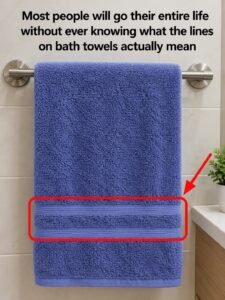
What Are the Woven Bands on Bath Towels Really For?
Have you ever noticed the horizontal bands or decorative-looking lines woven across your bath towels and wondered why they are there? Most people see these stripes every day without giving them much thought. They appear on everything from simple everyday bath towels to the thick, plush towels often associated with luxury bathrooms and hotels.
At first glance, these bands might seem like nothing more than a design detail. They give towels a finished appearance, break up the uniform texture of the fabric, and sometimes add an elegant touch to an otherwise ordinary household essential.
But there is more to these woven bands than meets the eye.
In textile manufacturing, these sections are often called dobby borders or woven borders, depending on the technique used to create them. They are produced as part of the towel’s fabric rather than simply added as decoration afterward.
Their most obvious purpose is visual, but the different weave also changes how that particular section of fabric feels, stretches, and behaves compared with the soft, looped surface surrounding it.
Depending on the towel’s construction, these differences can influence its structure, appearance, and everyday handling.
Understanding the purpose of these bands also reveals something interesting about bath towels themselves. A towel might seem like a simple piece of fabric, but its performance depends on the way its fibers, loops, edges, and woven sections work together.
Let’s take a closer look at the main reasons these woven bands appear on so many bath towels, what they may contribute to the towel’s performance, and which common assumptions about them deserve a little clarification.
1. Reinforcement to Help Prevent Stretching and Fraying
One of the practical roles a woven band can play is providing a more structured section within an otherwise flexible towel.
Think about everything a bath towel experiences during normal use. It is pulled from a towel bar, wrapped around the body, rubbed against damp skin, folded, unfolded, washed, and dried repeatedly.
The familiar soft surface of a bath towel is generally made from terry fabric, which contains raised loops designed to absorb moisture. These loops give the towel its recognizable plush texture and comfortable feel.
The decorative band, however, often has a flatter or more tightly woven construction.
This creates a visible and physical contrast between the main body of the towel and the band itself.
How a Different Weave Can Add Structure
A section with a tighter weave may stretch differently from the surrounding terry fabric. This can give that portion of the towel a firmer, more defined feel.
Depending on its placement and construction, the band may contribute to how the fabric holds its shape during everyday handling.
Potential structural benefits include:
- Reduced localized stretching: A tightly woven band may resist distortion differently from the softer terry sections surrounding it.
- Improved shape definition: The flatter woven area can create a more clearly defined border that helps the towel maintain a tidy appearance.
- Additional stability near the ends: A band placed close to a finished edge may complement the overall structure of that section.
- More consistent appearance: The contrast between the band and the loops can help the towel retain its recognizable design even after repeated use.
However, the presence of a woven band does not automatically mean a towel is stronger or more durable than one without it.
Actual resistance to stretching, fraying, and distortion depends on several factors, including the quality of the fibers, the weave, the strength of the hems, and how the towel is maintained.
The band is only one part of that construction.
Why Towels Sometimes Lose Their Shape
Over time, regular washing and drying can affect a towel’s texture and appearance.
Some towels begin to look uneven along the edges. Others develop loose threads, stretched areas, or a slightly distorted shape.
A woven border can contribute to the towel’s overall structure, but it cannot compensate for weak stitching, poor-quality materials, or excessive wear.
For this reason, it is worth looking at the entire towel rather than judging durability from the stripes alone.
The Relationship Between the Band and the Hem
Another interesting detail is that woven bands and hems are not the same thing.
A hem is the finished edge of the towel, where the fabric is secured to help prevent unraveling.
The woven band is usually a separate design element positioned near that edge or elsewhere across the fabric.
Because the two features may appear close together, it is easy to assume that the band itself is responsible for holding the edge together.
In reality, the hem plays the more direct role in securing the fabric’s edge, while the band contributes its own texture, appearance, and potentially some localized structure.
This distinction matters because a towel can have a beautifully woven border but still develop problems if its hems are poorly finished.
2. Controlled Absorbency and Drying Efficiency
The second important detail involves the difference between the plush loops of the main towel and the flatter woven band.
Most bath towels are designed to absorb water efficiently. Their raised loops increase the surface area of the fabric and allow moisture to be taken up by the fibers.
These loops are one of the primary reasons terry towels feel so different from ordinary flat-woven fabric.
The woven bands generally have fewer raised loops or none at all, depending on their design.
As a result, these sections often feel smoother, flatter, and sometimes firmer than the surrounding fabric.
Why the Bands Feel Different
If you run your hand across a bath towel, you may notice an immediate change in texture when your fingers reach the horizontal band.
The main body feels soft and cushioned, while the band feels more compact.
That contrast comes from the way the yarns are arranged.
Some decorative borders are produced using dobby weaving techniques, which allow repeating geometric patterns and textured bands to be incorporated directly into the fabric.
Other designs may involve more elaborate woven patterns.
In either case, the result is a section that differs from the terry loops around it.
Because the surface construction changes, its absorbency can also differ.
Are the Woven Bands Less Absorbent?
In many towels, yes.
A flatter woven band generally does not provide the same plush loop surface as the main body of the towel.
This means it may absorb or hold water differently.
That does not make the band defective or poorly designed. It simply reflects the fact that different portions of the towel are constructed for different purposes.
The looped surface provides most of the absorbent area, while the woven border contributes texture and visual definition.
It is a practical example of how a single textile can contain different types of fabric construction.
Do These Bands Help a Towel Dry Faster?
You may have heard that the horizontal bands are specifically designed to move moisture around the towel, prevent wet loops from clumping, or dramatically improve drying speed.
While a flatter woven section may retain moisture differently from the surrounding terry fabric, it is important not to overstate its effect.
There is no universal rule that decorative woven bands make an entire bath towel dry faster.
The towel’s overall drying behavior depends more broadly on its thickness, fiber composition, construction, how much water it contains, and the surrounding conditions.
A thick towel with a narrow woven band may still remain damp longer than a thinner towel without one.
Similarly, a towel hanging in a humid bathroom may dry slowly regardless of how its decorative border is woven.
Why Moisture Matters in Everyday Use
A bath towel is repeatedly exposed to moisture, so the way it dries between uses is an important part of everyday comfort.
When a towel stays damp for a prolonged period, it may begin to develop an unpleasant odor.
This is why allowing the fabric to dry thoroughly between uses matters, whether the towel features woven bands or a completely uniform terry surface.
The presence of a border does not replace proper drying and laundering.
It is better to think of the band as one construction detail that can affect the feel and behavior of a small section of the fabric, rather than as a built-in moisture-control system for the entire towel.
Balancing Softness, Structure, and Appearance
There is also a visual and tactile reason for combining different weaves in one towel.
A towel made entirely from plush loops has a consistent texture, which many people appreciate for comfort and absorbency.
Adding a woven band creates contrast.
The soft body of the towel remains the main drying surface, while the smooth border introduces a different texture and a more finished appearance.
For some designs, this contrast makes the towel look more refined without requiring a separate decorative piece to be attached.
It demonstrates how textile design can combine appearance and practical construction within the same fabric.
3. Neater Folding and More Convenient Hanging
Another reason people appreciate woven towel bands has to do with everyday organization.
Even when the band is primarily decorative, its straight horizontal position can provide a useful visual reference when folding or hanging a towel.
This is particularly noticeable when several towels share the same design.
Matching woven borders create a consistent appearance when the towels are placed together.
How the Bands Can Make Folding Look Neater
Think about a neatly organized stack of bath towels.
The fabric is folded into even sections, with the edges arranged to create a clean, uniform appearance.
A horizontal woven band can make this arrangement easier to judge visually.
When several towels have identical borders, those decorative sections can be aligned so that the stack looks more consistent.
This is one reason woven borders are frequently associated with the polished presentation of towels in hotels and carefully organized bathrooms.
The band provides a recognizable line that helps the eye identify whether the towels have been folded similarly.
However, not every woven border is intentionally positioned as a folding guide.
Its usefulness for folding depends on its location, the towel’s dimensions, and the folding method being used.
The band can serve as a convenient reference without necessarily having been engineered for that purpose.
What Happens When the Towel Is Hung?
When a bath towel is placed over a towel bar, its weight is distributed through the fabric and across the point where it rests on the bar.
A woven band near one end may help the towel look more structured or provide a decorative feature that remains visible when it hangs.
Depending on the design, the firmer weave may also behave differently under tension compared with the surrounding terry surface.
But it is important to distinguish this from a guaranteed reinforcement function.
The woven band does not necessarily carry the towel’s weight or prevent stretching throughout the fabric.
How the towel hangs is influenced by its weight, dimensions, weave, and the position in which it is placed.
A heavy, wet towel can still stretch or become distorted over time, regardless of whether it contains a decorative band.
The Visual Appeal of a Well-Hung Towel
One of the simplest benefits of a decorative woven border is how it changes the appearance of a towel when displayed.
A plain towel becomes more visually interesting when a horizontal band breaks up the continuous looped surface.
When the towel is folded over a bar, the border can create a clear finishing detail.
With matching towels, the repeated pattern can make an ordinary bathroom arrangement look more coordinated.
This illustrates an important idea: a design feature does not need to perform a complicated mechanical function to be useful.
Sometimes its value lies in helping an everyday household item look orderly, recognizable, and attractive.
4. A Possible Marker of Quality and Craftsmanship
Woven bands can also reveal something about the design and manufacturing of a bath towel, although their presence should never be treated as automatic proof of superior quality.
Some towels feature simple, narrow borders with very little additional patterning.
Others have wider bands containing detailed geometric designs, repeating shapes, or subtle variations in texture.
These differences reflect the weaving choices made during production.
A well-executed band can give the towel a more refined appearance, especially when the pattern is consistent and the transition between the border and the terry fabric is neat.
What Makes a Woven Border Look Well Made?
When examining a towel, it can be useful to pay attention to the details of the woven band rather than simply noticing whether one exists.
Consider the following characteristics:
- Consistent weaving: The pattern should look even and deliberate across the width of the towel.
- A smooth transition: The point where the terry loops meet the flatter woven section should appear neatly constructed.
- Secure fabric: The border should not show obvious loose yarns or irregular areas.
- Balanced texture: The band should feel appropriate for the towel’s overall construction rather than appearing disconnected from it.
- Careful finishing: The hems and surrounding edges should complement the quality of the woven section.
These details can offer clues about manufacturing consistency.
Nevertheless, even an attractive, carefully woven border tells only part of the story.
The Importance of Cotton Quality
In higher-end bath towels, decorative woven borders may appear alongside other features that contribute to the fabric’s overall feel and performance.
One example is the type of cotton used.
Egyptian cotton and Pima cotton are often associated with premium towel collections because of their long fibers.
However, the name of a cotton variety alone does not determine the quality of the finished towel.
A towel made with carefully selected fibers and consistent manufacturing techniques may have a softer, more uniform surface than one produced with less attention to these details.
The woven band may complement that construction, but it is not the feature that determines the quality of the cotton.
Loop Density and Texture
The terry loops covering most of a bath towel are another important element to examine.
These loops create the familiar soft, absorbent surface.
Differences in their size, density, and construction affect how the fabric feels and behaves.
Some towels have dense, plush loops that create a substantial texture.
Others use a lighter construction that feels less bulky.
Neither characteristic can be evaluated from the woven band alone.
A towel with an elaborate decorative border may have relatively ordinary terry fabric, while a plain towel without decorative stripes may be exceptionally well constructed.
This is why the entire fabric deserves attention.
More Complex Weaving Techniques
Decorative bands can also demonstrate the possibilities of textile weaving.
Dobby weaving, for example, can create repeating geometric patterns that are integrated into the fabric.
More elaborate woven designs may use different patterning methods to achieve additional detail.
When these techniques are used carefully, the finished border can have a distinctive appearance and texture.
A relatively simple border may be just as well executed as a complicated one.
Why the Band Is Only One Quality Indicator
If you are comparing two bath towels, it may be tempting to assume that the one with the wider or more elaborate woven band is the better choice.
But appearance alone can be misleading.
A towel’s long-term performance depends on the quality of its materials, how the yarns are made, the construction of its loops, and the strength of its finished edges.
Its care and maintenance also influence how well it holds up with repeated use.
The woven border should therefore be viewed as one design and construction detail among many.
It may reflect careful manufacturing, but it cannot independently confirm that a towel will be more durable or more comfortable.
What the Woven Bands Are Not
Because these horizontal lines appear on so many bath towels, several explanations have circulated about their purpose.
Some are based on real differences in fabric construction, while others give the bands more significance than they actually have.
Understanding what they are not can be just as useful as understanding what they do.
They Are Not Always Functional Reinforcements
Although a tighter woven section can have different structural properties from the surrounding terry fabric, not every towel border is designed specifically to reinforce the towel.
In many products, the woven band is primarily a decorative feature.
It is more accurate to consider any reinforcement effect in the context of the towel’s overall construction.
They Are Not Seams
One of the most common misunderstandings is that the horizontal bands are seams.
A seam generally joins pieces of fabric or secures a constructed edge.
By contrast, a traditional woven towel band is formed directly into the textile during manufacturing.
Its pattern is part of the towel itself rather than a separate strip simply stitched over the surface.
This explains why the decorative line often appears as a continuous change in texture rather than as a visibly attached piece.
The distinction becomes easier to recognize when you look closely at where the terry loops end and the flatter woven section begins.
They Are Not Indicators of Thread Count
Another misconception is that the number or size of decorative bands reveals a towel’s thread count or absorbency.
It does not.
Thread count is more commonly associated with certain types of flat-woven bedding fabric.
Bath towels are frequently described using GSM, which stands for grams per square meter.
GSM refers to the weight of the fabric relative to its area.
It provides useful information about how substantial a towel may feel, but it does not tell the complete story about quality.
A higher GSM towel may feel thicker and heavier, while a lower GSM towel may feel lighter.
Factors such as yarn construction, fiber quality, and weaving method also influence performance.
None of these characteristics can be determined simply by counting the horizontal stripes.
They Are Not a Guarantee of Faster Drying
The flatter texture of a woven band may dry differently from the surrounding loops, but this does not establish that the towel as a whole will dry faster.
A narrow decorative strip represents only a portion of the fabric.
The thickness and moisture content of the main terry area remain important factors in how quickly the towel dries.
This is especially relevant in bathrooms where humidity can slow the drying process.
Regardless of the border design, giving a towel enough space to dry between uses is more useful than relying on decorative weaving to control moisture.
The Bigger Picture: How Bath Towel Design Works
Once you understand the role of woven borders, it becomes easier to appreciate the broader design of a bath towel.
What looks like a simple household textile is actually the result of several construction choices.
The fibers determine much of the fabric’s basic character.
The yarns influence its texture and strength.
The terry loops provide the absorbent surface that makes the towel useful after bathing or washing.
The hems secure its edges, while decorative woven borders contribute visual contrast and, depending on their construction, differences in texture and structure.
Each of these elements affects the finished product in its own way.
Why the Terry Loops Matter Most for Absorbency
The raised loops covering most of the towel are central to its purpose.
They create a textured surface that can make contact with moisture and absorb it into the fibers.
This is why the soft, plush part of a towel generally feels different from the horizontal woven band.
The main body is designed around the experience of drying skin, while the border contributes a contrasting fabric structure.
Looking at these two areas side by side makes the difference easier to understand.
How Fiber Twist Influences Texture
Another less visible part of towel construction involves the way the fibers are twisted into yarn.
This influences the character of the finished fabric, including how the loops feel and how the yarn behaves during use.
The woven border is therefore just one visible sign of the many decisions involved in textile design.
Practical Tips for Looking After Towels With Woven Bands
Whether your bath towels feature simple stripes or elaborate woven borders, regular care remains important.
The band does not make the towel immune to wear, so it is useful to treat the entire piece of fabric with the same attention.
- Follow the care label: The manufacturer’s washing and drying instructions are the best starting point for maintaining the towel’s fabric and woven details.
- Allow the towel to dry thoroughly: Avoid leaving it bunched up while damp, since trapped moisture can contribute to unpleasant odors.
- Pay attention to the hems: Check the finished edges for loose threads or signs of wear, especially after repeated laundering.
- Avoid unnecessary pulling: Handle the towel without repeatedly stretching or tugging at its decorative border.
- Fold it neatly: Use the woven band as a visual reference if its position makes alignment easier.
- Evaluate the entire towel: Judge its condition by the loops, texture, edges, and overall shape rather than by the decorative band alone.
These straightforward habits help keep the towel comfortable to use and presentable over time.
Frequently Asked Questions About Towel Bands
What are the horizontal bands on bath towels called?
They are commonly called woven borders or dobby borders, particularly when they are created using dobby weaving techniques.
The exact terminology can vary depending on the design and manufacturing method.
Are the bands on towels purely decorative?
They are often primarily decorative, but their different weave can also change the local texture, flexibility, and structure of the fabric.
Whether those differences provide a meaningful practical benefit depends on the specific towel.
Why do the bands feel flatter than the rest of the towel?
The main surface of a terry towel contains raised loops, while the woven band typically uses a flatter weave with fewer visible loops.
This produces the noticeable difference in texture.
Do towels with woven bands last longer?
Not necessarily. A woven border may contribute to local structure, but durability depends on the towel’s overall materials, construction, hems, and care.
The presence of a band alone does not guarantee a longer lifespan.
Why do so many hotel-style towels have these bands?
Woven borders can give towels a clean, coordinated appearance, particularly when matching towels are folded or displayed together.
They create a subtle decorative detail without requiring a separate applied trim.
Can a towel without horizontal bands still be high quality?
Absolutely. A towel can be soft, absorbent, durable, and carefully manufactured without having any decorative woven bands.
Its construction and materials matter much more than the presence or absence of stripes.
Final Thoughts
The horizontal woven bands found on many bath towels are a small but interesting part of textile design.
They provide visual contrast, create a distinctive change in texture, and may contribute to the structure and appearance of the finished fabric.
They can also make matching towels look especially neat when folded or displayed.
However, they are not universal reinforcements, guaranteed moisture-control features, or reliable indicators of premium quality.
The real performance of a bath towel comes from the combination of its fibers, yarns, terry loops, fabric weight, weaving techniques, and finishing details.
So the next time you reach for a bath towel, look a little more closely at those familiar horizontal stripes.
They are more than a simple visual interruption in the fabric. They offer a glimpse into how even the most ordinary household textiles can combine thoughtful construction with everyday design.
And sometimes, appreciating something as familiar as a bath towel begins with noticing the smallest details.