When the American Dream Collapsed
In October 1929, the United States entered a period of economic turmoil that would change the lives of millions.
The stock market crash did not immediately destroy every household, but it marked the beginning of a deep economic crisis that spread through banks, businesses, factories, farms, and communities.
By the early 1930s, the consequences were impossible to ignore.
Factories closed their doors.
Banks failed.
Families lost their savings.
Businesses that had operated for decades suddenly disappeared.
Men who had spent their lives working found themselves searching desperately for jobs that no longer existed.
Women who had carefully managed household budgets began wondering how they would feed their children.
And families who had once lived in modest but stable homes found themselves facing eviction.
At the worst point of the Depression, approximately one-quarter of the American workforce was unemployed.
But even that devastating figure cannot fully describe what happened.
Behind every unemployment statistic was a person.
A father who could no longer pay the rent.
A mother who skipped meals so her children could eat.
A child who stopped attending school because the family had moved again.
An elderly person who had worked for decades but now had no savings to fall back on.
The economic collapse did not simply take away money.
It took away stability.
It disrupted marriages, childhoods, communities, and the sense of security that people had spent their lives trying to build.
America had long celebrated the promise that hard work could create a better future.
But during the Depression, millions discovered that hard work could not guarantee survival when jobs vanished and the economy collapsed.
Families who had never imagined becoming homeless suddenly had nowhere to go.
And across the country, makeshift settlements began appearing on vacant lots, riverbanks, and the edges of cities.
They became known as Hoovervilles.
Hoovervilles: The Towns Nobody Wanted to Live In
The name Hooverville was a bitter reference to President Herbert Hoover, whom many Americans blamed for the government’s inadequate response to the economic crisis.
These settlements were not official towns.
They had no carefully planned streets, reliable utilities, or proper housing.
Instead, residents constructed shelters from whatever materials they could find.
Discarded lumber.
Flattened tin cans.
Cardboard.
Scrap metal.
Old doors.
Pieces of canvas.
Sometimes a family lived beneath a roof that barely kept out the rain.
Sometimes several people shared a shelter so small they could hardly stand upright.
Other residents slept in tents, abandoned vehicles, or structures assembled from salvaged materials.
There was often no running water.
Sanitation could be inadequate.
Cooking and heating required fuel that residents had to find or purchase with whatever little money they possessed.
In winter, conditions became especially harsh.
Cold winds passed through gaps in makeshift walls.
Snow collected around tents.
Blankets offered limited protection from freezing temperatures.
For children, elderly residents, and people who were already ill, these conditions could be dangerous.
Yet the settlements continued to grow because the people living there had few alternatives.
Some had lost jobs.
Others had been evicted.
Some were traveling in search of employment and had exhausted their resources.
Many were ordinary working people who had been pushed into homelessness by circumstances beyond their control.
They had not planned to live in shantytowns.
They had planned to work, raise families, and build stable lives.
But the Depression had destroyed those plans.
And in the absence of adequate housing and assistance, they were forced to improvise.
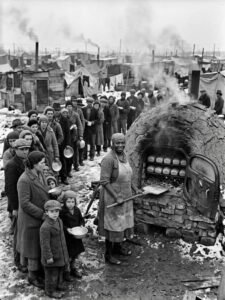
That is the world reflected in the photograph.
Snow on the ground.
Temporary shelters in the background.
People waiting in line for food.
And a woman standing beside an improvised oven, apparently preparing something to help them survive.
The Woman Beside the Oven
The most compelling figure in the described image is the woman working beside the outdoor oven.
She is surrounded by signs of hardship.
The shelters are temporary.
The weather appears bitterly cold.
People are waiting with empty bowls.
And the cooking equipment is assembled from humble materials rather than anything resembling a proper kitchen.
The oven is described as being constructed from mud, stones, and an old automobile door.
If that description is accurate, it would represent the kind of resourcefulness that people sometimes relied upon when conventional equipment was unavailable.
During the Depression, discarded objects often became valuable building materials.
A broken wooden crate might be turned into furniture.
An old metal container could become a cooking vessel.
Scrap lumber might provide fuel or help repair a shelter.
Families learned to reuse items that more prosperous households might have thrown away.
The woman in the photograph appears to be working within that same economy of necessity.
She is not surrounded by abundance.
There are no shelves filled with ingredients.
No modern oven.
No comfortable kitchen.
Yet food is apparently being prepared.
And people have gathered to receive it.
We do not know her name.
We do not know whether she lived in the settlement or came from a nearby community.
We do not know whether she organized the cooking effort, volunteered her labor, or worked alongside others outside the camera’s frame.
But her presence raises an important question.
How many people helped their communities survive the Depression without ever becoming part of the official historical record?
We remember presidents, economists, industrialists, and famous reformers.
We remember the major legislation that emerged from the crisis.
But countless acts of assistance took place far from government offices.
A neighbor shared a meal.
A church organized a food distribution.
A community group collected clothing.
A family opened its home to relatives who had nowhere else to go.
A woman prepared food for people who were hungry.
These acts rarely changed the national economy.
But they could change the course of an individual day.
For someone who had not eaten enough, a warm meal was not a small thing.
It was immediate relief from hunger.
It was a reminder that someone had noticed their suffering.
And sometimes, it was the difference between making it through the day and going without.
The Breadline That Told America’s Hidden Story
Behind the woman, people stand waiting for food.
Men.
Women.
Children.
Each person carries a container or waits for a portion of whatever is being prepared.
Their presence communicates the scale of the need.
During the Great Depression, breadlines and soup kitchens became familiar sights in many American cities.
Charitable organizations, churches, community groups, private donors, and local governments provided food assistance to people who could no longer afford adequate meals.
Some kitchens served soup and bread.
Others distributed basic groceries or prepared whatever food could be obtained.
The meals were often simple.
But for hungry families, they were essential.
Imagine standing in such a line during winter.
Your shoes are worn.
The cold has settled into your hands.
You have been waiting for a long time.
Perhaps you spent the morning searching for work.
Perhaps you have children at home who are waiting for you to return with something to eat.
You do not know whether there will be enough food for everyone.
You can see the people ahead of you.
You can smell something cooking.
And you wait.
For many Americans, receiving charitable food assistance was emotionally difficult.
People who had once supported themselves through steady employment now found themselves dependent on help.
Some experienced shame.
Others felt anger at the circumstances that had taken away their livelihoods.
But hunger does not disappear because someone feels embarrassed.
Children still need to eat.
Bodies still need nourishment.
And survival often requires accepting assistance.
The line in the photograph should therefore not be viewed as evidence of personal failure.
It represents people responding to an economic catastrophe.
They were not responsible for the collapse of the banking system.
They had not individually caused the disappearance of millions of jobs.
Yet they were living with the consequences.
Their empty bowls are among the most powerful details in the scene.
An empty bowl is a simple object.
But in the hands of a hungry person, it represents a need that cannot be postponed indefinitely.
It asks a question that every society must confront.
What happens when people are willing to work, but the economy no longer provides them with a way to survive?
The Extra Burden Carried by Black Americans
The woman at the center of the photograph is described as Black.
That detail matters because the Great Depression did not affect all Americans equally.
Black workers faced longstanding discrimination in employment, housing, education, and access to economic opportunity.
Even before the stock market crash, many African Americans were concentrated in low-paying jobs with limited security.
When businesses reduced their workforces, Black employees were often among the first to lose employment.
Competition for scarce jobs intensified racial tensions.
In some industries and communities, Black workers were pushed out of positions as white workers sought employment that they might previously have rejected.
Black women faced additional challenges.
Many worked in domestic service, agriculture, laundry, or other poorly paid occupations.
Their labor was essential to household survival, yet it was frequently undervalued.
During the Depression, Black communities developed and maintained networks of mutual assistance through churches, neighborhood organizations, families, and civic groups.
These efforts provided food, clothing, shelter, and other forms of support.
The woman in the photograph can be understood within that broader history of community labor.
But her identity should not be reduced to a symbol.
We do not know her personal circumstances.
She may have been hungry herself.
She may have had children or relatives depending on her.
She may have faced the same insecurity as the people waiting in line.
Her work could have been part of a larger organized effort, or it might have been a smaller local initiative.
Without documentation, we cannot know.
What we can recognize is that women—particularly working-class women and women from marginalized communities—performed enormous amounts of labor that helped families and neighborhoods survive.
Much of that labor was unpaid.
Much of it took place outside formal institutions.
And much of it was never recorded in the history books.
The woman beside the oven reminds us that the story of the Depression is incomplete if we remember only the men searching for work and the politicians debating solutions.
We must also remember the women who kept households functioning, organized relief, and helped communities care for their most vulnerable members.
When Sharing Became a Way to Survive
One of the most enduring lessons of the Great Depression is that survival was often a collective effort.
People who had very little sometimes found ways to help others who had even less.
Neighbors shared food.
Families pooled resources.
Churches organized relief.
Community groups distributed clothing.
People exchanged labor, repaired one another’s possessions, and offered temporary shelter.
These efforts did not eliminate poverty.
They did not create enough jobs to restore the national economy.
And they could not always meet the overwhelming demand for assistance.
But they mattered.
They mattered because they addressed immediate human needs.
They mattered because they created connections between people who might otherwise have faced hardship alone.
And they mattered because they preserved a sense of dignity during an era when economic collapse had stripped so many Americans of control over their lives.
The oven in the photograph is a compelling image of this kind of cooperation.
It is made from ordinary materials.
It appears crude.
It offers none of the conveniences of a proper kitchen.
Yet it may have allowed people to prepare food in a place where conventional facilities were unavailable.
The long line suggests that whatever was being cooked was needed by many.
The scene is not one of abundance.
It is one of scarcity being managed through shared effort.
And that distinction is important.
The people were not generous because they had more than enough.
They were trying to survive in a world where nearly everyone had less than they needed.
Sharing under those conditions could require genuine sacrifice.
But it could also strengthen relationships.
A person who received food one day might help collect firewood the next.
Someone who knew how to repair a shelter might assist a neighbor.
A family with an extra blanket might lend it during a cold night.
Such exchanges created informal systems of support.
They were not perfect.
They could not substitute for adequate public assistance or economic recovery.
But they demonstrated the importance of human cooperation when formal institutions failed to meet people’s needs.
From Hoovervilles to the New Deal: A Nation Forced to Change
By the time Franklin D. Roosevelt became president in March 1933, the United States was facing an extraordinary national emergency.
Unemployment was widespread.
Banks had failed.
Businesses had collapsed.
Millions of Americans needed assistance.
And Hoovervilles had become visible reminders of the suffering that accompanied the economic crisis.
Roosevelt’s administration introduced a series of programs and reforms collectively known as the New Deal.
The Civilian Conservation Corps provided employment for young men on conservation projects.
The Federal Emergency Relief Administration supported relief efforts.
The Civil Works Administration and later the Works Progress Administration created jobs through public projects.
Other programs addressed banking, agriculture, housing, and financial regulation.
The Social Security Act of 1935 established a lasting framework for retirement benefits and certain forms of social protection.
These initiatives did not end the Depression immediately.
Economic hardship continued through much of the decade.
And not all Americans benefited equally from New Deal policies.
Racial discrimination and unequal access to opportunities remained serious problems.
Nevertheless, the New Deal marked a major change in the federal government’s role in responding to economic insecurity.
The widespread suffering of the Depression had helped demonstrate that private charity and local relief alone could not meet the needs created by a national economic collapse.
The woman beside the oven belongs to the human history behind that transformation.
Her story, as presented in the photograph, is not evidence that one community kitchen directly caused federal reform.
Rather, it illustrates the conditions that made larger relief efforts necessary.
People needed food.
Families needed housing.
Workers needed employment.
Communities needed resources beyond what individual acts of generosity could provide.
The New Deal was one response to those needs.
And the history of the Hoovervilles helps explain why so many Americans demanded change.
The Woman History May Never Name
Nearly a century has passed since the darkest years of the Great Depression.
The Hoovervilles are gone.
The improvised shelters have largely disappeared from the landscape.
The economic institutions of the United States have changed.
And many of the people who endured that era have passed away.
But photographs preserve fragments of their lives.
A man standing beside a makeshift home.
A child wearing worn shoes.
A mother holding a baby.
A line of hungry people waiting for food.
And a woman working beside an outdoor oven in the snow.
We may never know her name.
We may never discover where she lived, what hardships she faced, or what happened after the photograph was taken.
But her image invites us to remember the countless people whose daily labor helped others survive.
She was not a president.
She did not sign legislation.
She did not command an army or lead a national movement.
Yet if she was preparing food for the people gathered around her, her work mattered directly to those who depended on it.
A hungry child does not need a famous person to offer food.
An unemployed worker does not need a celebrated hero to provide a warm meal.
They need someone willing and able to help.
And throughout the Great Depression, countless Americans answered that need in whatever ways they could.
The most moving part of the photograph is not simply the poverty.
It is the contrast between the poverty and the effort to provide relief.
Snow surrounds the shelters.
People wait with empty bowls.
The oven is built from salvaged materials.
There is so little comfort in the scene.
Yet someone is working to prepare food.
That act cannot erase the suffering around her.
It cannot restore lost homes or jobs.
It cannot solve the economic crisis.
But it represents something essential.
The recognition that another person’s hunger matters.
The Great Depression revealed how quickly economic security could disappear. It also revealed how much ordinary people depended on one another when institutions, savings, and employment failed them.
We should not romanticize a world in which families had to live in tents through freezing weather.
Nor should we celebrate poverty as though it were necessary to produce compassion.
The people in the photograph deserved better.
They deserved safe homes, adequate food, stable employment, and the chance to build lives free from constant uncertainty.
But within those difficult circumstances, acts of care still mattered.
And they deserve to be remembered.
Perhaps the most powerful thing about this image is that the woman appears to be working with almost nothing, while the people around her are waiting for something they desperately need.
A crude oven.
A winter day.
A long line of hungry neighbors.
And one person contributing what she can.
That is not the whole history of the Great Depression.
But it is an important part of it.
Because the story of America during those years was not written only in stock market reports, government programs, and unemployment statistics.
It was also written in kitchens, shelters, churches, streets, and makeshift settlements.
In places where people shared food.
Where neighbors helped neighbors.
Where families struggled to preserve their dignity.
And where ordinary acts of compassion made difficult days a little more bearable.
History may have forgotten this woman’s name. But the scene reminds us why the work of people like her should never be forgotten.
Not because kindness was enough to end the Depression.
But because, until larger help arrived, kindness was sometimes one of the few things people had left to offer.