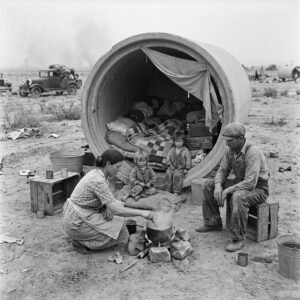
Bakersfield, California, 1935. Imagine losing your farm, packing everything your family owns into an old automobile, and traveling hundreds of miles in search of a better life. Then imagine arriving in California only to discover that the only roof you can afford is a concrete pipe lying in an empty field. For some desperate families during the Dust Bowl era, survival meant turning places never intended for human beings into something they could call home.
In the mid-1930s, America was living through one of the darkest periods in its history.The Great Depression had destroyed jobs, businesses, and financial security. Across the Great Plains, severe drought and destructive dust storms made life even more difficult for farming families.
In Oklahoma, Texas, Arkansas, Kansas, and surrounding states, countless families watched the lives they had worked so hard to build begin to disappear.
Fields that had once produced crops became dry and barren.
Farm machinery stood unused.Debts accumulated.And the land that had supported generations could no longer provide enough to keep families fed.For many, leaving was not an adventure.
It was an act of desperation.
Families loaded old cars and trucks with mattresses, cooking pots, clothing, and whatever possessions they could carry.Some tied furniture to the roofs of their vehicles.Others squeezed children between bags and blankets.Then they headed west, following the promise of agricultural work in California.
They imagined green fields, steady wages, and the possibility of beginning again.
But the journey was long, exhausting, and uncertain.Vehicles broke down.
Money ran out.Children grew hungry.And when families finally reached California, many discovered that the opportunities they had dreamed about were far more limited than they had expected.There were jobs, but not enough for everyone.Wages could be painfully low.
Housing was often overcrowded or unaffordable.
For some newcomers, the dream of a fresh start quickly became another struggle for survival.
Bakersfield, California, 1935. Imagine losing your farm, packing everything your family owns into an old automobile, and traveling hundreds of miles in search of a better life. Then imagine arriving in California only to discover that the only roof you can afford is a concrete pipe lying in an empty field. For some desperate families during the Dust Bowl era, survival meant turning places never intended for human beings into something they could call home.
THE JOURNEY THAT BEGAN WITH A LOST HOME
In the mid-1930s, America was living through one of the darkest periods in its history.
The Great Depression had destroyed jobs, businesses, and financial security. Across the Great Plains, severe drought and destructive dust storms made life even more difficult for farming families.
In Oklahoma, Texas, Arkansas, Kansas, and surrounding states, countless families watched the lives they had worked so hard to build begin to disappear.
Fields that had once produced crops became dry and barren.
Farm machinery stood unused.
Debts accumulated.
And the land that had supported generations could no longer provide enough to keep families fed.
For many, leaving was not an adventure.It was an act of desperation.Families loaded old cars and trucks with mattresses, cooking pots, clothing, and whatever possessions they could carry.Some tied furniture to the roofs of their vehicles.
Others squeezed children between bags and blankets.Then they headed west, following the promise of agricultural work in California.They imagined green fields, steady wages, and the possibility of beginning again.But the journey was long, exhausting, and uncertain.Vehicles broke down.Money ran out.Children grew hungry.And when families finally reached California, many discovered that the opportunities they had dreamed about were far more limited than they had expected.There were jobs, but not enough for everyone.
Wages could be painfully low.
Housing was often overcrowded or unaffordable.For some newcomers, the dream of a fresh start quickly became another struggle for survival.
The fertile agricultural valleys of California seemed almost miraculous to families escaping the Dust Bowl.
After years of failed crops and relentless dust, the sight of productive farmland offered hope.
But the reality of migrant life was harsh.
Seasonal agricultural work meant families often had to move from place to place as crops ripened and harvests began.
A father might find employment picking fruit for a few days, only to discover that the work had ended before he earned enough to support his family.
A mother might stretch a small supply of flour, beans, or potatoes across several meals.
Children sometimes missed school because their families had to move again.
And at night, the question remained the same.
Where would they sleep?
Some families found space in overcrowded labor camps.
Others lived in canvas tents, makeshift shacks, or automobiles that had carried them west.
THE STRANGEST SHELTER OF ALL: A CONCRETE WATER PIPE
One particularly striking account associated with Depression-era migrant hardship describes families sheltering inside large concrete irrigation pipes near Bakersfield, California.
The story describes pipes approximately six feet across and twenty feet long—large enough for a family to crawl inside and arrange a few belongings.
The precise location, dimensions, and individual family circumstances in this account have not been independently established, so it is best understood as a reported example rather than a fully documented household history.
But the image is unforgettable.
A structure manufactured to carry water had become a place where human beings sought shelter.
There were no windows.No bedrooms.No kitchen.No wooden floors.No proper door to close against the night.Just a long, hollow cylinder of concrete.
Imagine standing at the entrance and looking inside.
The curved walls offer almost no room for furniture.
A mattress might take up much of the available floor space.
Blankets and sacks would have to serve as bedding.
Clothing would be folded into small bundles.
Every possession would need a place because there was so little room to move.
Cooking inside would be dangerous and impractical because smoke could quickly accumulate.
So meals would have to be prepared outside, over a small fire or stove.
When rain arrived, keeping belongings dry would become another challenge.
During the summer, the concrete could absorb heat.
During colder nights, it could offer little warmth.
Yet compared with sleeping completely exposed to the weather, even this unlikely shelter might seem like an improvement.
And perhaps the most heartbreaking detail was the reason such a place could appeal to a desperate family.
There was no monthly rent.No landlord.No lease.But there was also almost none of the comfort or safety that a proper home should provide.The shelter was free because it had never been designed for people to live in.
A MOTHER’S IMPOSSIBLE TASK: MAKING A PIPE FEEL LIKE HOME
Instead, she must gather what little food remains and prepare breakfast outside.Perhaps there are beans left from the previous evening.Perhaps a small amount of bread.
Perhaps nothing until someone finds work.Her husband may already be walking toward nearby fields, hoping a farmer needs another pair of hands.She knows he might return with wages.
She also knows he might return empty-handed.
But the children still need to eat.
Their clothes still need washing.And somehow, she must preserve a sense of normal life.She might straighten the blankets.Arrange the family’s few belongings.
Brush dirt away from the entrance.She might tell the children to be careful around the concrete edges and stay close to one another.
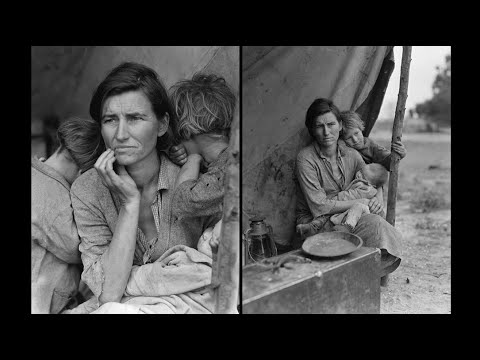
These imagined details are not a documented account of one specific mother. They reflect the kinds of practical challenges that confronted families living in makeshift Depression-era shelters.And they reveal something important.Poverty does not eliminate the responsibilities of parenthood.A mother without a proper house still wants her children to feel protected.
A father without steady employment still wants to provide.
A family without furniture still hopes to sit together at the end of the day.
Their circumstances may have stripped away comfort, but they had not erased their humanity.
After years of failed crops and relentless dust, the sight of productive farmland offered hope.
But the reality of migrant life was harsh.Seasonal agricultural work meant families often had to move from place to place as crops ripened and harvests began.
A father might find employment picking fruit for a few days, only to discover that the work had ended before he earned enough to support his family.A mother might stretch a small supply of flour, beans, or potatoes across several meals.Children sometimes missed school because their families had to move again.
And at night, the question remained the same.Where would they sleep?
THE STRANGEST SHELTER OF ALL: A CONCRETE WATER PIPE
There were no windows.No bedrooms.No kitchen.No wooden floors.No proper door to close against the night.Just a long, hollow cylinder of concrete.
Imagine standing at the entrance and looking inside.The curved walls offer almost no room for furniture.A mattress might take up much of the available floor space.Blankets and sacks would have to serve as bedding.
Clothing would be folded into small bundles.Every possession would need a place because there was so little room to move.Cooking inside would be dangerous and impractical because smoke could quickly accumulate.So meals would have to be prepared outside, over a small fire or stove.
When rain arrived, keeping belongings dry would become another challenge.
During the summer, the concrete could absorb heat.
During colder nights, it could offer little warmth.
Yet compared with sleeping completely exposed to the weather, even this unlikely shelter might seem like an improvement.And perhaps the most heartbreaking detail was the reason such a place could appeal to a desperate family.There was no monthly rent.No landlord.No lease.
But there was also almost none of the comfort or safety that a proper home should provide.
The shelter was free because it had never been designed for people to live in.
Consider what daily life might have meant for a mother living under such conditions.
She wakes before sunrise.
The children are still sleeping beneath worn blankets.There is no kitchen waiting for her.
No sink with running water.No stove that can be switched on.Instead, she must gather what little food remains and prepare breakfast outside.Perhaps there are beans left from the previous evening.Perhaps a small amount of bread.
Perhaps nothing until someone finds work.
Her husband may already be walking toward nearby fields, hoping a farmer needs another pair of hands.
She knows he might return with wages.
She also knows he might return empty-handed.But the children still need to eat.
Their clothes still need washingAnd somehow, she must preserve a sense of normal life.