The Summer Nights When New York’s Apartments Became Unbearable
During the 1930s, New York City was a place of enormous contrasts.
Its skyline was rising to extraordinary heights. The Empire State Building, completed in 1931, stood as a symbol of American ambition even as the Great Depression left millions of people unemployed. Elegant hotels, theaters, and fashionable avenues existed only a short distance from neighborhoods where families struggled to afford food and rent.
On the Lower East Side, life unfolded inside crowded tenement buildings.
Many had been constructed decades earlier to accommodate the waves of immigrants who arrived in New York seeking work and opportunity. Their apartments were often small, poorly ventilated, and occupied by families who had little choice but to make the most of limited space.
In winter, residents struggled to keep warm.
In summer, they faced a different enemy.
Heat.
The thick brick walls absorbed the sun throughout the day. Rooms with inadequate ventilation could remain stifling long after sunset. In apartments where several people shared a small sleeping area, the heat could become especially oppressive.
Air conditioning was not a realistic option for most working-class households. Electric fans existed, but not every family could afford one, and some buildings lacked the electrical arrangements or resources that would have made them practical.
For many residents, the only relief came from opening windows and hoping for a breeze.
But on particularly hot nights, the air inside barely moved.
Children tossed and turned on damp sheets.
Parents opened doors to encourage whatever circulation they could find.
People gathered on stoops, rooftops, and sidewalks, searching for a place where the temperature felt even slightly more bearable.
Some families took the desperate step of moving their bedding outdoors.
A fire escape, designed as an emergency route from a burning building, could become a temporary sleeping space.
The arrangement was dangerous. Narrow iron platforms were not intended to serve as bedrooms, especially for children.
But for families enduring extreme heat, the risks of sleeping outside sometimes seemed preferable to another suffocating night indoors.
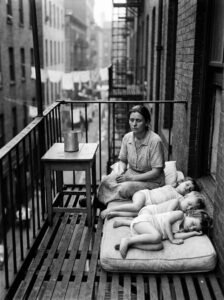
It was within this world that the mother and her three sleeping children were photographed.
A world in which comfort was scarce, privacy was limited, and even the simple act of getting a night’s rest could become a struggle.
One Mother, Three Children, and a Mattress Above the Street
The scene is striking because of its simplicity.
Three children lie together on a thin mattress spread across the fire escape.
Their bodies are close, sharing the limited space available on the narrow metal platform.
They appear to be sleeping peacefully, or at least resting after a long, uncomfortable day.
Beside them sits their mother.
She is not stretched out comfortably.
She is not enjoying the cool evening air as though this were a summer holiday.
Instead, she appears watchful, her presence suggesting the responsibilities that continue even after her children have fallen asleep.
There is a metal pitcher nearby.
Perhaps it held drinking water for the hot night, although the photograph alone cannot tell us.
Behind the family, laundry hangs across the narrow space between buildings.
Fire escapes climb the surrounding brick walls, creating a repeating pattern of iron ladders and platforms.
Windows open onto the alley.
Every visible detail suggests a neighborhood where private life frequently spilled into shared outdoor spaces.
In these crowded buildings, the boundaries between one household and another could be remarkably thin.
Neighbors heard conversations through open windows.
They knew when babies cried.
They could smell meals cooking in nearby apartments.
They watched children grow up across courtyards and narrow streets.
The fire escape was part of this shared landscape.
During hot weather, residents sometimes sat outside to talk, cool off, or watch the activity below.
But sleeping there was something different.
A mattress on a fire escape was not a sign of leisure.
It was evidence that the family’s living conditions had made an ordinary night’s sleep difficult.
And the mother sitting beside her children adds an emotional dimension that no description of temperature alone could capture.
We do not know what she was thinking.
Perhaps she was simply resting.
Perhaps she was watching to make sure the children remained safely away from the edge.
Perhaps she was listening to the sounds of the city, waiting for a breeze.
The photograph cannot reveal her thoughts.
But it invites us to consider the demands placed on parents who were trying to protect their children with very few resources.
The Great Depression Made Every Ordinary Day a Struggle
By the early 1930s, the economic crisis had transformed daily life for millions of Americans.
The stock market crash of 1929 had been followed by bank failures, collapsing businesses, and widespread unemployment.
At the Depression’s worst point, roughly one-quarter of the American labor force was out of work.
In New York City, the consequences were visible everywhere.
Unemployed workers waited in lines for food assistance.
Families fell behind on rent.
Charitable organizations struggled to meet growing demand.
Some people were forced into overcrowded living arrangements as relatives and friends combined households to reduce expenses.
For families already living in small tenement apartments, the loss of income could make an uncomfortable situation unbearable.
A father who had worked regularly might suddenly find himself without wages.
A mother might take in sewing, laundry, or other work to help pay for food.
Older children might seek small jobs, sell newspapers, or contribute whatever they could to household survival.
Every purchase required consideration.
Could the family afford fresh food?
Would there be enough money for rent?
Could a worn pair of shoes last another season?
Should a doctor be called when a child became ill, knowing that the visit might create another expense?
The Depression was not simply an economic event reported in newspapers.
It entered people’s homes.
It changed what families ate, where they slept, how children spent their days, and what parents worried about after dark.
For a mother raising three children in a crowded New York apartment, summer heat was only one problem among many.
The family might also have been concerned about employment, housing, illness, or the price of basic necessities.
We cannot assume that every one of those hardships affected the particular family in the photograph.
But they were part of the broader world in which the image was made.
That context matters because it prevents us from seeing the scene as merely picturesque.
A mattress on a fire escape might look unusual or even nostalgic to someone viewing it nearly a century later.
For the people who depended on such arrangements, however, it could reflect a lack of safer and more comfortable alternatives.
The Hidden Dangers of Sleeping Above the City
There is something almost peaceful about the image of children sleeping beneath the open sky.
But a New York fire escape was never designed to be a bedroom.
The platforms were narrow.
The railings could be low or deteriorated.
The iron surfaces could become uncomfortable, and the ladders connecting different levels created obvious hazards for anyone moving around in the dark.
For young children, the danger was especially serious.
A sudden movement during sleep, an attempt to climb down, or a moment of confusion after waking could have tragic consequences.
Fire escapes also needed to remain clear for emergencies.
Bedding, furniture, and household objects could obstruct the very routes intended to help residents escape a burning building.
Yet families sometimes used these spaces because their circumstances left them with few appealing choices.
That is an important distinction.
People do not always make decisions under ideal conditions.
They make decisions within the limits of what is available.
A family without access to a cool, safe sleeping area may choose an option that seems unreasonable to someone living in greater comfort.
For the mother in the photograph, the fire escape may have offered her children the possibility of sleeping through the night.
But it also required vigilance.
Her presence beside them is one of the image’s most powerful details.
She appears to occupy the space between her children and the surrounding city.
A mother on a narrow iron platform.
Three children sleeping beside her.
The vast brick buildings rising behind them.
There is no dramatic action.
No rescue.
No visible emergency.
Only the quiet responsibility of keeping children safe under difficult circumstances.
And that responsibility could be exhausting.
Motherhood during the Depression often meant performing ordinary acts of care while facing extraordinary uncertainty.
Preparing meals with limited ingredients.
Repairing clothing that could not easily be replaced.
Keeping children clean in cramped apartments.
Managing illness, hunger, and fear.
And sometimes finding a place for them to sleep when their own rooms had become unbearably hot.
The woman in the photograph represents one small moment within that much larger history.

The Lower East Side: Where Poverty and Community Lived Side by Side
The Lower East Side had long been one of New York’s most important immigrant neighborhoods.
During the late nineteenth and early twentieth centuries, it became home to families from many backgrounds, including Jewish, Italian, Irish, and Eastern European communities.
Residents brought languages, traditions, religious practices, recipes, and ambitions that helped shape the cultural identity of New York.
But opportunity often came with hardship.
Factory work could be exhausting and poorly paid.
Housing was crowded.
Sanitation and ventilation were serious concerns in many older buildings.
Families frequently shared limited space because rent consumed a substantial portion of their income.
By the 1930s, the neighborhood had already experienced decades of social change, but many working-class residents continued to face difficult housing conditions.
The Depression made financial security even harder to achieve.
Yet these neighborhoods were not defined by poverty alone.
They were also places of extraordinary social connection.
People borrowed ingredients from neighbors.
Children played together in courtyards and streets.
Families exchanged information about jobs and assistance.
Community organizations, religious institutions, and local businesses offered support in ways that formal systems sometimes could not.
On hot summer evenings, the neighborhood itself became a shared living space.
Residents gathered on stoops.
Conversations floated through open windows.
Children played until darkness made the streets harder to navigate.
Someone might be singing from an upstairs apartment while another family prepared a late meal.
The city was noisy, crowded, and often uncomfortable.
But it was also alive with human relationships.
The fire escapes in the photograph reflect that world.
They are stacked one above another, connecting the private lives of individual households to the larger urban landscape.
The mother and her children are not isolated in a wilderness.
They are surrounded by other families, other windows, and other stories.
Behind each wall, someone else may have been struggling with the same heat.
Another mother may have been rocking a restless baby.
Another father may have been returning from a long search for work.
Another child may have been lying awake, listening to the sounds of the city.
The photograph captures one family.
But it points toward the experiences of an entire neighborhood.
The Photographers Who Made America Look at Its Own Suffering
During the Great Depression, photography became one of the most powerful ways to document the lives of ordinary Americans.
Photographers recorded unemployment lines, struggling farmers, crowded housing, migrant workers, and families living in poverty.
Their images helped audiences understand that the economic crisis was not simply a matter of numbers and financial institutions.
It was affecting real people.
Margaret Bourke-White was among the prominent photographers whose work explored industry, society, and the human consequences of economic hardship.
Other photographers, including Dorothea Lange, Walker Evans, and Russell Lee, created influential records of Depression-era America.
Their photographs differed in subject, style, and purpose, but many shared an ability to make individual lives visible within enormous historical events.
A photograph could communicate something that statistics alone could not.
It could show the worn clothing of a child.
The exhaustion on a parent’s face.
The interior of a crowded home.
The fragile structure of a makeshift shelter.
Or a family sleeping outdoors because the heat inside their apartment had become unbearable.
Such images could inspire sympathy, provoke debate, or encourage viewers to consider conditions they had never personally experienced.
But historical photographs also require careful interpretation.
A camera captures only a fraction of a second.
It does not explain everything that happened before or after the shutter was pressed.
It cannot tell us exactly what the people pictured were thinking.
And without reliable archival documentation, it may be impossible to establish the identities of the subjects or the circumstances surrounding the image.
That uncertainty should not diminish the photograph’s emotional power.
Instead, it should encourage us to look more carefully.
The mother on the fire escape deserves to be seen as a real person, not simply as a symbol onto which later generations can project whatever story they wish.
Her children deserve the same respect.
Their lives were more complicated than one photograph could reveal.
They had names, personalities, relationships, hopes, and fears that remain beyond our knowledge.
The image matters not because it tells us everything about them.
It matters because it reminds us how much of ordinary people’s history can otherwise disappear.
A Mother’s Love in a City That Could Offer Her So Little
Nearly a century later, the scene remains difficult to forget.
Three children sleep on a thin mattress above a New York alley.
Their mother stays beside them.
The city rises around the family, its brick walls and iron fire escapes forming a harsh backdrop to an intimate moment of care.
There are no expensive furnishings.
No comfortable bedroom.
No evidence of the conveniences that many people today consider essential.
But there is a mother keeping her children close.
It is tempting to describe the scene as proof that love can overcome any hardship.
Yet the truth is more complicated.
Love could not cool the apartment.
It could not make the fire escape safe.
It could not guarantee steady employment, adequate housing, or enough money for food.
The family’s situation reflected problems that required more than individual determination to solve.
That is part of what makes the photograph historically important.
It shows the human cost of inadequate housing and economic insecurity.
It reminds us that parents often make extraordinary sacrifices simply to provide their children with ordinary comforts.
And it challenges us to consider the difference between admiring resilience and accepting the conditions that make such resilience necessary.
The mother did not need to become a symbol of heroism.
She needed a safe place for her children to sleep.
But the fact that she remained beside them, caring for them within the limits of her circumstances, is still deeply moving.
There is a quiet kind of strength in ordinary parental responsibility.
It does not announce itself.
It does not ask for applause.
It appears in countless small decisions made every day.
A mother giving her child the last portion of supper.
A father repairing shoes that should have been replaced months earlier.
A parent staying awake beside a sick child.
Or a woman sitting on a narrow fire escape, watching over three sleeping children while the city struggles through another sweltering night.
We do not know what became of this family.
Perhaps the children grew up and left the Lower East Side.
Perhaps they remembered those summer nights as part of a childhood shaped by hardship but also by neighborhood life.
Perhaps the mother eventually lived in a home with better ventilation and safer sleeping arrangements.
Perhaps she never did.
The photograph cannot answer those questions.
But it preserves a moment that deserves our attention.
The Great Depression was not experienced only in banks, factories, and unemployment offices. It was experienced in the bedrooms of overcrowded apartments, on the narrow platforms of fire escapes, and in the exhausted faces of parents trying to give their children a little comfort.
And in this scene, the most powerful detail is not the architecture, the laundry lines, or even the thin mattress.
It is the mother.
She is there while her children sleep.
Not because she can control everything that threatens them.
Not because she has the resources to solve every problem.
But because, at that moment, her presence is one thing she can give.
America remembers the Great Depression through unemployment figures, breadlines, and photographs of poverty. But sometimes its deepest human story is found in a mother sitting awake beside three sleeping children, high above a crowded New York street, doing everything she can with the little she has.
The city may have offered them no relief from the heat that night.
But the children did not have to face it alone.
Their mother was beside them.
And that quiet act of care is what makes the image endure.