The Afternoon When The Music Changed Forever
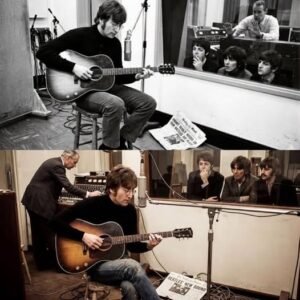
Nobody spoke for a moment. Not Paul McCartney. Not George Harrison. Not Ringo Starr. Not even George Martin, the producer whose extraordinary musical instincts had helped transform four young musicians from Liverpool into the most famous band in the world. In this imagined moment inside Abbey Road’s Studio Two, John Lennon sat with an acoustic guitar resting against his body, his attention fixed on a melody that seemed to have arrived from somewhere beyond ordinary experience. Outside, London was wrapped in the gray chill of January 1967. Inside, the familiar recording studio was becoming a place where something entirely unfamiliar might emerge. Lennon was working on a song that would eventually become “A Day in the Life,” one of the most celebrated recordings in the Beatles’ catalog. But before the orchestral crescendos, before the unforgettable final piano chord, and before millions of listeners began debating its meaning, there was simply a young songwriter confronting the strange distance between the events of everyday life and the emotions those events awakened. What would make the finished recording extraordinary was not merely its sound. It was the way Lennon and McCartney would transform fragments of newspaper stories, ordinary routines, and unsettling observations into something that seemed to capture the uncertainty of an entire generation.
To understand why this music mattered, it is necessary to return to the months preceding those January recording sessions. The Beatles had stopped touring in August 1966, following years of exhausting schedules, overwhelming crowds, and performances during which their own music was often drowned out by screaming audiences. Their final commercial concert took place at Candlestick Park in San Francisco on August 29, 1966. By then, the four musicians had become trapped inside a phenomenon larger than any of them could comfortably control. Their lives were scrutinized, their statements became international controversies, and their creative ambitions had begun exceeding what they could reproduce onstage. Lennon, in particular, was moving through a period of restlessness. Fame had given him wealth, influence, and opportunities he could once scarcely have imagined, yet none of those things guaranteed personal satisfaction. Away from touring, the Beatles could finally use the recording studio as an instrument in its own right. They could experiment without worrying about whether a song could be performed in front of thousands of screaming fans. And out of that freedom came a composition that would blur the boundaries between pop music, orchestral experimentation, and the private thoughts of a man looking at the world with growing bewilderment.
The Newspaper Story That Haunted John Lennon
Two days before the Beatles began recording the song, Lennon had been at his home in Weybridge, Surrey, reading a newspaper. Among the ordinary reports of politics, accidents, and public affairs was a story connected to the death of Tara Browne, a young heir to the Guinness fortune who had died in a car crash in December 1966. Browne was only twenty-one, a familiar figure in London’s fashionable social circles and someone Lennon and McCartney knew. His death carried the particular cruelty of a life interrupted before it had properly begun. Here was a young man surrounded by privilege, money, and opportunity, yet none of those advantages could protect him from a sudden accident. Lennon was drawn to the contrast between the tragic event and the detached language used to report it. Newspapers could compress an entire human existence into a few paragraphs, place it beside an unrelated story, and move on. That contrast helped shape the opening of the song. Rather than write a conventional tribute, Lennon approached the subject through an almost dreamlike perspective, allowing the listener to experience the strange emotional distance between reading about tragedy and truly comprehending it.
The newspaper also contained a report about potholes in Blackburn, Lancashire. On its own, the story was almost comically ordinary. A town had problems with its roads, and someone had calculated the number of holes. Yet Lennon found something fascinating in the absurd precision of the report. A young man’s death and thousands of holes in a road had little in common, but both appeared in the same world of headlines, numbers, and fleeting attention. That was the world Lennon began transforming into music. The song moved between tragedy and absurdity, public events and private reactions, as though the human mind were wandering through a newspaper without being able to decide what mattered most. The title “A Day in the Life” would eventually capture this remarkable combination. It was not simply a description of one person’s daily routine. It was an exploration of the bewildering mixture of information, memory, loss, and distraction that fills human consciousness. And Lennon had only begun. What he brought into the studio was powerful, but the song still contained a space that nobody yet knew how to fill.

The Song That Was Still Missing Its Heart
On January 19, 1967, the Beatles began recording the composition under the working title “In the Life of…”. The basic recording was comparatively simple, built around Lennon’s vocal and the band’s instrumental accompaniment. Yet the atmosphere created by the music was unlike the cheerful energy that had characterized many of their earliest hits. Lennon’s voice seemed to float above the arrangement, distant and intimate at the same time. The melody moved with a restrained sadness, while the lyrics introduced images that were simultaneously recognizable and unsettling. George Martin and engineer Geoff Emerick were accustomed to unusual requests from the Beatles, particularly after the experiments of Revolver. Nevertheless, this recording presented a different challenge. It was not merely a question of inventing a new sound. The musicians were trying to build a structure capable of connecting several distinct musical ideas without losing the strange emotional power of Lennon’s original composition.
Paul McCartney possessed another piece of the puzzle. He had developed a separate musical passage describing the hurried routine of an ordinary morning: waking, getting ready, leaving home, and moving through familiar daily activities. Its rhythm and character differed dramatically from Lennon’s reflective verses. Where Lennon seemed suspended above the world, McCartney’s section was firmly grounded in everyday motion. Instead of treating those differences as a problem, the two songwriters recognized that they might provide the contrast the composition needed. Their collaboration had always benefited from contrasting instincts. Lennon often gravitated toward ambiguity, irony, and emotional intensity, while McCartney frequently brought melodic clarity, structure, and an instinctive understanding of musical balance. Neither description captured the full complexity of either man, but their different approaches could become extraordinarily productive when combined. Here, they allowed two seemingly unrelated musical worlds to coexist. The remaining challenge was connecting them. The Beatles needed something that could carry the listener from Lennon’s haunting atmosphere into McCartney’s brisk morning routine and then return to the original dreamlike landscape. The solution would become one of the most astonishing sounds in popular music.
Twenty-Four Empty Bars And An Impossible Idea
During the early recording sessions, the Beatles left a twenty-four-bar passage between the sections. Rather than immediately fill the space with conventional instrumentation, they allowed it to remain open while they considered what might belong there. Assistant Mal Evans counted the bars, and an alarm clock was used to mark the transition into McCartney’s section. The arrangement was unusual, but it created an extraordinary opportunity. Most popular songs of the period depended on recognizable structures: verses, choruses, bridges, and instrumental breaks that reinforced the melody. The Beatles were moving toward something less predictable. Lennon wanted an orchestral sound that would rise with tremendous intensity. McCartney helped develop the idea of musicians beginning with low notes and climbing toward the highest notes their instruments could produce. George Martin, whose classical training allowed him to translate such ideas into practical arrangements, faced the difficult task of making the concept possible.
The proposed orchestral passage was not intended to sound like a traditional symphonic melody. It was meant to grow from near silence into overwhelming noise, with individual instruments moving upward at different speeds. Martin prepared instructions that would allow trained musicians to perform something deliberately unpredictable. This was a radical reversal of conventional orchestral discipline. Classical players spent years learning to blend, follow a conductor, and coordinate precisely with those around them. Here, they were being asked to preserve their individuality within a controlled musical explosion. The idea was ambitious, expensive, and technically challenging. Yet it suited the emotional landscape of the song. Lennon’s verses suggested a world in which familiar events had become strangely unreal. McCartney’s middle section represented the relentless movement of ordinary life. Between them, the orchestra could sound like consciousness itself expanding beyond the limits of language. What began as empty space on a recording tape was becoming the central dramatic event of the composition. But imagining such a sound was one thing. Persuading dozens of professional musicians to create it was another.
The Night Forty Musicians Were Asked To Break The Rules
On February 10, 1967, the Beatles assembled forty orchestral musicians at EMI’s Studio One in London. The session was unlike an ordinary classical recording. Musicians arrived with their instruments and encountered an atmosphere that combined serious musical experimentation with the Beatles’ characteristic humor. Some wore unusual accessories, including novelty noses and playful costume items. Cameras were present to capture the occasion, and guests included prominent figures from London’s music scene. Yet beneath the festive appearance lay a demanding artistic assignment. George Martin had written an orchestral framework in which the players were instructed to begin quietly on low notes and gradually rise toward a thunderous climax. The musicians had to resist the instinct to coordinate their movements with their neighbors. The result would be a controlled form of musical chaos, unlike the tightly synchronized orchestral passages they were accustomed to performing.
As the orchestra began, the sound gradually transformed. Low instruments established an uneasy foundation. Strings climbed, brass instruments rose, and the musical texture became increasingly dense. Each player followed an individual route toward the climax, producing a mass of sound that seemed to gather strength from every direction. The effect was overwhelming, but it was not accidental. Martin’s instructions provided a carefully designed progression from quiet uncertainty to explosive intensity. Because the Beatles wanted an even larger orchestral presence than forty musicians could naturally produce, the recordings were layered to create the impression of a much bigger ensemble. The result was a sound that few listeners would have associated with a rock group only a few years earlier. The orchestra did not merely decorate the song. It changed the emotional scale of the entire composition. What had begun with one man’s observations about newspaper stories now seemed to encompass the noise and confusion of modern existence itself. Yet even after this extraordinary session, the Beatles faced another question. How could a song containing such a monumental climax possibly end?
The Final Chord That Seemed To Last Forever
The Beatles initially experimented with a sustained vocal ending, but the result did not provide the dramatic conclusion they wanted. After the extraordinary orchestral climax, an ordinary fade-out seemed inadequate. The song needed a final statement that would feel both decisive and mysterious. Eventually, the musicians settled upon the idea of a massive piano chord. On February 22, 1967, John Lennon, Paul McCartney, Ringo Starr, and assistant Mal Evans gathered around three pianos to strike an E major chord together. The challenge was to hit the notes simultaneously and allow the sound to resonate for as long as possible. Geoff Emerick, working in the control room, carefully managed the recording levels as the chord decayed. Additional overdubs and George Martin’s harmonium helped create the enormous final sound. It was a deceptively simple idea, but its execution required precision and patience.
The completed chord became one of the most recognizable endings in recorded music. It begins with tremendous force, then slowly fades into a lingering resonance that seems reluctant to disappear. As the sound diminishes, the recording becomes so sensitive that faint background noises can be heard. The effect is extraordinary because it transforms silence into part of the composition. After the complexity of Lennon’s verses, McCartney’s contrasting section, and the enormous orchestral crescendos, everything resolves into one sustained musical event. There is no conventional final chorus, no triumphant vocal declaration, and no attempt to explain what the listener has experienced. Instead, the music simply hangs in the air. The final chord feels like an ending, but it also leaves an unsettling sense of continuation, as though the world outside the recording has not stopped moving. For a song built around the unpredictable collision of life, death, routine, and imagination, the conclusion could hardly have been more appropriate. The Beatles had discovered that sometimes the most powerful musical statement is not another melody, but the space left behind when the music disappears.

The Record That Challenged Everything Pop Music Was Supposed To Be
When Sgt. Pepper’s Lonely Hearts Club Band was released in June 1967, “A Day in the Life” appeared as its closing track. By that point, the Beatles had already transformed expectations about what a popular music album could accomplish. Their earlier records had demonstrated remarkable songwriting ability, but Sgt. Pepper pushed the possibilities of studio recording much further. Its elaborate arrangements, unusual instruments, experimental production techniques, and carefully developed artistic identity encouraged listeners to experience the album as something more substantial than a collection of individual hits. “A Day in the Life” provided an extraordinary conclusion. Lasting more than five minutes, it moved through contrasting musical sections, orchestral passages, and an ending that seemed almost architectural in its scale. It demanded attention in a way that many conventional pop singles did not. The listener could not easily predict where the music would go next, and that uncertainty became part of its attraction.
Not everyone welcomed the experiment. The BBC initially restricted the song from broadcast because of concerns about possible drug references. The controversy reflected the cultural tensions surrounding the Beatles during the late 1960s. They were no longer simply entertainers whose primary purpose was to provide catchy songs for teenage audiences. Their music had become entangled with debates about youth culture, artistic freedom, experimentation, and the changing social atmosphere of the decade. Yet reducing “A Day in the Life” to controversy misses the deeper significance of the recording. Its power came from the way ordinary experiences were transformed through music. A newspaper report about a fatal accident, a story about damaged roads, and a recollection of everyday morning activities became the foundation of something emotionally immense. The song did not need to deliver a single clear message. Its ambiguity allowed listeners to discover different meanings within it. For some, it suggested the fragility of life. For others, it captured the disorientation of modern existence. Still others heard a meditation on the distance between public events and private consciousness. The fact that these interpretations could coexist helped give the recording a life far beyond its original release.
The Partnership That Created Something Neither Man Could Have Made Alone
The extraordinary achievement of “A Day in the Life” also reveals something important about the creative relationship between John Lennon and Paul McCartney. Their partnership was never simply a matter of two men writing identical kinds of songs together. Each possessed distinctive instincts, and their greatest collaborations often emerged when those differences became complementary rather than competitive. Lennon’s contribution to “A Day in the Life” provided the haunting central atmosphere, the newspaper-inspired observations, and the emotional ambiguity that gave the song its unsettling character. McCartney’s contribution introduced movement, contrast, and a vivid sense of ordinary daily life. Together, their sections created a composition that seemed to move between two different states of consciousness. George Martin then helped translate their ambitious musical ideas into a recording that could actually be realized. The final result was not the triumph of one individual over the others. It was an example of what could happen when contrasting creative minds trusted one another enough to pursue an idea beyond familiar boundaries.
That collaboration becomes even more moving when considered in light of what happened to the Beatles in the years that followed. Their partnership eventually deteriorated under the pressure of personal disagreements, business conflicts, and changing artistic priorities. By 1970, the band had effectively come to an end. Lennon and McCartney continued creating music separately, but the unique circumstances that had allowed songs like “A Day in the Life” to emerge could never be completely recreated. Their relationship remained complicated, marked by affection, rivalry, frustration, and shared history. Yet the recording preserves a moment when those tensions had not prevented extraordinary cooperation. Lennon’s haunting verses and McCartney’s energetic middle section remain distinct, but neither feels out of place. They belong together precisely because they are different. The orchestral passages connect them, and the final chord gives their collaboration a common destination. Long after the Beatles stopped recording as a group, the song continued demonstrating the creative possibilities that had once existed between them. It was not merely a Lennon song with a McCartney addition, or a McCartney arrangement built around Lennon’s lyrics. It was a work that depended upon their differences to achieve its remarkable emotional effect.

The Song That Survived The End Of The Beatles
When John Lennon was murdered in New York City on December 8, 1980, the world lost one of the most influential songwriters of the twentieth century. His death gave many of his recordings an additional emotional weight, particularly songs that had already explored themes of mortality, uncertainty, and human vulnerability. “A Day in the Life” became especially poignant because its opening images had been inspired partly by the death of a young acquaintance. Lennon had written about the strange experience of encountering tragedy through the detached language of a newspaper. Years later, his own death would become an international news event, reported in headlines and television broadcasts around the world. Millions of people who had never met him would struggle to reconcile the familiar voice on their records with the sudden reality of his absence. The connection was not something Lennon had predicted, and the song should not be treated as a prophecy. Yet its exploration of how people encounter loss through ordinary information acquired an unexpected resonance after his death.
The recording continued to reach new generations of listeners, many of whom had no personal memory of Beatlemania, the summer of 1967, or the cultural upheavals that surrounded the band’s original career. For these audiences, “A Day in the Life” could be experienced without the burden of its historical reputation. They could hear the delicate opening, the unsettling lyrics, the contrasting middle section, and the astonishing orchestral passages as though encountering them for the first time. The song’s enduring appeal rests partly upon its refusal to remain confined to one period. Its specific references belong to the 1960s, but its emotional concerns are universal. People still read about strangers dying in accidents. They still rush through ordinary mornings while larger events unfold beyond their control. They still experience moments when the world feels simultaneously familiar and incomprehensible. And they still turn to music to express feelings that ordinary language cannot easily contain. That is why the song remains more than a historical artifact. It continues to offer listeners a way of recognizing something about their own lives in a recording created decades before they were born.The Silence That Became Part Of Music History
Return, finally, to Abbey Road in the winter of 1967. The popular image of Lennon sitting alone with an unnamed song while everyone in the control room falls silent is a compelling dramatic scene, but the surviving recording history tells a more collaborative story. “A Day in the Life” did not arrive fully formed in a single miraculous performance. It developed through multiple sessions, revisions, experiments, and decisions made by musicians and engineers who were willing to attempt things that had rarely been heard in popular music. The original January recording was only the beginning. McCartney’s section, the twenty-four-bar transitions, the February orchestral session, and the final piano chord all contributed to the completed work. That documented process is, in many ways, more extraordinary than the legend. It demonstrates that great art does not always emerge from one sudden moment of inspiration. Sometimes it develops when an unusual idea survives uncertainty, criticism, practical obstacles, and repeated attempts to make it real.
And perhaps that is the most powerful way to understand what John Lennon and the Beatles accomplished. A young songwriter read a newspaper and found himself thinking about the distance between human suffering and the ordinary routines that continue around it. He began turning those thoughts into music. Another songwriter brought a contrasting fragment that gave the composition a different emotional dimension. A producer found a way to transform an almost impossible orchestral idea into a remarkable recording. Engineers captured sounds that pushed the limits of the available technology. And finally, several people gathered around pianos to create one enormous chord that seemed to suspend time itself. No single element explains the finished song. Its greatness lies in the relationship between all of them. The music begins with the everyday world, rises toward something almost overwhelming, and then slowly disappears into silence. More than half a century later, that silence still feels meaningful.