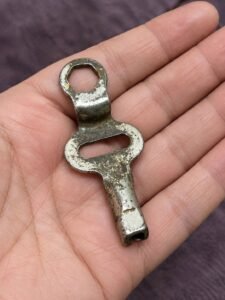
Some items look completely unremarkable until they suddenly open a doorway to the past. A small, weathered piece of metal tucked away in a drawer, an old sewing box, a family keepsake container, or a forgotten corner of a closet might seem like an odd little tool at first glance. To someone unfamiliar with it, its purpose may not be obvious. But to many people who grew up with traditional roller skates, the object is instantly recognizable: a roller skate key.
It is the kind of object that can trigger recognition before the memory itself fully takes shape. The metal may be dull with age, the edges may show signs of years of handling, and the shape may seem almost too simple to have mattered very much. Yet for generations of children, this little key played an important role in getting outside, fastening on a pair of skates, and turning an ordinary stretch of pavement into a place for movement, practice, and adventure.
What a Roller Skate Key Was Used For
Long before plastic skates, molded boots, and quick adjustment systems became common, roller skates were often built with metal frames and leather straps. Many traditional models relied on clamps and adjustable fittings rather than the more self-contained designs familiar today. Because the skates needed to fit securely around the wearer’s shoes, they often required a small metal key to make the necessary adjustments.
The key could be used to tighten clamps, loosen fittings, and help adjust the skate so it sat more securely on the foot. Those small adjustments mattered. A skate that was too loose could feel unstable, while one that had not been fitted carefully could make learning even more awkward than it already was. The key gave the wearer a practical way to make those changes before setting off.
Without it, making the proper adjustments could be difficult. That is why the key often stayed close at hand. It was not simply an accessory tossed into a box and forgotten until later. It was part of the routine of skating itself: put on the skates, check the fit, use the key if something needed tightening, and then head outside.
Why Children Wore the Key Around Their Necks
Children often wore the key on a string around their necks, where it was easy to reach and much harder to lose. Hanging there against a shirt or sweater, the little piece of metal could move and clink softly as they ran, walked, or skated down the sidewalk.
That familiar sound could become part of the experience. It meant the skates were nearby, the afternoon was still young, and there might be another stretch of pavement waiting to be explored. In a small but memorable way, the key announced freedom, speed, movement, and the possibility of adventures waiting just beyond the doorstep.
The habit of wearing it around the neck was also practical. Children could stop, make a quick adjustment, and keep going without having to search through pockets or return home. When a strap felt loose or a fitting needed attention, the key was right there. It helped make the process feel independent, allowing young skaters to take some responsibility for keeping their own equipment ready.
But the key was not just practical. Over time, it could take on the feeling of a small passport to joy. Putting it on meant something was about to happen. It was associated with getting outside, meeting friends, moving faster than walking, and testing a new skill again and again until balance began to feel natural.
Part of the Learning Experience
The roller skate key helped make those first shaky rides on uneven sidewalks possible. Learning to skate was rarely a perfectly smooth experience from the beginning. There could be uncertain starts, stiff legs, sudden stops, wobbly turns, and more than one moment when staying upright required complete concentration.
As confidence grew, those hesitant movements could turn into longer glides, quicker turns, and more relaxed rides. Children learned how to shift their weight, find their balance, and recover when the wheels moved faster than expected. The key stayed in the background of all that effort, quietly helping keep the skates adjusted while the child focused on mastering the movement itself.
For some, skating meant neighborhood sidewalks and long stretches of pavement. For others, it meant bright roller rink lights, music, polished floors, and the excitement of circling the rink while trying not to lose balance. The surroundings might change, but the sense of achievement remained much the same.
Scraped knees, cautious first attempts, sudden bursts of confidence, and proud cries of “Look at me!” were all part of the experience. Every outing created another opportunity to improve. A child who needed a wall, railing, or helping hand at the beginning might eventually push off alone and glide forward with much more confidence.
That progress often happened gradually. Learning to skate required practice, patience, and a willingness to try again after a fall or a shaky turn. The roller skate key did not create that confidence, but it quietly supported the experience by helping keep the equipment fitted and ready for another attempt.
In that sense, the key became connected not only with skating but also with persistence. It was there before the first uncertain push, during the adjustment between rides, and after the child had become comfortable enough to move faster and farther.
More Than a Simple Piece of Metal
The little metal key was ultimately more than a tool for adjusting skates. For many people, it became part of the childhood experience itself. It was handled before play began, worn during long afternoons outside, and carried home again when the day was over.
Objects can become meaningful in this way because they are attached to repeated moments. The key may have been small, but it appeared again and again during an activity filled with excitement, challenge, and freedom. Over time, the memory of the object became inseparable from the memory of skating.
A child might not have thought of the key as important at the time. It was simply something that was needed. Yet years later, seeing one again can bring back a surprising amount of detail: the feel of the metal, the tug of the string around the neck, the sound of wheels against pavement, or the moment before pushing off and hoping to stay balanced.
A Tiny Key With a Big Meaning
For many people, the roller skate key eventually became a treasured keepsake. Even if it was not intentionally saved as a souvenir, it could remain in a drawer, toolbox, old jewelry box, or collection of childhood belongings long after the skates themselves had disappeared.
Its meaning often grew with time. What had once been an everyday tool could later represent independence, small achievements, and the excitement of learning something new on one’s own. It could stand for the first time a child managed to tighten the skate without help, the first successful trip down the sidewalk, or the first afternoon spent skating confidently with friends.
Misplacing the key could temporarily interrupt an afternoon of skating. Without it, a loose fitting might be difficult to correct, and the skates might have to remain unused until the key was found. That made such a small object unexpectedly important.
Finding it again could feel like recovering the whole afternoon. The skates could be adjusted, the straps could be checked, and another ride was possible. That simple cycle of losing and finding the key gave it a value far greater than its size suggested.
Why Finding One Today Feels So Familiar
Finding a roller skate key today can feel like uncovering a tiny time capsule. The object itself has not changed, but the memories attached to it can return with remarkable clarity.
One glance may bring back the feeling of warm pavement under summer sun, chalk drawings scattered across concrete, or the heat held in leather straps after they had been outside for a while. There may be memories of pushing off from the curb, trying to keep speed under control, or feeling the wind at your back once you finally became confident enough to skate faster.
Those memories are often sensory as much as visual. People may remember the sound of metal wheels or the rhythm of skates passing over cracks in the sidewalk. They may remember the slight pressure of the straps, the effort of keeping ankles steady, or the quiet satisfaction of realizing that balance had become easier than it was the week before.
Memories Built Through Practice
These are not just nostalgic trinkets. Objects like a roller skate key can remind us of the joy of learning through practice and repetition. Skating demanded participation. There was no shortcut to balance, no instant way to become comfortable, and no guarantee that the first few attempts would go smoothly.
Children learned by doing. They adjusted the skates, stood up carefully, pushed forward, corrected themselves, fell occasionally, and tried again. Progress was visible because it was earned one small step at a time.
That process could make the experience especially satisfying. A turn that once seemed impossible eventually became natural. A sidewalk that felt intimidating at first later became familiar. What began as uncertainty could gradually become confidence.
The roller skate key was part of that routine. It represented preparation before the fun began and small corrections along the way. Tighten, adjust, try again. That simple pattern reflected the larger experience of learning the skill itself.
The Simplicity of Childhood Play
The key can also serve as a reminder of how simple childhood entertainment could be. A pair of skates, a safe stretch of pavement, enough room to move, and the willingness to practice could fill an afternoon.
The excitement came from movement, imagination, and personal progress. Children could invent races, practice stopping at a certain line, challenge themselves to go a little farther, or simply enjoy the sensation of rolling instead of walking.
There was also a certain patience built into the experience. Before skating began, the equipment had to fit properly. Straps needed attention. The skates sometimes needed another adjustment after a few minutes of use. The process was not necessarily difficult, but it required involvement.
That involvement made the activity feel personal. The skates were not simply put on and forgotten. They were checked, adjusted, and learned through repeated use. The little metal key became part of that hands-on relationship.
A Small Object That Carries a Whole Era
In its own quiet way, the roller skate key represents a time when fun often demanded patience, practice, and imagination. It belonged to an experience in which children learned by repeating the same movement until it became easier, and where a simple afternoon outdoors could become memorable without needing much beyond a pair of skates and enough space to roll.
The key itself may be tiny, but the memories connected to it can be enormous. It can represent the nervous excitement of a first attempt, the relief of finally finding one’s balance, the pride of skating without help, or the carefree feeling of moving quickly down a familiar sidewalk.
It may also recall the sound of friends nearby, the scrape of a sudden stop, the sting of a minor fall, and the determination to get back up. These details are ordinary when they happen, yet they often become the parts people remember most clearly many years later.
Why Old Everyday Objects Matter
Everyday objects often become meaningful precisely because no one expects them to. They are not always saved because they are expensive, rare, or beautiful. Sometimes they survive simply because they were placed in a drawer and never thrown away.
Years later, that survival can give them unexpected emotional weight. A roller skate key may suddenly connect someone with a particular period of childhood, a familiar neighborhood, a favorite pair of skates, or a season when afternoons seemed longer and more open-ended.
The object does not have to tell the entire story. Its shape alone can be enough to begin remembering. From there, the rest may return naturally: the sidewalk, the straps, the first successful glide, the race with friends, or the moment someone called out from nearby to be careful.
A Quiet Symbol of Childhood Independence
Perhaps that is why the roller skate key remains so memorable. It was both practical and symbolic. Children used it for a real purpose, yet it also became associated with independence and growing confidence.
Wearing the key around the neck meant being ready to make an adjustment without immediately asking an adult for help. Learning to use it was one more small part of learning how to manage the skates, just as learning to balance was part of learning how to move on them.
Those small acts of independence could feel important. They turned skating from something being done for the child into something the child was gradually learning to handle alone.
A Tiny Reminder With Lasting Power
Today, an old roller skate key may look like little more than a worn piece of metal. Yet for someone who remembers using one, it can hold an entire collection of sounds, sensations, and emotions.
It is a reminder of afternoons spent practicing, of freedom earned through balance and persistence, and of a kind of childhood play that asked for effort before offering its reward.
That is what gives the roller skate key its lasting meaning. It is not valuable because of what it is made from or because of its size. It matters because of what it represents: movement, confidence, childhood independence, and countless ordinary moments that became unforgettable with time.
A tiny key could tighten a pair of skates, but decades later, it can unlock something much larger—a vivid memory of what it once felt like to roll forward, find your balance, and discover just how much freedom could fit into a single afternoon.