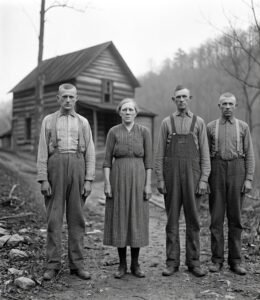
The cabin rose from the valley one log at a time.
For nearly six months, Ezra, Caleb, and Matthias Goins worked from sunrise until the mountains swallowed the light. They felled towering American chestnut trees, split limestone from the creek banks, and hauled every beam themselves. By the first snowfall of 1893, a single enormous cabin stood where the forest had once been untouched.
It puzzled the few travelers who happened upon the valley.
Three grown brothers could easily have built three separate homes, yet they chose one structure large enough to house an entire clan. It stretched nearly eighty feet from end to end, with a broad stone chimney at its center and a steep roof of hand-cut cedar shingles. Instead of glass windows, they covered each opening with tightly stretched oiled paper that turned every ray of sunlight into a dull amber glow.
Even at midday, the interior felt like permanent dusk.
The brothers divided the cabin into sections, though no walls completely separated one room from another. Long curtains of heavy canvas hung from rough-hewn beams, offering privacy without truly hiding anyone. Every floorboard creaked. Every whispered conversation drifted through the rafters.
Visitors later remarked that the cabin felt less like a home and more like a living thing.
It breathed with the mountain wind.
It groaned after sunset.
And on calm nights, people claimed they heard footsteps crossing the attic, despite the brothers insisting no one ever slept upstairs.
The nearest neighbors lived almost twelve miles away, separated by ridges, creeks, and dense forests of rhododendron. During the winter months, snowfall often blocked the narrow trails for weeks at a time, leaving the valley completely isolated from the outside world.
The brothers seemed to prefer it that way.
They hunted deer, trapped foxes, grew corn in small terraces carved into the hillside, and kept enough livestock to survive without relying on nearby settlements. Once every few months, one of them rode into Pike County to purchase salt, lamp oil, iron tools, and ammunition before disappearing back into the mountains.
No one ever saw all three brothers in town together.
When merchants asked about life in the hollow, the answers were always brief.
“Quiet.”
“Peaceful.”
“Just us.”
As the years passed, strange rumors began to spread among hunters who wandered too close to Black Laurel Hollow.
Some claimed smoke rose from two chimneys even though the cabin had only one.
Others insisted they saw lights moving beneath the ground long after midnight.
A traveling preacher reported hearing dozens of voices singing inside the cabin one evening, only to find the house nearly silent when he knocked on the door.
The brothers welcomed no visitors after sunset.
That rule never changed.
Then there were the children.
No one could say exactly when they first appeared.
A trapper passing through in the spring of 1898 remembered seeing four young boys carrying buckets from the creek. A year later, another traveler counted nearly a dozen children playing in the fields beyond the cabin. Their clothes were plain, their faces expressionless, and they stopped whatever they were doing the instant they noticed a stranger.
They didn’t wave.
They didn’t smile.
They simply watched.
By the time the traveler looked away and turned back again, every child had vanished into the trees.
The cabin remained.
Silent.
Waiting.
The Rules of Black Laurel Hollow
No one knew exactly who created the rules.
The brothers never spoke of them aloud, yet everyone who visited the valley seemed to learn them almost immediately.
The first rule was simple.
Never whistle after sunset.
According to an old storekeeper in Pike County, a young hunter ignored the warning during the autumn of 1901. He claimed the mountains echoed differently in Black Laurel Hollow and wanted to hear the sound bounce between the cliffs.
He whistled only once.
The echo came back.
Then it came back again.
And again.
Each repetition sounded slightly farther away, as though someone else had picked up the tune and continued it deeper into the forest.
The hunter left before dawn and never returned to the hollow.
Years later, he refused to explain what frightened him, saying only, “The last whistle wasn’t mine.”
The second rule was even stranger.
Never count the children.
Travelers often tried.
Six children carrying water.
Nine working in the cornfield.
Four sitting on the porch.
Yet every headcount produced a different number.
One census volunteer wrote that he counted seventeen children before lunch, twenty-three that afternoon, and only eleven standing in the same yard before sunset.
He blamed exhaustion.
His assistant quietly crossed the numbers out of the notebook.
The third rule was the one everyone remembered.
If someone invited you to stay the night…
…leave before the sun disappeared behind the western ridge.
Old mountain families claimed the valley changed after dark.
Windows that faced east during the day somehow reflected moonlight from the north.
Footpaths wandered into places they had never led before.
Dogs refused to cross the creek.
Even horses became restless, pulling at their reins as if desperate to escape.
One traveling doctor ignored every warning in 1908 after agreeing to treat a sick child at the cabin.
He arrived shortly before sunset.
The brothers thanked him politely and insisted he remain until morning because the mountain trail had become too dangerous in the dark.
The doctor accepted.
When he returned to Pike County three days later, he insisted he had stayed only one night.
His pocket watch disagreed.
It had stopped exactly forty-eight hours earlier.
He never practiced medicine in the mountains again.
As the years passed, the stories grew stranger.
Hunters claimed they occasionally saw lanterns moving along the ridgeline long after midnight, forming a slow procession through the trees before disappearing into the fog.
Loggers reported hearing axes striking timber where no camps existed.
Children from nearby farms spoke of music drifting through the valley on cold winter evenings—a melody that seemed close enough to follow but always faded before anyone reached the tree line.
Whether the stories were true hardly mattered anymore.
Black Laurel Hollow had become something larger than a place.
It had become a warning.
Parents mentioned its name whenever children wandered too far into the woods.
Surveyors marked it on maps with unusual care.
Even seasoned trappers preferred to circle around the valley rather than pass through it.
Because everyone who entered Black Laurel Hollow came back with a story.
And none of those stories ever matched.
The Census That Couldn’t Be Filed
In the spring of 1932, the Kentucky Department of Revenue dispatched veteran census enumerator Franklin H. Weaver to survey several remote settlements in Pike County. Weaver had spent nearly twenty years traveling the Appalachian backcountry and was known for his patience. He had counted coal camps, logging towns, and isolated farms where families had not seen a government official in years.
Black Laurel Hollow was supposed to be just another stop.
His assignment should have taken less than an hour.
Instead, he remained in the valley until nearly sunset.
When Weaver finally returned to town, he looked exhausted. Witnesses at the general store later recalled that he ordered two cups of black coffee, drank both without speaking, then purchased an entirely new ledger before checking into the local boarding house.
The original census book was never seen again.
Weeks later, county officials received Weaver’s rewritten report.
It contained only a handful of names.
Ezra Goins.
Caleb Goins.
Matthias Goins.
Below them appeared a list of children, but the handwriting became increasingly uneven with every line. Several names had been scratched out so aggressively that the paper tore beneath the ink. Others appeared twice, each with a different age.
One boy was listed as eight years old on one page.
The same name appeared three pages later as twelve.
A girl called Ruth was marked as having died in 1928.
Further down, Weaver recorded interviewing her in person during the census.
The inconsistencies multiplied.
Some birthdates suggested children had been born months before their older siblings.
Several individuals shared identical birthdays despite supposedly being unrelated.
A few names simply disappeared halfway through the ledger, replaced by blank spaces where sentences had been carefully erased.
When supervisors requested clarification, Weaver sent back a single handwritten note.
“The numbers refuse to remain the same. Send someone else if you doubt me.”
No replacement was ever assigned.
Instead, the report was quietly accepted with dozens of corrections scribbled into the margins.
For years, historians assumed Weaver had simply become confused while working in an isolated community.
That explanation survived until the winter of 1976.
While renovating the abandoned Pike County courthouse, construction workers discovered a rusted metal lockbox hidden behind a false wall inside the records office. Among tax receipts and weather logs lay several loose census pages bearing Franklin Weaver’s signature.
These were not copies.
They were the missing original notes.
Unlike the official report, these pages contained observations never intended for public record.
The margins were filled with hurried remarks.
“Children answer before questions are finished.”
“Every person watches before speaking.”
“Cannot determine how many reside here.”
The final page was the most unsettling of all.
Across the bottom, written in noticeably darker ink, Weaver had underlined a single sentence three times.
“Every window reflected more faces than were standing inside.”
There was no explanation.
No names.
No conclusion.
Only those nine words.
The remaining pages of the notebook had been torn away so cleanly that investigators believed they had been removed with a knife.
No one ever discovered what had been written on them.
By the time the missing ledger resurfaced, everyone Franklin Weaver had interviewed in Black Laurel Hollow was long gone.
The cabin had collapsed.
The trails had disappeared beneath decades of forest growth.
And the valley, once carefully marked on county maps, had quietly faded into another Appalachian legend.