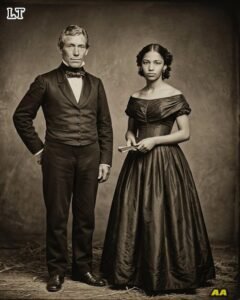
The Newspaper Scandal That Challenged America’s Most Celebrated Founding Father
In September 1802, a political controversy erupted that would follow Thomas Jefferson for the rest of his life and long after his death. James Thomson Callender, a partisan journalist who had previously attacked Jefferson’s political opponents, published allegations in the Richmond Recorder claiming that the president had fathered children with Sally Hemings, an enslaved woman at Monticello. The accusations struck at the heart of Jefferson’s public identity. He was the author of the Declaration of Independence, the document that proclaimed the equality of human beings, and a leading voice in a nation that had declared liberty a fundamental principle. Yet he also enslaved hundreds of people during his lifetime. Callender’s reports transformed that contradiction into a national political weapon. Newspapers circulated the allegations, Jefferson’s enemies seized upon them, and his supporters struggled to defend a president whose private life had become a matter of public controversy. Jefferson himself did not issue a direct public response to Callender’s specific accusations. His silence allowed the controversy to persist, while the broader question of his relationship with Hemings remained contested for generations. What made the story so consequential was not merely the allegation of an affair between a president and an enslaved woman, but the immense imbalance of power between them. Jefferson possessed wealth, political authority, and legal control over Hemings’s life. She possessed none of those protections. The scandal therefore raised a question that went far beyond personal morality: could a nation genuinely celebrate liberty while its most prominent leaders participated in a system that denied it to others?
A Family Connection Hidden Inside the Institution of Slavery
The story of Sally Hemings becomes even more complicated when her family background is examined. She was born around 1773 to Elizabeth Hemings, an enslaved woman at Monticello, and John Wayles, a wealthy Virginia planter who was also the father of Martha Wayles Skelton Jefferson, Thomas Jefferson’s wife. Sally and Martha were therefore paternal half-sisters, although they occupied radically different positions in the society into which they were born. Martha was a free white woman who married one of Virginia’s most influential men. Sally was born enslaved, and her legal status subjected her to the authority of those who claimed ownership over her. When John Wayles died in 1773, members of the Hemings family became part of the estate inherited by his descendants, including Thomas Jefferson through his marriage to Martha. This connection placed Sally within the same extended household as the woman who would become the president’s wife. After Martha died in 1782, Jefferson continued to hold Sally and other members of her family in slavery. Their shared ancestry did not grant Sally legal equality, social standing, or control over her own future. Instead, it exposed the disturbing ways slavery could divide a single family along lines of race, status, and ownership. In a society that placed enormous importance on ancestry and inheritance, the Hemings family’s history revealed a reality that respectable plantation households often concealed: the boundaries between enslavers and enslaved people could run directly through the same family tree. The relationship between Sally and Jefferson must be understood within that reality, rather than through the romantic language that later generations sometimes used to describe it.
The Journey to Paris and the Promise That Shaped Her Future
In 1787, Jefferson brought Sally Hemings to Paris while serving as the United States minister to France. She was approximately fourteen years old, while Jefferson was forty-four. She accompanied his younger daughter, Mary Jefferson, and became part of the household responsible for the child’s care. Paris offered a striking contrast to Virginia. France was experiencing intense debate about natural rights, political authority, and the institution of slavery, and enslaved people who reached French territory sometimes found legal opportunities unavailable to them in the American South. Hemings’s position was nevertheless precarious. She remained enslaved under Virginia law, and Jefferson continued to exercise authority over her. Historians have examined the circumstances of her time in France carefully, including later accounts that she negotiated with Jefferson before agreeing to return to Virginia. According to the recollections of her son Madison Hemings, published in 1873, Jefferson promised Sally that their children would be freed when they reached adulthood if she returned with him to the United States. The precise details of their discussions cannot be independently reconstructed, but the account has become central to understanding her decision. Paris was not simply a distant setting in a political drama. It was a place where Hemings may have recognized possibilities for freedom that she could not easily secure in Virginia. She ultimately returned to Monticello with Jefferson in 1789. That decision has sometimes been presented as evidence of affection, but such an interpretation cannot account for the full circumstances of her life. She was a young woman navigating an extraordinary imbalance of power, with her family’s future and her own freedom bound to decisions made by a man who legally owned her.
4. Six Children and a Relationship Defined by Unequal Power
Sally Hemings had six children attributed to Thomas Jefferson: Harriet, who was born in 1795; Beverly, born in 1798; an unnamed daughter who died in infancy in 1799; Harriet, born in 1801; Madison, born in 1805; and Eston, born in 1808. The two daughters who survived into childhood were both named Harriet, following a naming practice found in the family’s history. The children grew up at Monticello, where their mother remained enslaved and Jefferson controlled the household. Several members of the Hemings family possessed skills that distinguished them within the plantation community. Sally’s brothers, for example, worked as highly skilled artisans, including a blacksmith and a carpenter, while other relatives served in domestic roles. The children’s experiences were shaped by their ancestry and by the peculiar possibilities available to people who were both enslaved and related to their enslaver. Jefferson allowed Beverly and Harriet to leave Monticello as young adults, and both appear to have lived in white society. Madison and Eston eventually obtained freedom, while their mother remained enslaved until Jefferson’s death in 1826. The children’s lighter complexions later became part of discussions about their parentage, but appearance alone cannot establish paternity. More important is the testimony passed down within the Hemings family and the documentary record that places Jefferson and Sally in the same household during the relevant years. Their relationship was not one between equals who could negotiate freely without consequences. Enslaved women had limited legal protection against sexual exploitation, and the law generally denied them the power to refuse an enslaver’s demands with the safeguards available to free women. Any serious account of this family must therefore acknowledge both the historical evidence of their relationship and the conditions under which Sally lived.
The Silence at Monticello and the Questions That Survived Jefferson
For much of the nineteenth century, the allegations surrounding Jefferson and Hemings remained entangled in partisan disputes, family recollections, and conflicting accounts. Jefferson’s defenders frequently dismissed the story as political slander, while critics viewed it as evidence of hypocrisy among the founders. The controversy was complicated by the fact that Jefferson left no known public confession acknowledging that he had fathered Hemings’s children. His household records documented many details of plantation life, but they did not provide a simple, definitive statement settling the question. The absence of such a statement allowed competing interpretations to survive. Some descendants of Jefferson’s acknowledged family rejected the Hemings account, while members of the Hemings family preserved a different history. Madison Hemings’s 1873 interview was particularly significant because he identified Jefferson as his father and described the circumstances surrounding his mother’s relationship with him. For decades, historians debated the reliability of that testimony and the meaning of the surviving records. The discussion was also shaped by the racial assumptions of the period, which often made historians more willing to accept claims about white ancestry than testimony from Black families. As historical scholarship developed, researchers increasingly examined plantation records, family histories, and the patterns of Jefferson’s presence at Monticello. The story could no longer be understood solely as a political accusation printed during an election season. It had become a question about how historians evaluate evidence, whose testimony they consider credible, and how the legacy of slavery has shaped the preservation of American history. Jefferson’s silence did not end the debate. Instead, it left later generations with the responsibility of examining the evidence that survived.
DNA Evidence Changed the Historical Debate
A major shift came in 1998, when genetic testing published in the journal Nature examined the Y chromosome of descendants from the Jefferson and Hemings family lines. The results demonstrated a genetic connection between the male Jefferson line and descendants of Eston Hemings. DNA evidence alone could not establish every detail of the relationship, and researchers considered the possibility that another male Jefferson relative could have fathered Eston. However, when the genetic findings were considered alongside the historical records, family testimony, and the timing of Jefferson’s visits to Monticello, the evidence strongly supported the conclusion that Thomas Jefferson fathered Eston Hemings. In 2000, the Thomas Jefferson Foundation, which operates Monticello, concluded that Jefferson was the likely father of Sally Hemings’s children, a position that subsequently became widely accepted among historians. The distinction matters: the DNA study did not independently prove that Jefferson fathered all six children, because the genetic evidence specifically connected the Jefferson male line with Eston’s descendants. The broader conclusion rests on the convergence of multiple forms of evidence. This development represented a significant moment in historical research because it helped shift the discussion away from speculation and toward a more evidence-based understanding of the Hemings family. It also prompted renewed attention to the voices of descendants whose accounts had been discounted or marginalized for generations. The findings did not erase every uncertainty about the family’s private life, nor could science reconstruct the emotions or precise circumstances of a relationship that began under slavery. They did, however, make it increasingly difficult to dismiss the central historical conclusion that Jefferson fathered children with Hemings. A controversy once treated by many as political gossip had become a major case study in how scientific evidence can reshape our understanding of the past.

The Legacy of Sally Hemings and the Meaning of American Freedom
Thomas Jefferson died at Monticello on July 4, 1826, exactly fifty years after the Declaration of Independence was adopted. Sally Hemings survived him by nearly a decade, dying in 1835. Jefferson’s will freed only a small number of enslaved people, including members of the Hemings family, while Sally herself was not formally emancipated in the document. After his death, Jefferson’s daughter Martha allowed Hemings to live with her sons Madison and Eston in Charlottesville, Virginia, a form of informal freedom that did not erase the legal and social restrictions of the time. Her life ended without the public recognition that later generations would give her story. Today, the history of Jefferson and Hemings is central to discussions of slavery, political hypocrisy, family, and the meaning of liberty in the early United States. It reminds us that the language of universal rights existed alongside a legal system that treated human beings as property and allowed powerful men to exercise extraordinary control over the lives of enslaved women. Yet Sally Hemings should not be remembered only through her connection to a president. She was a mother whose children carried a family history across generations, a woman whose choices were constrained by circumstances few people today can fully imagine, and a person whose descendants preserved an account that eventually helped reshape the historical record. Her story challenges us to look beyond the polished portraits of the founding era and ask who was excluded from its promises. The question is not simply whether Jefferson’s public ideals contradicted his private conduct. It is whether a nation can honestly understand its founding without confronting the lives of the people whose labor, suffering, and denied freedom helped sustain it.