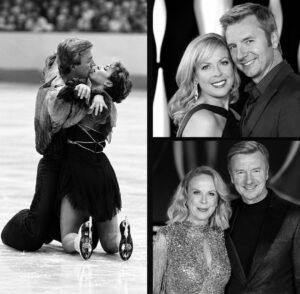
Long before the standing ovations, the Olympic medals, and the worldwide recognition, Jayne Torvill and Christopher Dean lived remarkably ordinary lives in Nottingham, England. Jayne worked as an insurance clerk, spending her days in an office, while Christopher served as a police constable. Neither had grown up surrounded by the wealth, sponsorship opportunities, or sophisticated athletic support systems often associated with Olympic champions today.
Their dreams existed beyond their daily responsibilities. While other people finished work and returned home to relax, Jayne and Christopher made their way to the ice rink. There, under fluorescent lights and often after exhausting days, they practiced the movements that would eventually transform the sport. Their dedication demanded sacrifices that few spectators would ever understand. Every hour spent training meant less time for ordinary pleasures, and every setback carried the possibility that their Olympic ambitions might remain unfulfilled.
They began skating together in 1975, forming a partnership built on discipline, trust, and a shared understanding of music. Their early years were not filled with effortless victories. Instead, they gradually learned how to anticipate each other’s movements, respond to subtle changes in balance, and create the illusion that two separate bodies were moving as one. Their remarkable chemistry would eventually become their greatest strength.
2. The Long Road From Nottingham to Sarajevo
The journey toward Olympic greatness was neither immediate nor guaranteed. At the 1980 Winter Olympics in Lake Placid, Torvill and Dean finished fifth, an achievement that demonstrated their potential but also revealed how much work remained. They returned to Britain determined to improve, knowing that the difference between being excellent and becoming Olympic champions required years of extraordinary dedication.
Their partnership flourished under the guidance of coach Betty Callaway, whose expertise helped them refine both their technical skills and artistic expression. Dean increasingly took a central role in developing their choreography, exploring ways to make ice dancing more theatrical, emotionally engaging, and musically sophisticated. Rather than simply performing steps to familiar melodies, they wanted audiences to experience a complete story through movement.
Their progress was remarkable. They won consecutive World Championships in 1981, 1982, and 1983, establishing themselves as dominant figures in international ice dancing. By the time the 1984 Winter Olympics approached, they were already recognized as favorites for gold. Yet success created its own pressure. Winning was no longer enough to satisfy their creative ambitions. They wanted to deliver something that would remain meaningful long after the judges had recorded their scores.

3. The Strange Musical Choice That Changed Everything
The inspiration for their most famous performance came from an unexpected source: Boléro, the mesmerizing orchestral composition written by French composer Maurice Ravel in 1928. Unlike conventional music built around contrasting melodies, Boléro repeats a central musical idea while gradually increasing its intensity through changing orchestration and an extraordinary crescendo.
For many skaters, the composition would have seemed an unusual choice. Its relentless repetition offered little of the obvious variety traditionally associated with competitive dance routines. But Torvill and Dean recognized something different. They heard the possibility of creating a performance that would grow in emotional power with every passing moment, carrying the audience toward a dramatic conclusion.
There was one significant obstacle. The music they wanted to use required a performance longer than the permitted Olympic free-dance skating time. Rather than abandon their artistic vision, they developed an innovative opening sequence performed while kneeling on the ice. This allowed them to incorporate the musical introduction before beginning the timed skating portion of the routine.
The decision was daring. Their opening would look unlike anything spectators expected from an Olympic ice dance. Instead of immediately gliding across the rink, the two athletes would begin close to the surface, moving slowly and deliberately as the music gathered momentum. Every gesture had to be carefully controlled. The result would require absolute confidence in both the choreography and their ability to execute it under immense pressure.
4. Valentine’s Day, 1984: The Night the World Stopped Watching the Clock
On February 14, 1984, Torvill and Dean entered the ice at Zetra Olympic Hall in Sarajevo, then part of Yugoslavia. The arena was filled with spectators eager to witness the British pair’s final performance. The expectations were enormous, but the two skaters appeared focused on something beyond medals or rankings.
As the opening notes of Boléro emerged from the speakers, they lowered themselves into their starting position. Their movements were slow, intimate, and carefully synchronized. Instead of immediately displaying technical difficulty, they allowed the music to establish the emotional atmosphere. The effect was mesmerizing.
As the rhythm intensified, they rose and began moving across the ice. Their skating seemed almost impossibly fluid. Every turn, extension, and change of direction appeared connected to the musical structure. There were no unnecessary gestures, no movements designed merely to impress the judges. Everything served the larger performance.
The audience watched as the routine gradually became more powerful. The choreography conveyed tension, closeness, and emotional urgency without requiring a single spoken word. Torvill and Dean moved with such remarkable unity that the distinction between leader and partner seemed to disappear.
Then came the final crescendo.
As Ravel’s music reached its dramatic conclusion, the pair collapsed together onto the ice, completing one of the most unforgettable endings in Olympic history. The audience erupted into applause, recognizing that they had witnessed something far beyond an ordinary competitive performance.

5. Nine Judges, Nine Perfect Scores, One Unforgettable Moment
The performance itself had already created an extraordinary emotional response, but the most remarkable moment was still to come. Under the scoring system used at the time, judges awarded marks for technical merit and artistic impression, with 6.0 representing perfection.
As the artistic impression scores appeared, the scale of Torvill and Dean’s achievement became clear.
For Jayne and Christopher, the scores represented the culmination of nearly a decade of shared work. Every early morning, every exhausting rehearsal, every disappointment, and every sacrifice had contributed to this moment. The insurance clerk and the policeman from Nottingham were now Olympic champions.
But their achievement meant something greater than a gold medal. They had demonstrated that ice dancing could communicate the emotional depth of theater, the elegance of ballet, and the intensity of classical music while remaining an extraordinary athletic discipline.
6. Returning to the Ice Where History Was Made
After winning another World Championship in 1984, Torvill and Dean turned professional, beginning a new chapter that allowed them to explore their artistry beyond the restrictions of amateur competition. Their performances continued attracting audiences around the world, while their Olympic Boléro became an enduring cultural reference.
Ten years after Sarajevo, they returned to Olympic competition at the 1994 Winter Games in Lillehammer, Norway. By then, the sport had evolved, and they faced a new generation of competitors. Although they did not repeat their gold-medal victory, they earned bronze, demonstrating that their technical ability and extraordinary partnership remained formidable.
Perhaps one of the most emotional chapters came in 2014, when Torvill and Dean returned to Sarajevo to mark the thirtieth anniversary of their Olympic triumph. The city had endured devastating suffering during the Bosnian War, and Zetra Olympic Hall itself had been severely damaged before being reconstructed.
Returning to the same venue carried a significance that extended far beyond sporting nostalgia. The building represented not only the memory of their greatest triumph but also the resilience of a city that had survived enormous hardship. When they performed Boléro again, the moment connected past and present, reminding spectators of the power of art to preserve memories across generations.
For the two skaters, it was an opportunity to revisit the place where their lives had changed forever. For Sarajevo, it was a reminder of a time when the world’s attention had been focused on the city for a celebration of athletic achievement and international unity.

7. The Four Minutes That Became Forever
More than four decades after their Olympic triumph, Torvill and Dean’s Boléro remains one of the most celebrated performances in figure skating history. Its significance cannot be measured solely through medals, scores, or competitive records. What made the routine extraordinary was its ability to transcend the boundaries of sport and become a shared cultural memory.
Their achievement was particularly remarkable because of where their journey began. They were not born into a world designed to produce Olympic champions. They were two young people from Nottingham who combined ordinary working lives with extraordinary ambition. Their success required years of persistence, creative experimentation, and an almost instinctive trust in each other.
The nine perfect artistic impression scores remain one of the defining images of the Sarajevo Winter Olympics. Although figure skating has since adopted a different judging system, making direct comparisons with modern competitions impossible, the achievement continues to symbolize a rare moment of complete agreement among judges from different nations.
Yet perhaps the most enduring lesson of their story is not about perfection.
It is about partnership.
Torvill and Dean demonstrated what can happen when two individuals commit themselves completely to a shared vision. Their greatest achievement was not simply mastering difficult movements or winning the approval of judges. It was learning to communicate something deeply human through the language of movement.
On Valentine’s Day in 1984, two people stepped onto the ice carrying nine years of dreams, disappointments, and determination.
They began on their knees.
They moved together as the music grew.
And when the final notes faded, they lay together on the ice, unaware of just how deeply their performance would enter sporting history.
The judges raised their scores.
Nine perfect marks for artistic impression.
Twelve perfect scores in total.
One Olympic gold medal.
And a performance that generations would continue watching long after the competition ended.
Because sometimes, greatness is not measured by how long a moment lasts, but by how long the world remembers it.
For Jayne Torvill and Christopher Dean, that moment lasted just over four minutes.
But its magic has endured for more than forty years.