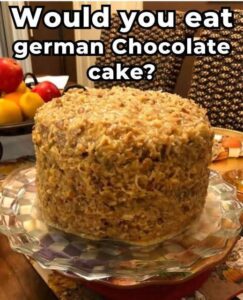
There are some cakes that don’t just sit on a plate — they sit in your memory.
German Chocolate Cake is one of those cakes.
This isn’t the flashy bakery-case kind of dessert with towering buttercream swirls and perfect edges. This is the cake you remember being carried into the room on a chipped ceramic platter, slightly leaning to one side, the coconut-pecan frosting sliding just a little as the table shook. The kind of cake where someone always asked, “Did you make this from scratch?” and the answer mattered.
For many of us, German chocolate cake meant birthdays, church suppers, potlucks, and family gatherings where the recipe was written on an index card and guarded like a family secret. It was sweet but not too sweet, rich without being heavy, and always finished with that unmistakable topping — sticky, nutty, buttery, and spoonable.
This is the German chocolate cake our mothers and grandmothers made. The real one. The one that doesn’t need fancy tricks or modern shortcuts.
Despite its name, German chocolate cake has nothing to do with Germany.
The cake is named after Samuel German, an American baker who developed a sweet baking chocolate in the mid-1800s. That chocolate — milder and sweeter than most baking chocolate — became the foundation for this now-iconic dessert.
The recipe as we know it today rose to fame in the 1950s, when a home baker submitted it to a newspaper. It spread quickly, passed from kitchen to kitchen long before the internet ever existed. By the 1960s and 70s, German chocolate cake had secured its place as a classic American dessert.
And unlike many recipes that have been endlessly “improved” over time, this one didn’t need fixing.
What Makes German Chocolate Cake So Special
German chocolate cake stands apart from other chocolate cakes in a few very important ways:
First, the cake itself is mildly chocolatey, not dark or bitter. It’s soft, tender, and slightly sweet, meant to support the frosting rather than overpower it.
Second, the frosting is not frosting at all in the modern sense. There’s no powdered sugar fluff here. Instead, it’s a cooked custard made with egg yolks, evaporated milk, butter, sugar, coconut, and pecans. Warm, glossy, and thick enough to spoon on generously.
And finally, tradition matters. A true old-fashioned German chocolate cake is frosted only between the layers and on top. The sides stay bare, letting you see the layers and that generous filling peeking through.
Ingredients You’ll Need
This recipe stays true to the old standard. Nothing fancy. Nothing unnecessary.
For the Cake (Three 9-Inch Layers)
4 ounces (113 g) sweet baking chocolate, chopped
½ cup (120 ml) boiling water
2¼ cups (270 g) all-purpose flour
1 teaspoon baking soda
½ teaspoon salt
1 cup (226 g) unsalted butter, softened
2 cups (400 g) granulated sugar
4 large eggs, separated
1 teaspoon vanilla extract
1 cup (240 ml) buttermilk
For the Coconut-Pecan Frosting
4 large egg yolks
1 can (12 oz / 354 ml) evaporated milk
1½ cups (300 g) granulated sugar
¾ cup (170 g) unsalted butter, cut into pieces
1½ teaspoons vanilla extract
2⅔ cups sweetened shredded coconut
1½ cups chopped pecans
Optional but traditional: a small pinch of salt
Step-by-Step: How This Cake Was Always Made
Step 1: Prepare the Pans and Oven
Preheat your oven to 350°F (180°C).
Grease three 9-inch round cake pans. Line the bottoms with parchment paper, then grease again and lightly flour. This cake is tender, and parchment makes sure nothing sticks.
Step 2: Melt the Chocolate
Place the chopped sweet chocolate in a heatproof bowl. Pour the ½ cup boiling water over it. Let it sit for a few minutes, then stir until smooth.
Set aside to cool slightly. This step alone fills the kitchen with a smell that feels like home.
Step 3: Mix the Dry Ingredients
In a medium bowl, whisk together the flour, baking soda, and salt. Set aside.
Step 4: Cream the Butter and Sugar
In a large bowl, beat the softened butter until creamy. Add the sugar and beat until light and fluffy, about three to four minutes. Don’t rush this step — this is where the cake gets its soft crumb.
Step 5: Add Egg Yolks, Chocolate, and Vanilla
Beat in the egg yolks one at a time. Then mix in the melted chocolate and vanilla until fully combined.
Step 6: Alternate Dry Ingredients and Buttermilk
On low speed, add the flour mixture in three additions, alternating with the buttermilk in two additions. Begin and end with the flour.
Mix just until combined. Overmixing makes the cake tough.
Step 7: Beat and Fold in Egg Whites
In a clean bowl, beat the egg whites until stiff peaks form. Gently fold them into the batter in two or three additions, using a spatula and a light hand.
This old-fashioned step is what gives the cake its airy texture.
Step 8: Bake the Layers
Divide the batter evenly among the prepared pans. Bake for 20–25 minutes, or until a toothpick inserted in the center comes out clean.
Cool the cakes in the pans for 10 minutes, then turn out onto wire racks to cool completely.

Making the Coconut-Pecan Frosting (The Soul of the Cake)
This frosting is made on the stovetop, just like it always was.
In a large saucepan, whisk together the egg yolks, evaporated milk, and sugar. Cook over medium heat, stirring constantly, until thickened — usually about 10 to 12 minutes.
Remove from heat and stir in the butter and vanilla until smooth. Then fold in the coconut and pecans.
The frosting should be thick, glossy, and warm — not hot — when you spread it.
Assembling the Cake the Traditional Way
Place one cake layer on a serving plate. Spread about one-third of the frosting evenly over the top. Add the second layer and repeat. Finish with the third layer and frost the top.
Leave the sides bare. That’s how it was always done.
Why This Cake Tastes Better the Next Day
German Chocolate Cake is one of those rare desserts that actually improves with time.
As it sits, the frosting settles slightly into the cake layers. The flavors meld. The texture becomes even softer. Many experienced bakers intentionally make this cake a day ahead for that reason.
Grandma’s Best Tips
Use real butter. This cake depends on it.
Don’t rush the frosting — thickness comes from patience, not heat.
Toast the pecans lightly if you want extra depth of flavor.
Store the cake covered at room temperature for the best texture.
How to Serve German Chocolate Cake
This cake doesn’t need garnish. It doesn’t need whipped cream or syrup.
Serve it:
With a cup of black coffee
At room temperature
In generous slices
It’s not meant to be delicate. It’s meant to be satisfying.
Frequently asked questions:
What makes German Chocolate Cake different from regular chocolate cake?
German Chocolate Cake is lighter and sweeter than traditional chocolate cake, with a signature coconut-pecan frosting instead of buttercream.
Can I make this cake ahead of time?
Yes! Bake the cake layers a day in advance and refrigerate. Frost just before serving.
How do I store German Chocolate Cake?
Keep it in an airtight container at room temperature for up to 2 days or refrigerate for up to 5 days.
Can I freeze German Chocolate Cake?
Yes! Wrap each layer in plastic wrap and freeze for up to 3 months. Thaw and frost when ready to serve.
Can I use store-bought frosting?
Homemade coconut-pecan frosting is key to the flavor, but in a pinch, you can use store-bought.
Can I make this as a sheet cake instead of layers?
Absolutely! Pour the batter into a 9×13 pan and bake for about 35-40 minutes.
Can I use walnuts instead of pecans?
Yes! Walnuts can be used, but pecans are traditional and offer a milder, buttery flavor.
Why is my cake dry?
Overbaking or using too much flour can cause dryness. Check for doneness with a toothpick at the minimum bake time.
How do I get a smoother frosting texture?
Let the frosting cool before spreading, and stir gently to keep the coconut and pecans evenly distributed.
Can I add chocolate buttercream to this cake?
Yes! Many people add a layer of chocolate buttercream between the cake and the coconut-pecan frosting for extra indulgence.