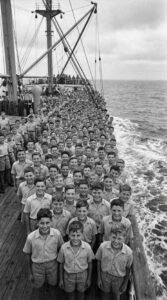
In the darkest years of World War II, 740 Polish children found themselves trapped between a past filled with unimaginable suffering and a future that seemed to offer no place for them.
They had survived deportation, hunger, disease, and the loss of their families. Some had watched their parents grow weaker in Soviet labor camps. Others had endured journeys across unfamiliar lands, carrying memories no child should ever have to bear.
They had finally reached safety in Iran, believing that the worst was behind them.
But their ordeal was far from over.
With nowhere permanent to go, the children faced an uncertain future. They needed shelter, food, medical care, and a country willing to accept them. Instead, their search for refuge became another painful journey, marked by closed doors and unanswered pleas.
Then, thousands of miles away, a message reached an Indian ruler named Jam Sahib Digvijaysinhji, the Maharaja of Nawanagar.
He could not end the war. He could not bring the children’s parents back to life. He could not erase the suffering they had already endured.
But he could do something that mattered immediately.
He could give them a home.
His decision would become one of the most remarkable humanitarian stories to emerge from the Second World War, a reminder that even when governments hesitate and the world seems indifferent, one person’s compassion can change hundreds of lives.
A Childhood Stolen by War
Before the war transformed their lives, Polish children had known ordinary childhoods.
They had attended school, played with friends, listened to stories, and imagined futures that seemed as limitless as the world around them. Some dreamed of becoming teachers or doctors. Others simply wanted to grow up, stay close to their families, and live peaceful lives.
Then, in September 1939, Nazi Germany invaded Poland from the west. The Soviet Union invaded from the east later that month under the terms of the German-Soviet agreement.
Poland was divided between the two occupying powers, and countless families found themselves caught in a catastrophe they had done nothing to create.
Under Soviet rule, hundreds of thousands of Polish citizens were deported to remote parts of the Soviet Union. Families were forced from their homes and transported over enormous distances, often in overcrowded railway cars under brutal conditions.
Among those deported were children whose lives would be changed forever.
They arrived in unfamiliar regions where the climate could be harsh, food could be scarce, and survival depended on conditions far beyond their control. Parents struggled to keep their children alive while facing exhausting labor, inadequate shelter, and the spread of disease.
For many families, the suffering proved fatal.
Children watched adults grow weaker. Some lost their mothers or fathers to hunger and illness. Others became separated from relatives and had no reliable way of knowing whether they would ever see them again.
The experience forced children to grow up long before they were ready.
A child who had once worried about schoolwork might suddenly have to find food. A young brother or sister might become the only family left to someone barely old enough to understand what had happened.
The war did not merely threaten their futures. It took away the ordinary world in which childhood was supposed to unfold.

The Long Road From the Soviet Union to Iran
The fate of many Polish deportees changed after Germany invaded the Soviet Union in June 1941.
Following the German attack, the Polish government-in-exile and the Soviet authorities reached an agreement that enabled the formation of a Polish army on Soviet territory and brought an amnesty for many Polish citizens previously imprisoned or deported.
As Polish military units were organized, large numbers of civilians began making their way toward evacuation points.
The journey was difficult, and survival was far from guaranteed. Families who had endured years of deprivation were now traveling through regions where food, transport, and medical care remained limited.
Eventually, Polish military personnel and civilians were evacuated through the Soviet Union into Iran, then under British and Soviet occupation.
For many refugees, Iran represented the first opportunity in years to receive assistance in a comparatively safer environment.
Relief workers provided food, shelter, and medical attention. Polish institutions and humanitarian organizations worked to care for the arrivals, many of whom were suffering from malnutrition and illness.
Yet reaching Iran did not solve every problem.
There were enormous numbers of displaced people, and the youngest survivors needed more than temporary accommodation. They required a stable place to live, adults who could care for them, opportunities for education, and the emotional security that had been missing for so long.
Some children had relatives who could help them. Others were effectively alone.
The international search for suitable destinations continued, with different countries and institutions taking in groups of Polish refugees.
Among the children who needed protection were those who would eventually find sanctuary in western India, where a local ruler would offer something they had almost stopped expecting: a place where they were wanted.
The Children Who Needed More Than Survival
It is easy to describe the Polish children who reached Iran as refugees, but that word cannot fully capture what many of them had experienced.
A refugee is someone forced to flee danger. These children had also endured the destruction of their families, the loss of their homes, and the sudden disappearance of everything familiar.
Some were old enough to understand that their parents were gone. Others were too young to comprehend why they had been separated from the people who were supposed to protect them.
The older children often assumed responsibilities that belonged to adults.
An older sister might look after a younger brother, making sure he ate whatever food she could find. A teenage boy might try to appear brave because the younger children around him were frightened. Children who were themselves desperate for comfort sometimes became the only source of reassurance available to someone else.
Such responsibilities could be overwhelming.
Imagine trying to comfort a younger sibling when you have no idea where you will sleep the following night. Imagine promising that everything will be all right when you cannot even be certain that there will be enough food tomorrow.
Yet children continued to care for one another.
Their resilience was not evidence that their suffering had been small. It was evidence that they had been forced to endure circumstances no child should have faced.
What they needed next was not another temporary stop in a long journey. They needed a place where they could recover, learn, laugh, and begin to imagine a future beyond the war.
That opportunity would come from an unexpected direction.
A Maharaja Hears Their Story
In the princely state of Nawanagar, in what is now Gujarat, India, the ruler was Jam Sahib Digvijaysinhji.
He occupied a position unlike that of an ordinary private citizen. As a princely ruler under British paramountcy, he governed his state within the complicated political structure of British India.
He did not control the entire Indian coastline, command the British Empire’s military, or possess unlimited authority over every port. His resources and powers had limits.
But he did have the ability to make decisions within his own domain, mobilize assistance, and use his position to provide refuge.
When he learned about Polish children who had been displaced by the war, he recognized a humanitarian responsibility that extended beyond nationality.
The children were not his subjects. They did not share his language, religion, or cultural background. Their country was far away, and the conflict that had uprooted them was not a war he had started.
None of those differences made their suffering less important.
Accounts of the maharaja’s response have helped establish his reputation as a compassionate protector of Polish children. He became determined to help provide a safe environment where they could live and recover.
The significance of that decision was enormous.
For children who had repeatedly experienced the collapse of security, a welcome from an authority figure could mean far more than the promise of food and accommodation. It meant that someone had considered their lives worth protecting.
It meant they would not have to remain unwanted strangers forever.
A Home at Balachadi
The refuge associated with the maharaja’s generosity was established at Balachadi, near Jamnagar, where a camp was created for Polish children.
The location offered an opportunity to build a community rather than simply provide temporary beds.
The children needed a structured environment where they could receive care, continue their education, and begin rebuilding the routines that war had destroyed. They also needed to be surrounded by people who understood that emotional recovery could not be achieved through food and shelter alone.
At Balachadi, the children were given a place to live and opportunities to resume parts of ordinary life.
Schooling helped restore a sense of continuity. Shared meals created routines. Games and friendships allowed children to experience moments of joy without having to forget the families and homes they had lost.
The camp became more than an emergency refuge. It became a community.
The importance of such a place is difficult to overstate. After years of uncertainty, a child could begin to understand where the next meal would come from, where they would sleep, and whether there would be adults available to help if they became ill or frightened.
Those assurances were simple, but for children who had experienced extreme insecurity, they could be life-changing.
The maharaja’s contribution was not simply that he allowed refugees to enter a territory under his authority. His support helped create the conditions in which displaced children could regain some measure of stability.
They could study, play, build friendships, and begin to imagine that their lives might contain something beyond survival.
For the first time in a long while, tomorrow did not have to be only another source of fear.
The Maharaja Who Treated Children as His Own
Jam Sahib Digvijaysinhji is remembered in Poland by the affectionate name Dobry Maharadża, meaning the Good Maharaja.
That title reflects the gratitude many Polish people have expressed for his role in providing refuge during one of their country’s darkest periods.
The relationship between the maharaja and the children is often described through stories of kindness and personal concern. He was remembered not merely as a distant political figure but as someone associated with their welfare and their new home.
His generosity mattered because it crossed boundaries that conflict so often makes rigid.
The children came from a country devastated by invasion and occupation. Their language and customs differed from those of the people among whom they found shelter. Yet their need for safety was understandable without translation.
A child frightened by hunger does not need to share the same nationality as the person offering food. A child mourning a parent does not need to follow the same traditions as someone who provides comfort.
Compassion begins when another person’s suffering becomes important enough to demand a response.
The maharaja’s decision demonstrated that humanitarian responsibility need not be restricted to political alliances or national interests.
He could have regarded the Polish children as a problem for distant governments to solve. Instead, he became part of the solution.
His actions could not restore the lives destroyed in Soviet labor camps or reverse the devastation in Poland. But they gave children an opportunity to continue living in a place where their presence was accepted.
For those who survived, that welcome became part of a much larger story of endurance, recovery, and gratitude.