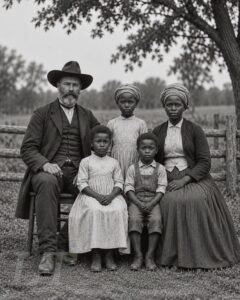
For six years, a wealthy coffee baron hid a second family from his wife. When she finally discovered his three children, she didn’t scream, demand a divorce, or expose him to society. Instead, she quietly invited him to dinner—and personally prepared his favorite coffee.
What happened afterward would destroy everything he had spent his life building.
In this fictional tale set against the troubled legacy of colonial Réunion Island, Baron Antoine Frédéric d’Albuquerque was one of the wealthiest plantation owners near Saint-Paul.
His magnificent Cedar Estate stretched across hundreds of hectares. His mansion was filled with imported French furniture, expensive paintings, and servants who attended to his every need.
But behind those beautiful walls, Antoine was hiding a secret.
He had three children with Marianne, a young Malagasy woman who had once been held in bondage.
And his wife, Baroness Claire Isabelle, knew nothing about them.
Until one afternoon in 1862.
The Secret That Changed Everything
Antoine and Claire had been married for sixteen years.
Their marriage had united two wealthy families, but affection had never followed.
Claire loved society, appearances, and the prestige of being a baroness.
Antoine preferred books, philosophy, and solitude.
Most painfully, they had never had children.
Then Antoine met Marianne.
She was intelligent, outspoken, and unafraid to challenge him.
When he once expressed sympathy for the suffering she had endured, Marianne confronted him with a question he couldn’t answer.
“How can you feel sorry for someone while claiming the right to own them?”
Her words haunted him.
Over time, Antoine began teaching Marianne to read. Their conversations grew increasingly personal, eventually becoming a secret relationship.
But Marianne understood something Antoine refused to confront.
Love could never be truly free when one person held power over another.
He promised to secure her independence.
Yet he repeatedly delayed fulfilling that promise.
When Marianne became pregnant, Antoine moved her into a secluded house in the hills.
Their first child, Thomas, was born in 1857.
Anne followed in 1860.
Then Joseph arrived in 1861.
Antoine visited every Tuesday and Friday, bringing gifts and spending precious hours with his children.
For the first time, he experienced the happiness of fatherhood.
But Marianne and the children remained hidden.
And Claire remained deceived.

The Servant Who Discovered Everything
One afternoon, Claire’s trusted servant, Paolo, followed Antoine into the hills.
He watched the baron enter a modest house.
Through a window, Paolo saw Marianne standing beside three children.
Then Antoine lifted the youngest boy into his arms and kissed his forehead.
The older children ran toward him, calling him Father.
Paolo immediately understood.
When he returned to Cedar Estate, he found Claire embroidering in her drawing room.
“Madam, your husband has another family.”
Her needle stopped.
“How many children?”
“Three, madam.”
“And their mother?”
Paolo hesitated.
“Marianne.”
For several seconds, Claire said nothing.
Then she carefully folded her embroidery.
“Does my husband know you followed him?”
“No, madam.”
“Good. He must never know.”
Paolo expected tears or fury.
Instead, Claire asked him to close the door.
What she said next would haunt him for the rest of his life.
A Wife’s Terrifying Revenge
Over the following weeks, Claire behaved as though nothing had happened.
She greeted Antoine politely.
She hosted elegant dinners.
She even began asking about his travels, smiling whenever he mentioned business in the hills.
But secretly, she was gathering information.
She learned the children’s names.
She discovered where Marianne lived.
And she began making plans.
One evening, she summoned Paolo.
“I want you to deliver a message to that woman.”
Paolo lowered his head.
“What message, madam?”
“Tell her the baroness knows everything. Tell her I wish to meet her privately.”
Marianne received the message with dread.
She feared Claire might harm her children or force Antoine to abandon them.
But when she arrived at Cedar Estate, the baroness surprised her.
Claire offered her tea.
Then she asked a single question.
“Does he love you?”
Marianne remained silent.
Claire leaned forward.
“Does he love those children?”
“Yes,” Marianne answered quietly.
Claire’s expression hardened.
“Then you have taken everything I was supposed to have.”
Marianne looked directly at her.
“I never took your husband, madam. He made his own choices.”
For a moment, neither woman spoke.
Then Marianne added something Claire had not expected.
“He promised me freedom. But he was always afraid I would leave.”
Claire stared at her.
For the first time, she understood that the woman she had imagined as her rival was also trapped by Antoine’s selfishness.
Yet understanding did not extinguish her anger.
It made her revenge more deliberate.
The Final Dinner
Three nights later, Claire arranged a private dinner.
She instructed the servants to leave after the main course.
Antoine was surprised by her unusual warmth.
They had barely spoken intimately in years.
Now Claire was smiling across the table, asking about his childhood and recalling their wedding.
When dessert arrived, she rose.
“I’ve prepared your coffee myself tonight.”
Antoine laughed.
“You haven’t made my coffee in sixteen years.”
“Perhaps I should have.”
She returned carrying two porcelain cups.
The familiar aroma filled the room.
Antoine took a sip.
Then another.
Claire watched him carefully.
“Tell me something, Antoine.”
“Anything.”
“Do you believe a man can love two families?”
His hand froze around the cup.
Claire continued.
“One family that gives him respectability. Another that gives him happiness.”
Antoine slowly placed the cup down.
“Claire…”
“Thomas. Anne. Joseph.”
His face drained of color.
She knew.
Every name.
Every secret visit.
Every lie.
“How long?” he whispered.
“Long enough.”
Antoine reached for her hand.
“I can explain.”
Claire pulled away.
“No. For once, you will listen.”
She told him about the humiliation of their childless marriage, the whispers she had endured, and the years she had spent believing herself inadequate.
Then she asked the question that finally broke him.
“Did you ever intend to tell me?”
Antoine couldn’t answer.
Suddenly, he began coughing.
His hand trembled.
The porcelain cup slipped from his fingers and shattered against the floor.
He looked toward Claire in horror.
“What have you done?”
She remained seated.
“I wanted you to understand what it feels like to have no control over your own future.”
Antoine collapsed beside the table.
But Claire had not prepared the ending he expected.
The Truth Behind the Coffee
As Antoine struggled to breathe, Paolo entered with a physician who had been waiting nearby.
Claire had secretly arranged for the doctor to come.
The coffee had been deliberately adulterated with an unknown substance, and the physician immediately began treating Antoine.
For hours, his condition remained uncertain.
By morning, he was alive.
But the life he had known was over.
Claire had already summoned a lawyer.
She demanded a legal separation and an independent settlement.
More importantly, she insisted that Antoine publicly acknowledge Marianne’s children and provide for their future.
Antoine initially resisted.
Recognition would damage his reputation and invite questions about his treatment of Marianne.
Claire placed a document before him.
“Sign it, or everyone will learn what happened in this house.”
With his health weakened and his secrets exposed, Antoine finally signed.
Marianne received independent financial support and control over the home where she lived with her children.
Thomas, Anne, and Joseph were formally acknowledged as Antoine’s children in the fictional family’s records.
Claire left Cedar Estate within a month.
She never returned.
The Last Cup
Years later, rumors still circulated about that terrible dinner.
Some claimed Claire had attempted murder.
Others believed she had only intended to frighten her husband.
Paolo never revealed everything he knew.
And Antoine refused to discuss the incident.
But Marianne remembered something more important than the rumors.
For years, Antoine had claimed to love her while denying her the freedom to choose her own future.
Only after his carefully constructed life collapsed did he finally relinquish that control.
The baron kept his fortune, but lost his marriage, his standing in society, and the illusion that wealth could protect him from consequences.
Claire gained her independence, though the choices she made that night remained morally troubling.
And Marianne, who had spent years hidden from the world, finally began building a life that belonged to her.
The most disturbing part of this story isn’t the poisoned coffee. It’s that a powerful man needed to lose control of everything before he would stop controlling the people he claimed to love.
What do you think: Was Claire seeking justice, or did her revenge make her just as cruel as the husband who betrayed her?