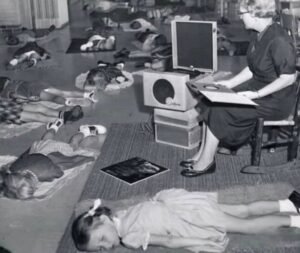
There was a moment in many kindergarten classrooms during the 1950s, ’60s, and early ’70s when the entire world seemed to slow down.
The songs were finished. The crayons had been put away. The last crumbs from morning snacks had disappeared, and the excitement of circle time gradually gave way to a softer, quieter atmosphere.
Then the teacher dimmed the lights.
A record player might begin turning, filling the room with gentle music or a familiar story. Small children stretched out on striped mats, colorful rugs, or little cots arranged across the classroom floor. Shoes were slipped off, blankets were pulled close, and the last whispers slowly faded.
For a little while, nobody had to answer a question, finish a worksheet, or prove they had learned something new.
It was naptime.
For generations of American children, this daily pause was a familiar part of early education. Not every kindergarten followed the same routine, and the practice varied depending on the school, the age of the children, and the length of the day. But for many who attended kindergarten during the middle decades of the twentieth century, the memory remains remarkably vivid.
They remember the mats, the soft music, the teacher’s quiet footsteps, and the strange mixture of comfort and impatience that came with being asked to rest in the middle of a busy day.
Some children fell asleep almost immediately. Others stared at the ceiling, watched sunlight move across the floor, or tried to remain perfectly still while wondering how much longer the quiet would last.
Looking back, many adults remember naptime as more than an opportunity to catch a few minutes of sleep.
It was a lesson in slowing down, sharing a peaceful space with others, and understanding that a day did not have to be filled with activity from beginning to end.
And in today’s increasingly structured world of early education, that simple ritual raises an important question: Have we forgotten how valuable a little quiet can be?
The Familiar Rhythm of a 1950s Kindergarten
Kindergarten in the 1950s often looked different from the classrooms many children experience today.
Teachers placed considerable emphasis on play, social interaction, songs, stories, movement, and activities that helped children become comfortable in a school environment. Children learned to share materials, follow simple routines, recognize letters and numbers, and work alongside classmates who might have very different personalities.
A typical morning could include singing familiar songs, drawing pictures, listening to a story, playing with blocks, or gathering together for circle time.
For children attending a longer kindergarten program, the day could also include a scheduled rest period.
The transition to naptime was often part of the routine itself. Children learned that certain activities came before others, and the teacher’s actions signaled that it was time to become quieter.
Mats were arranged. Blankets appeared. Lights were lowered, and the room gradually changed from a place of movement and conversation into a place of stillness.
That predictability mattered.
Young children often feel more comfortable when they know what comes next. A familiar sequence of activities can help them understand expectations and make the school day feel less overwhelming.
After a morning of new experiences, social interaction, and physical activity, the quiet period offered a different kind of environment.
There were no elaborate instructions to follow. Nobody needed to win a game or finish a drawing. For a little while, the goal was simply to settle down.
To adults remembering those years, it may seem like an ordinary detail from an old-fashioned classroom. But to a five-year-old learning how to navigate the world beyond home, a dependable daily rhythm could provide a welcome sense of security.
The Magic of the Little Sleeping Mats
Ask someone who remembers kindergarten naptime what comes to mind first, and the answer may have little to do with educational philosophy.
They might remember the mats.
Some recall thin, striped sleeping mats spread across a classroom floor. Others remember small cots, rugs, or blankets brought from home. The details varied, but the image of a room filled with resting children has become part of the collective memory of many generations.
There was something comforting about seeing the entire classroom transformed.
Desks and chairs that had been important during the morning seemed less significant. The teacher moved quietly between the resting places, making sure everyone had room. A child who had been full of energy minutes earlier might now be curled beneath a familiar blanket.
Even the sounds of the room seemed different.
The scrape of chairs gave way to soft footsteps. Conversations became whispers. Outside noises seemed farther away, while the faint hum of the building became easier to notice.
For some children, the environment made sleep almost irresistible.
They had spent the morning running, singing, drawing, and trying to keep up with everything happening around them. Once the stimulation disappeared, their bodies finally had an opportunity to relax.
Other children found the experience frustrating.
They were not tired, or they simply did not want to close their eyes. They might count ceiling tiles, inspect the patterns on their blankets, or watch dust drifting through a shaft of sunlight.
Yet even those children experienced something different from the usual rhythm of kindergarten.
They were being asked to slow down without needing to produce anything.
In a world where children were still learning what school expected of them, that was a distinctive experience.
Why Rest Matters in Early Childhood
Although the precise routines of historical kindergartens differed, the basic importance of sleep and adequate rest in early childhood is well established.
Young children are growing rapidly. Their brains are developing, their bodies are changing, and they are learning to manage emotions, attention, language, and relationships.
Sleep supports many of these processes.
Adequate sleep is associated with healthy development, learning, memory, and emotional regulation. When children do not get enough sleep, they may become irritable, have difficulty concentrating, or struggle to manage everyday frustrations.
However, the need for a scheduled daytime nap changes as children grow. Many preschool-aged children still benefit from naps, while many five- and six-year-olds gradually stop needing one as long as they receive sufficient nighttime sleep.
That distinction is important.
A quiet rest period can be helpful, but it does not mean every kindergarten child needs to sleep every afternoon. Children’s sleep needs vary, and a child who no longer naps should not automatically be considered less healthy or less capable of learning.
What matters is ensuring that children receive enough sleep and have appropriate opportunities to recover from the demands of their day.
For younger children, a calm period can be particularly valuable after an active morning. For older children who remain awake, quiet reading, listening to a story, or another peaceful activity may provide a reasonable alternative.
The lesson behind traditional naptime was not necessarily that every child must sleep at the same hour.
It was that children’s needs extend beyond academic instruction.
Learning requires attention, but attention is not unlimited. Children also need movement, play, social connection, and opportunities to relax.
A well-designed school day makes room for these different needs rather than treating every minute of quiet as wasted time.
The Teacher Who Protected the Quiet
In the old classroom memories, the teacher often occupies a special place.
During naptime, the teacher was no longer leading a song, demonstrating an activity, or explaining a lesson. Instead, the role became quieter and less visible.
A teacher might walk between the mats, speak softly to a restless child, or remind the class that everyone needed to respect one another’s resting time.
Sometimes a story or gentle music helped establish the atmosphere. Sometimes the room simply became quiet.
The teacher’s responsibility was not to force every child to fall asleep. It was to create a peaceful environment where children could rest without being disturbed.
That required patience.
One child might be exhausted and ready to sleep. Another might need a few minutes to settle down. A third might have difficulty lying still, especially after an exciting morning.
The teacher had to balance those differences while keeping the classroom calm.
For children who felt overwhelmed by noise or activity, the rest period could provide a rare sense of relief. For children who struggled with separation from their families, the predictable presence of a trusted teacher could help them feel safe.
The teacher’s quiet attention also reflected an important part of early childhood education: children are not simply miniature adults who need to be kept busy.
They are developing people who need guidance, reassurance, boundaries, and time to adjust.
Sometimes the most valuable thing a teacher can do is introduce a new idea. At other times, it is to create an environment where children can pause long enough to absorb everything that has happened.
Not Every Child Loved Naptime
Nostalgia can make the past seem simpler than it really was.
For every child who remembers falling asleep beneath a favorite blanket, there was probably another who considered naptime the longest part of the school day.
Some children were simply not sleepy. Others found lying still uncomfortable or disliked being separated from the activities happening around them.
A child might hear classmates breathing softly and wonder why everyone else seemed able to sleep. Another might feel restless, repeatedly adjusting a blanket or turning from one side to the other.
Teachers had to manage those differences, and expectations varied from one classroom to another.
The children who stayed awake still had to learn how to respect the quiet environment. They could not necessarily talk loudly, disturb their classmates, or turn the rest period into another game.
That expectation could be frustrating, but it also introduced a basic social skill: learning that other people sometimes need something different from what we need.
A child who did not feel sleepy could still learn to give classmates space. A child who wanted to keep playing could discover that the classroom had rhythms and boundaries.
Of course, teaching consideration does not require forcing children to remain motionless for unreasonable periods. A thoughtful rest routine recognizes individual differences and offers appropriate quiet alternatives.
The value of the experience lay in helping children learn how to coexist, not in making every child behave identically.
And for those who disliked naptime, the memory may still be entertaining decades later.
They might remember counting the minutes, watching the clock, or waiting impatiently for the teacher to announce that the class could get up.
Even the children who hated the ritual were participating in a shared part of classroom life.
When Kindergarten Began to Change
Over the second half of the twentieth century, expectations surrounding kindergarten gradually evolved.
The pace and timing of these changes varied across communities, but educational debates increasingly emphasized academic preparation, early literacy, numeracy, and readiness for later grades.
Kindergarten had long included opportunities to develop early academic skills. The shift was not that reading and numbers suddenly appeared in classrooms where they had never existed.
Rather, in many settings, the balance between play-based learning and more structured academic instruction changed.
As expectations increased, teachers faced pressure to fit more activities into the school day. Parents wanted children to be prepared for first grade, and schools increasingly paid attention to measurable learning outcomes.
In some classrooms, the day became more tightly scheduled.
Teachers had to make time for reading instruction, mathematics, group activities, assessment, and other requirements. Depending on the program, rest periods could be shortened, adapted, or removed.
The transition did not happen everywhere at once. Some kindergartens retained naps or quiet time, especially in full-day programs and settings serving younger children.
Others moved toward schedules that emphasized continuous activity and academic preparation.
The result was not a single national decision to abolish naptime. It was a gradual and uneven change in how schools organized the kindergarten experience.
For adults who remember the old routine, the contrast can feel dramatic.
They recall a school day that included an explicit invitation to rest. Today’s classrooms may look busier, with more learning stations, scheduled lessons, and planned transitions.
Yet the most important question is not whether one generation’s kindergarten was universally better than another’s.
It is whether schools provide a healthy balance between instruction, play, movement, social development, and rest.