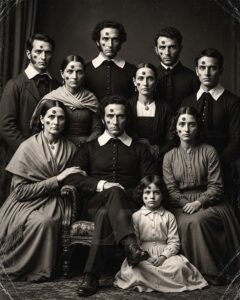
The Woman Who Was Never Supposed to Be Found
The iron lock clicked behind Isabel Soto, and the sound seemed to echo through every stone of the abandoned east wing. Somewhere beyond the heavy wooden door, the guards were walking away, their boots fading into the darkness. Isabel pressed her hands against the cold walls, desperately searching for another exit, but the room had only one narrow window, positioned too high for her to reach.
Then she heard something that made her blood run cold.
A woman was whispering in the corner.
“María… forgive me, María. I tried to save you.”
Isabel turned slowly. In the faint moonlight, she could make out a thin figure sitting on the floor, wrapped in a faded shawl. The woman’s silver hair fell across her face, and her fingers moved endlessly over a small wooden cross.
“Aunt Leonor?” Isabel whispered.
The woman stopped moving.
For a long moment, she stared at Isabel with an expression of disbelief. Then her gaze settled on the young girl’s exposed shoulder, where the reddish crescent birthmark glowed faintly against her skin.
Leonor’s face twisted with terror.
“No,” she whispered. “Not another one.”
She scrambled toward Isabel and seized her wrist.
“Tell me they haven’t arranged your marriage yet.”
Isabel could barely speak.
“They want me to marry Gabriel. My cousin.”
Leonor closed her eyes, and a single tear slipped down her cheek.
“Then we have very little time.”
The Marriage That Started the Curse
For seventeen years, Isabel had heard that Aunt Leonor was a disturbed woman who had lost her mind after a terrible disappointment in her youth. The family rarely spoke her name, and the servants were forbidden to approach the east wing.
But the woman sitting before her did not seem mad.
She seemed frightened.
Leonor explained that nearly thirty years earlier, she had fallen deeply in love with a young teacher named Tomás Herrera. He was intelligent, gentle, and poor, everything the powerful Soto family considered unsuitable.
They had planned to marry secretly.
But Leonor carried the same red crescent birthmark as Isabel, and her father had already promised her to a wealthy cousin.
When she refused the arrangement, Tomás disappeared.
For years, Leonor believed he had abandoned her. Then, while searching her father’s study, she discovered letters suggesting that Tomás had been detained by men employed on the estate.
“I never learned whether he lived or died,” Leonor said, her voice trembling. “But when I confronted my father, he told everyone I had become insane.”
Within days, she was imprisoned in the east wing.
The family physician signed a statement declaring her incapable of making decisions. Her inheritance was transferred to male relatives, and her existence was slowly erased from the household.
“They told everyone I was dangerous,” Leonor whispered. “But the only dangerous thing about me was that I knew the truth.”
Isabel felt a terrible realization forming.
Her aunt had not been hidden because she was ill.
She had been hidden because she refused to obey.
The Ledger Beneath the Floorboards
Leonor rose slowly and crossed the room toward an old wardrobe. She knelt, removed a loose wooden panel beneath it, and pulled out a leather-bound book covered in dust.
“Your great-grandfather kept this,” she said. “And every man who inherited this house added something to it.”
Isabel opened the ledger.
Its pages contained generations of names, marriage agreements, inheritance calculations, and handwritten notes concerning children born into the Soto family.
Some entries were ordinary.
Others were horrifying.
Beside several names were the words Unfit for inheritance, Removed from household, and Transferred to distant relatives.
Entire families had been reduced to financial calculations.
Children who were born with disabilities had disappeared from official family records. Women who resisted arranged marriages had been declared unstable. Young heirs who died unexpectedly had their shares quietly redistributed among surviving relatives.
Isabel counted twenty-three names she had never heard mentioned.
“Where are they?” she asked.
Leonor looked away.
“Some died. Some were sent away. And others simply vanished from everything the family was willing to acknowledge.”
Isabel stared at the pages until the writing blurred.
The Soto tradition had never truly been about protecting a sacred birthmark.
It had been about protecting money.
The red crescent was merely the symbol used to convince each generation that their suffering was necessary.
And behind the family’s beautiful chapel, magnificent gardens, and expensive portraits stood a system built on fear.
Her Mother’s Terrifying Confession
Shortly before sunrise, the locked door opened.
Doña Catalina entered carrying a candle and a small bundle of food. Her face was pale, and her hands trembled so violently that melted wax spilled onto the floor.
When she saw the ledger, she stopped breathing for a moment.
“Where did you find that?”
“Aunt Leonor showed me,” Isabel answered. “Mother, tell me the truth. Did you know?”
Catalina sank onto a chair.
For several seconds, she remained silent. Then she began to cry.
“I was eighteen when they married me to your father,” she whispered. “They told me I was fortunate. They said our matching marks meant God had chosen us.”
She looked at Isabel with unbearable sadness.
“I believed them because I was too young to understand that obedience and love were not the same thing.”
Catalina confessed that before Isabel was born, she had lost three infants. Each death had left her devastated, but Rodrigo refused to reconsider the family’s marriage customs.
Instead, he demanded that she produce another heir.
When Isabel was finally born healthy, Catalina believed her prayers had been answered.
Then the midwife noticed the red crescent on the baby’s shoulder.
“I knew that one day they would come for you too,” Catalina whispered.
Isabel knelt beside her mother.
“Why didn’t you tell me?”
“Because I thought keeping you ignorant would keep you safe.”
The room fell silent.
Then Catalina reached beneath her shawl and produced a small brass key.
“There is a passage behind the old chapel,” she said. “Your father believes it was sealed years ago. It wasn’t.”
Isabel stared at her.
“You’re helping me escape?”
Catalina shook her head.
“No, my daughter. This time, we’re leaving together.”

The Night Everything Changed
That evening, the Soto family gathered in the grand dining room to discuss Isabel’s wedding.
Don Rodrigo sat at the head of the table, while Gabriel and his father, Don Artemio, examined documents concerning the inheritance.
But when the doors opened, Isabel entered beside her mother and Aunt Leonor.
The room went silent.
Rodrigo stood so abruptly that his chair struck the marble floor.
“What is she doing here?”
Leonor looked directly at him.
“Something you should have allowed me to do thirty years ago. Walk through my own home.”
Isabel placed the ledger on the table.
Then she began reading.
She spoke the names of forgotten children, the inheritance transfers, and the women whose lives had been destroyed because they dared to resist.
Rodrigo’s face darkened.
“You understand nothing about what it takes to preserve a family!”
“I understand what it costs,” Isabel replied.
Gabriel slowly reached for the ledger.
As he turned the pages, his expression changed from confusion to disbelief.
“Father,” he whispered to Artemio, “did you know about this?”
Artemio refused to answer.
For the first time, Gabriel seemed to recognize that the fortune he had been promised was built on more than silver, land, and trade.
It was built on generations of people who had never been allowed to choose their own lives.
He closed the book.
“I will not marry Isabel.”
Rodrigo slammed his fist against the table.
“You will destroy everything our ancestors built!”
Gabriel looked at him coldly.
“Then perhaps it should have been destroyed long ago.”
The Fall of Los Cristales
Within weeks, the carefully guarded reputation of the Soto family began to unravel.
With the assistance of Father Sebastián and sympathetic legal advisers, Catalina and Leonor sought protection and challenged the family’s control over their property.
The ledger became evidence in disputes concerning inheritance, confinement, and financial misconduct.
Not every secret could be uncovered. Some witnesses were dead, some records had disappeared, and powerful families still possessed considerable influence in nineteenth-century Mexico.
But the silence surrounding Los Cristales had finally been broken.
Gabriel rejected the marriage arrangement and left to establish a life independent of his father’s fortune.
Catalina moved with Isabel to a modest house outside Puebla.
And Leonor, who had spent decades staring through a narrow window, stood beneath the open sky without guards watching her every movement.
She remained there for a long time, feeling the sunlight against her face.
Then she began to cry.
Isabel approached and gently took her hand.
“Are you afraid?”
Leonor smiled through her tears.
“No, child. For the first time in my life, I am not.”

The Red Crescent’s Final Secret
Years passed, and the great estate of Los Cristales slowly lost the power it had once held over the surrounding countryside.
Its beautiful halls remained, but the family name no longer inspired the same unquestioning admiration.
Isabel never returned.
She built a quieter life, far from the rigid traditions that had nearly destroyed her. She learned to make decisions without asking permission, to speak without lowering her eyes, and to understand that a person’s worth could never be measured by inheritance.
Yet one question continued to haunt her.
How many people before her had stood in front of a mirror, touched the same red crescent on their skin, and believed they had no choice?
How many women had surrendered their dreams?
How many children had been hidden?
How many lives had disappeared behind the walls of a house that the world considered magnificent?
One afternoon, years later, a little girl noticed the reddish mark on Isabel’s shoulder.
“Does that mean you’re special?” the child asked.
Isabel looked down at the crescent that had once seemed like a sentence written into her skin.
Then she smiled.
“No,” she answered gently. “It means I was born with a mark. Nothing more.”
The child nodded and ran back into the sunshine.
Isabel watched her go, remembering the frightened seventeen-year-old girl who had once believed she would never escape.
She finally understood something her ancestors never had.
The true curse of the Soto family had never been the red crescent birthmark. It was the belief that preserving wealth mattered more than preserving human dignity.
And the greatest inheritance Isabel ever received was not the fortune she had been promised.
It was the freedom to walk away from it.