The Phone Call That Made Dolly Parton’s Dream Come True
In the early 1970s, Dolly Parton was standing at a turning point in her career. She had spent years performing alongside Porter Wagoner, the country music star who helped introduce her to a national audience. Their partnership had brought success, recognition, and financial stability, but Dolly knew she needed to establish her own identity as an artist.
Leaving Wagoner’s television show was one of the most difficult decisions she had ever made.
Their professional relationship had become complicated, and Dolly understood that walking away meant risking the security she had worked so hard to achieve.
Rather than expressing her feelings through anger, she turned to songwriting.
The result was I Will Always Love You, a tender farewell that expressed gratitude, affection, and the painful realization that sometimes loving someone means knowing when to leave.
Released in 1974, the song quickly became a country hit.
Then came a telephone call Dolly would remember for the rest of her life.
Elvis Presley wanted to record it.
For Dolly, the news was almost impossible to believe. Elvis was not merely a successful entertainer. He was one of the most recognizable voices in the world, a performer whose music had influenced generations.
And now he wanted to sing words she had written.
She was thrilled.
But the excitement would not last.
The Demand That Broke Her Heart
According to Dolly’s own accounts, Elvis’s representatives contacted her about recording I Will Always Love You. She was delighted by the possibility and expected the session to move forward.
Then Elvis’s manager, Colonel Tom Parker, explained the condition.
Elvis’s team wanted half of the song’s publishing rights.
For an inexperienced songwriter, such a request might have seemed like an unavoidable price for working with the biggest star in music.
But Dolly understood something important.
Publishing rights represented more than immediate earnings. They were ownership of the composition itself, the foundation of a songwriter’s future income and creative independence.
Dolly had written I Will Always Love You from a deeply personal experience. Giving away half of its publishing would mean surrendering a substantial portion of something she had created.
She faced an agonizing choice.
Accept the demand and hear Elvis Presley record her song, or refuse and risk losing an opportunity she had dreamed about for years.
She chose to refuse.
In later interviews, Dolly recalled crying over the decision because she had wanted Elvis to sing the song so badly.
Yet she believed she could not surrender the publishing.
It was a decision that required extraordinary confidence from a young artist still building her career.
And at that moment, she could not possibly have imagined how valuable that decision would become.
The Recording That Never Happened
Elvis never released a recording of I Will Always Love You.
For Dolly, that remained a genuine disappointment.
She had admired Elvis since childhood, and hearing his interpretation of her music would have been a deeply meaningful experience.
His voice had the ability to transform a song into something unforgettable. He could move between tenderness and intensity with remarkable ease, and Dolly believed he would have brought something special to her composition.
But the negotiations did not produce an agreement.
The opportunity disappeared.
What makes this story particularly emotional is that Dolly’s refusal was not an act of hostility toward Elvis.
She did not reject him as a performer.
She rejected a business condition.
That distinction matters because it reveals the difficult position artists often face when negotiating with powerful figures in the entertainment industry.
A songwriter can admire a singer enormously while still recognizing that an unfavorable contract may have lasting consequences.
Dolly’s decision demonstrated that affection and professional judgment do not always lead in the same direction.
Sometimes protecting your work means saying no to someone you have admired your entire life.
The Las Vegas Moment That Became a Legend
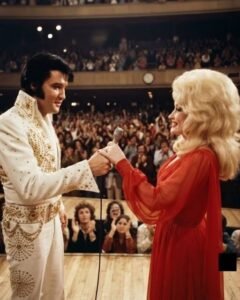
Over the years, emotional retellings of this story have described a dramatic reunion in Las Vegas, where Elvis supposedly invited Dolly onto the stage, challenged her before thousands of fans, and left in tears after an extraordinary exchange.
It is a compelling image.
Two legendary performers standing beneath the bright lights, confronting the disappointment of a song that was never recorded.
But there is an important distinction between the documented history and the dramatic legend.
There is no reliable evidence establishing that such an onstage confrontation occurred, or that Elvis publicly challenged Dolly about the publishing dispute in front of 2,000 people.
The confirmed story is powerful enough without inventing a reunion.
Dolly has repeatedly explained that she was heartbroken when the recording arrangement fell apart.
She also understood why preserving ownership mattered.
The conflict was not a public battle between two performers. It was a private business disagreement with consequences neither side could fully predict.
Elvis died in 1977, just three years after Dolly’s original recording became a hit.
He never had the opportunity to revisit the decision publicly in the way fictional accounts sometimes suggest.
Yet the connection between the two artists remained an important part of Dolly’s musical history.
And the song Elvis never recorded was about to achieve something almost unimaginable.

The Song That Found a Second Life
In 1982, Dolly recorded a new version of I Will Always Love You for the film The Best Little Whorehouse in Texas.
Once again, the song reached number one on the country chart.
That alone was remarkable.
Few compositions become major hits twice for the same artist, particularly when separated by years and changing musical trends.
But the greatest chapter of the song’s history was still waiting.
A decade later, Whitney Houston recorded I Will Always Love You for the 1992 film The Bodyguard.
Her interpretation transformed Dolly’s intimate country farewell into a soaring pop and soul ballad.
The opening was almost impossibly simple.
Whitney began singing without instrumental accompaniment, allowing the emotion of the lyrics to carry the moment.
Then the arrangement grew, building toward one of the most recognizable vocal performances in modern popular music.
The recording became an international sensation.
It spent fourteen weeks at number one on the Billboard Hot 100 and became one of the best-selling singles of all time.
For millions of listeners around the world, Whitney’s version became their first introduction to Dolly’s songwriting.
And because Dolly had retained her publishing rights, the song’s enormous success also brought her substantial financial rewards.
The decision that had once caused her so much heartbreak had become one of the most important business choices of her career.
Why Dolly Never Regretted Protecting Her Song
Dolly has spoken warmly about Elvis while also acknowledging the significance of refusing the publishing arrangement.
In retrospect, the financial implications were enormous.
Had she surrendered half of the publishing rights, her share of the composition’s future earnings would have been considerably smaller.
But the story is not simply about money.
It is about understanding the value of creative ownership before the rest of the world recognizes that value.
When Dolly wrote I Will Always Love You, she was expressing a personal goodbye. She could not have known that the song would later become a global anthem associated with love, loss, and remembrance.
She could not have predicted Whitney Houston’s extraordinary recording.
She could not have imagined the countless weddings, funerals, concerts, and emotional moments in which people would turn to her words.
What she did know was that the song belonged to her.
And she was unwilling to give away a major part of it merely to secure a prestigious recording.
That principle would become increasingly important as Dolly developed into one of the most successful singer-songwriters in American music.
Her career demonstrated that a performer could be generous, humble, and appreciative while remaining fiercely protective of the work she created.

The Beautiful Irony Elvis Never Lived to See
There is something deeply moving about the way this story unfolded.
Elvis Presley, one of the most influential singers in history, wanted to record a song by a young country artist who had grown up admiring him.
The recording never happened.
Dolly was devastated.
But she held firm.
Years later, another extraordinary voice carried that same composition around the world, introducing it to an audience far larger than Dolly could have imagined when she first wrote it.
Whitney Houston’s performance did not erase Dolly’s original recording.
Instead, it revealed how a truly exceptional song can transcend genre, generation, and interpretation.
Dolly’s tender country farewell and Whitney’s powerful ballad were different expressions of the same emotional truth.
Both were possible because a young songwriter had written something honest enough to endure.
And both remained connected to a decision she made long before anyone knew how valuable the composition would become.
The tragedy was not that Elvis and Dolly became enemies. They did not.
The sadness was that a beautiful artistic collaboration never came to life.
Yet the lesson that emerged from that disappointment was extraordinary.
Sometimes the opportunity that seems destined to change your life is not the opportunity you should accept.
Sometimes the greatest success comes from having the courage to walk away.
And sometimes the word that protects your future is the hardest word you will ever say.
Dolly Parton lost the chance to hear Elvis Presley sing her song. But by refusing to surrender her publishing rights, she preserved something far greater: ownership of a timeless piece of music that would eventually touch millions of hearts around the world.