The Summer Nights When New York’s Poor Had Nowhere Cool to Sleep
During the 1930s, New York City was a place of astonishing contrasts.
Its skyscrapers reached higher than ever before. Its theaters, department stores, and fashionable avenues displayed the wealth and ambition of modern America.
But only a short distance from the city’s grand buildings, countless working-class families lived in cramped tenement apartments.
On the Lower East Side, streets such as Norfolk Street were lined with brick buildings that housed generations of immigrants and laborers.
These were neighborhoods filled with life.
Children played on sidewalks.
Laundry hung between buildings.
Neighbors called to one another through open windows.
Families worked long hours and returned to apartments that offered shelter but often little comfort.
During winter, residents struggled with the cold.
During summer, the heat could become unbearable.
Brick walls absorbed sunlight throughout the day and released that warmth long after sunset. Small rooms with inadequate ventilation became stifling.
Families opened their windows, hoping to catch a breeze.
But sometimes there was no breeze.
The air simply refused to move.
A mother might lie awake listening to her children toss and turn.
A baby might cry because the room was too hot.
Older children might press themselves against an open window, searching for relief.
And parents faced the painful realization that the place meant to protect their family had become almost impossible to sleep in.
Air conditioning was not a practical option for most working-class households.
Electric fans existed, but many families could not afford them, especially during the economic hardship of the Great Depression.
So residents improvised.
They carried mattresses onto rooftops.
They slept on stoops.
Some moved their bedding onto narrow fire escapes, hoping the outdoor air would be cooler than the rooms inside.
It was an uncomfortable solution.
It could also be dangerous.
But for families with few alternatives, it sometimes seemed like the only way to get through another summer night.
And somewhere along Norfolk Street, a mother and her two children became part of that history.
Two Little Boys and a Mattress Above the Street
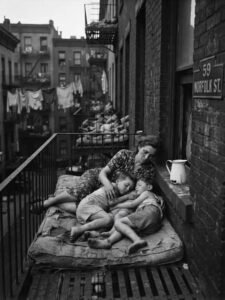
At first glance, the photograph appears simple.
A woman sits on a fire escape.
Two young boys rest against her.
A mattress lies beneath them.
Their feet are bare.
There are no expensive blankets or carefully arranged pillows.
No nursery.
No comfortable bed.
Only a narrow outdoor platform surrounded by the hard surfaces of the city.
Yet the children’s apparent peacefulness draws the viewer’s attention.
They are resting close to their mother.
Their bodies are relaxed.
The woman remains beside them, providing the familiar presence of someone they trust.
We cannot know whether they had been sleeping for minutes or hours.
We do not know whether they had spent previous nights on the fire escape.
We cannot know whether their mother was awake from worry, exhaustion, or simply because the heat made sleep difficult.
But the arrangement speaks to the reality of raising children under difficult circumstances.
Parents often had to create comfort wherever they could.
A mattress placed outside became a temporary bed.
A thin sheet became a covering.
A mother’s arms became a place where two children could settle after an exhausting day.
The fire escape itself was never intended for such a purpose.
Its iron platform was designed as an emergency route, not a sleeping area.
The railings and open height presented serious hazards, particularly for young children.
And bedding placed on a fire escape could obstruct evacuation during a fire.
The mother’s presence could not eliminate those dangers.
But she remained close.
That detail gives the photograph its emotional weight.
The children were not sleeping in a safe, comfortable bedroom.
They were sleeping in the best arrangement their family could manage that night.
And their mother was beside them.
The Great Depression Behind the Mother’s Tired Eyes
To understand the photograph, we must also understand the America in which it was taken.
The Great Depression transformed the lives of millions of families.
After the stock market crash of 1929, the American economy entered a prolonged collapse.
Banks failed.
Businesses closed.
Factories reduced production.
Millions of workers lost their jobs.
By 1933, roughly one-quarter of the country’s labor force was unemployed.
For families already living on modest wages, the crisis could be devastating.
Rent remained due even when employment disappeared.
Children still needed food.
Clothing wore out.
Illness still required attention.
And parents had to make difficult decisions about expenses that had once seemed ordinary.
In working-class New York neighborhoods, families relied on careful budgeting, community assistance, and whatever employment they could find.
Some women took in sewing or laundry.
Some families shared apartments with relatives to reduce costs.
Children sometimes wore clothes passed down from older siblings.
Meals were stretched to feed as many people as possible.
The mother in the photograph lived within that larger historical world.
We cannot assume that her family was unemployed or homeless.
We cannot know her household income or personal circumstances.
But we can recognize the economic pressures that shaped life for many families in Depression-era tenements.
The worn mattress, bare feet, and improvised sleeping arrangement invite questions about what comfort and security meant in such a setting.
Perhaps the family had very little money.
Perhaps their apartment was simply too hot to sleep in.
Perhaps both were true.
The photograph cannot provide every answer.
But it reminds us that poverty is not only visible in breadlines or makeshift shelters.
It can also appear in ordinary domestic moments.
In the absence of a comfortable bed.
In a parent’s struggle to keep children cool.
In the small compromises families make when they cannot afford better alternatives.
And in the quiet exhaustion of a mother who continues caring for her children after a difficult day.
The Invisible Work of a Mother Who Never Truly Rested
History often celebrates dramatic acts of courage.
Soldiers facing danger.
Workers confronting disaster.
Leaders making decisions that change nations.
But much of human endurance takes place far from public attention.
It happens inside homes.
At kitchen tables.
Beside sickbeds.
And sometimes on narrow fire escapes above crowded streets.
During the Depression, many mothers carried an enormous burden of responsibility.
They prepared meals from limited ingredients.
Repaired clothing that could not easily be replaced.
Cared for children in overcrowded apartments.
Managed household expenses with little or no financial security.
And tried to create a sense of stability when the wider world was uncertain.
Their work did not end when the sun went down.
A child might become ill during the night.
A baby might wake hungry.
An older child might be frightened by a thunderstorm or the noise of the city.
And during a summer heat wave, a mother might find herself searching for a cooler place where her children could rest.
The woman on the fire escape represents one such moment.
Her two boys appear to be sleeping.
She remains with them.
Perhaps she is watching the street below.
Perhaps she is listening to the neighborhood.
Perhaps she is simply resting her eyes while remaining close enough to respond if either child moves.
We cannot know.
But the image encourages us to recognize the ordinary labor of care.
The work of motherhood is not always visible in dramatic sacrifices.
Sometimes it is expressed through small, repeated actions.
Moving a child into the shade.
Saving the better portion of a meal.
Repairing a torn shirt.
Staying awake when everyone else is asleep.
And offering comfort even when the parent is uncomfortable too.
There is nothing glamorous about these acts.
They rarely appear in history books.
But they shape childhood.
For a young child, the world can feel enormous and unpredictable.
A familiar parent’s presence can make that world seem less frightening.
And on a hot summer night in Depression-era New York, two little boys found that familiar presence in the arms of their mother.
A Mother’s Arms Could Comfort Them, but They Could Not Erase Poverty
It is tempting to look at the photograph and say that the children had everything they needed because they had their mother’s love.
The sentiment is understandable.
Their closeness is moving.
Their trust is visible in the way they rest against her.
But the deeper truth is more complicated.
Love is essential.
Yet love cannot replace safe housing.
It cannot cool an overheated apartment.
It cannot eliminate the danger of sleeping on a fire escape.
It cannot guarantee enough food, reliable employment, or access to healthcare.
The mother may have been doing everything she could for her children.
That does not mean the family’s circumstances were acceptable.
This distinction matters when we remember the hardships of earlier generations.
We can admire the determination of parents who raised families under difficult conditions without romanticizing those conditions.
We can recognize the beauty of a mother’s care while acknowledging that her children deserved better.
They deserved a comfortable place to sleep.
They deserved protection from extreme temperatures.
They deserved a home where safety did not depend on balancing a mattress above the street.
And their mother deserved the chance to rest without worrying about the dangers surrounding them.
The photograph therefore tells two stories at once.
One is about love.
The other is about inequality.
The tenderness of the scene makes the hardship more visible, not less.
The mother’s arms may have offered emotional security.
But the iron fire escape reminds us how fragile the family’s physical security could be.
That contrast is what makes the image unforgettable.
The Lower East Side: Where Families Survived Together
The Lower East Side was more than a neighborhood of crowded apartments.
It was a place where generations of immigrants built communities, raised children, and pursued the possibility of better lives.
Jewish, Italian, Irish, and other families helped shape the area’s cultural identity.
Its streets were filled with small businesses, workshops, markets, religious institutions, and schools.
People lived close together.
Sometimes too close.
Privacy could be limited.
Noise traveled through open windows.
Families shared courtyards, stairways, and other common spaces.
But proximity also created opportunities for cooperation.
Neighbors exchanged news.
Children played together.
Families borrowed household items.
Community organizations and religious institutions offered assistance during difficult times.
On hot summer evenings, the neighborhood became a shared outdoor living space.
Residents gathered on stoops.
Conversations floated between windows.
Children played in the streets until darkness.
And when the heat became unbearable, some families moved their sleeping arrangements outside.
The mother and her two boys were part of that larger urban landscape.
Their fire escape was attached to a building filled with other lives.
Behind nearby windows, other parents may have been struggling to settle their children.
Other families may have been searching for a breeze.
Other residents may have been awake, listening to the sounds of the city.
The photograph captures one intimate moment.
But it also suggests the shared experience of an entire neighborhood.
A city is made of buildings, streets, and public spaces.
Yet its deepest history often belongs to the ordinary people who live within them.
Parents raising children.
Workers returning home after long days.
Neighbors helping one another.
Families finding small moments of comfort amid uncertainty.
These are the people whose lives give a city its meaning.
And their stories deserve to be remembered.
The Palace That Had No Walls
Nearly a century has passed since the photograph was taken.
The world has changed dramatically.
Air conditioning has transformed how Americans experience summer.
Modern housing standards have improved living conditions for many families.
Technology has brought conveniences that people in the 1930s could scarcely have imagined.
Yet the photograph still touches something deeply familiar.
A mother holds her children close.
They rest against her.
And for a brief moment, the noise and hardship of the surrounding city seem to fade into the background.
We do not know their names.
We do not know what became of the boys.
Perhaps they grew up and moved away from the Lower East Side.
Perhaps they remembered the hot summer nights of their childhood.
Perhaps their mother lived to see them build families of their own.
Or perhaps their lives took entirely different paths.
The photograph offers no answers.
But it preserves a moment of closeness that has survived long after the people themselves disappeared from public view.
And that is the extraordinary power of historical photography.
It allows us to encounter ordinary human experiences across generations.
The buildings may change.
The clothing may look unfamiliar.
The streets may belong to another era.
But the need for love, safety, and reassurance remains recognizable.
The boys in the photograph did not need to understand the Great Depression.
They did not need to know why their apartment was so hot.
They did not need to comprehend the economic forces shaping their family’s life.
They were children.
They needed rest.
They needed comfort.
And they needed someone they trusted.
Their mother was there.
That does not mean poverty disappeared.
It does not mean discomfort no longer mattered.
But it means that even within difficult circumstances, a moment of tenderness could exist.
The mother could not give her children a palace. She could not offer them a cool bedroom or a comfortable mattress. But she could hold them close, and for that moment, her presence offered a kind of peace that no photograph could fully explain.
The iron beneath them was hard.
The summer air was heavy.
The city around them was crowded and restless.
Yet the boys slept.
And their mother remained beside them.
Perhaps that is what makes the image so moving.
Not that love conquered every hardship.
But that love continued to exist in the middle of hardship.
A mother’s lap was not a substitute for a safe home. But to two tired little boys on a hot New York night, it may have felt like the safest place in the world.
The Great Depression left behind countless photographs of hunger, unemployment, and suffering.
This one reminds us of something else.
Even during the hardest years, parents still held their children.
Children still sought comfort.
Families still found moments of tenderness.
And ordinary love continued to shape lives that history would otherwise forget.
No golden walls. No silk sheets. No grand bedroom. Just a mother, two sleeping boys, and a narrow fire escape above the streets of New York.
It was not a palace.
But in that moment, it held something precious.
A mother’s embrace.
And two children resting within it.