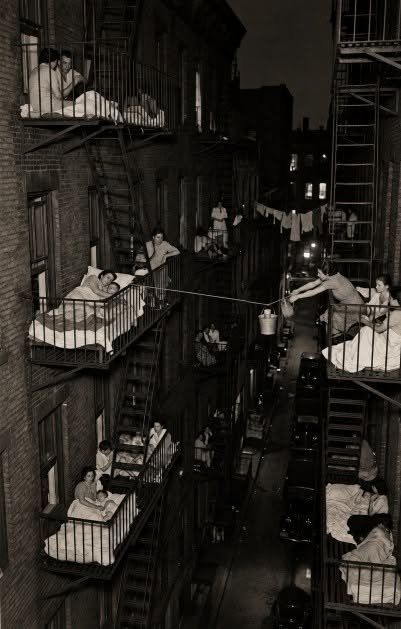
The Summer Nights When New York’s Homes Became Ovens
Long before air conditioning transformed American life, summer in New York City could be an exhausting test of endurance.
During the 1930s, many working-class families lived in crowded tenement buildings on the Lower East Side. These brick structures had been built to accommodate generations of immigrants and laborers who arrived in the city searching for opportunity.
For some families, New York represented the promise of a better future.
For others, it was a place where hard work barely covered the rent.
The apartments were often small, with limited ventilation and little protection from extreme temperatures.
During the day, sunlight heated the brick walls and rooftops. At night, the buildings released that stored warmth into rooms already crowded with furniture and people.
Opening a window did not always help.
The air outside could be almost as hot as the air indoors.
For families living in upper-floor apartments, the heat could become particularly uncomfortable.
Children struggled to sleep.
Babies cried.
Parents lay awake, listening to the sounds of a neighborhood that never seemed to cool down.
Electric fans existed, but they were not available to every household. Air conditioning remained far beyond the reach of most working-class families.
And in the middle of the Great Depression, even modest household expenses required careful consideration.
For some residents, the solution was simple, uncomfortable, and dangerous.
They moved outside.
Mattresses were dragged through windows.
Pillows were carried onto balconies.
Blankets were spread across rooftops and fire escapes.
The narrow iron structures originally intended for emergency evacuation became temporary sleeping places.
The city had not provided these families with comfortable summer bedrooms.
So they improvised.
And on particularly hot nights, entire buildings appeared to spill their private lives into the open air.
A City Where Bedrooms Hung Above the Street
Imagine standing in a narrow Lower East Side street on a summer evening in 1938.
Above you rise several stories of brick buildings.
Iron fire escapes climb their walls, forming a complicated network of platforms, railings, and ladders.
Laundry hangs between windows.
Lights glow from apartments.
Automobiles are parked along the curb.
The neighborhood is filled with familiar sounds: distant conversations, footsteps, children calling to one another, and the occasional rumble of a passing vehicle.
But tonight, something unusual is happening.
The fire escapes are crowded with people.
On one platform, a couple lies beside an open window.
On another, a mother settles a child beneath a thin sheet.
Elsewhere, neighbors sit talking while they wait for the air to cool.
Mattresses occupy spaces barely wide enough to hold them.
Some people stretch out on blankets.
Others remain seated, hoping that the breeze will become strong enough to make sleeping possible.
This was not a romantic adventure beneath the stars.
It was a response to uncomfortable and sometimes dangerous living conditions.
Fire escapes were never intended to serve as bedrooms.
Their narrow platforms and exposed heights presented serious risks, particularly for children.
Bedding could also obstruct emergency exits.
Yet families sometimes accepted those dangers because their apartments offered so little relief.
For parents, the decision must often have been difficult.
Inside, the children were miserable from the heat.
Outside, there was at least the possibility of moving air.
But the fire escape was high above the street.
Every movement required care.
A parent might spend the night only half asleep, aware of the children resting nearby.
The image of families sleeping outdoors may appear charming from a modern distance.
But for the people living through it, the experience was shaped by necessity.
Their improvised bedrooms reveal how much daily life depended on finding practical solutions to problems that wealthier households could more easily avoid.
The Woman With the Bucket: A Small Gesture in a Crowded World
At the center of the described photograph is a detail that transforms the scene.
A woman appears to be lowering a bucket on a rope toward someone nearby.
We do not know what the bucket contained.
Perhaps it held water.
Perhaps someone was passing an item between households.
Perhaps it was part of an ordinary domestic task.
Without more information, its purpose remains uncertain.
But the gesture draws attention to an important feature of tenement life: the close physical relationship between neighboring households.
In crowded buildings, people often lived within hearing distance of one another.
They could exchange greetings through windows.
They could call across narrow courtyards.
They could see laundry drying on neighboring lines and recognize the routines of families living only a few feet away.
This closeness did not always produce harmony.
Crowded housing could create disputes over noise, privacy, sanitation, and shared facilities.
But it also created opportunities for cooperation.
A neighbor might lend a household utensil.
Someone might watch a child while a parent ran an errand.
Families could exchange food, information about employment, or advice about local assistance.
During the Great Depression, such informal networks could become especially valuable.
When money was scarce, relationships sometimes provided forms of support that could not easily be purchased.
A borrowed pot.
A shared meal.
A few hours of childcare.
A warning about a broken stairway.
Or simply someone willing to listen when the day had been difficult.
The bucket in the photograph does not prove a particular act of generosity.
But it encourages us to consider how daily life unfolded across the narrow spaces separating these apartments.
What looks like a collection of isolated windows was also a neighborhood filled with relationships.
People were living beside one another through the same heat, the same economic uncertainty, and many of the same daily challenges.
And even small exchanges could help make those challenges more manageable.
The Great Depression Behind the Open Windows
The summer heat was only one part of the hardship facing New York families in the late 1930s.
The Great Depression had disrupted the American economy for nearly a decade.
Millions of workers had lost jobs.
Families had exhausted savings.
Some businesses had closed permanently.
And the financial uncertainty continued to affect households even as government relief and employment programs expanded.
For families on the Lower East Side, the consequences were deeply personal.
Rent had to be paid.
Children needed clothing.
Food had to be purchased or obtained through assistance.
Medical expenses could create serious financial strain.
A parent who lost steady employment might spend days searching for work while another adult tried to keep the household running with very little money.
Many residents relied on community institutions, charitable organizations, public relief, or informal assistance from relatives and neighbors.
The city was not simply a place where people lived close together.
It was a place where economic survival often required cooperation.
Families learned to stretch meals.
Clothing was repaired repeatedly.
Household items were reused until they could no longer function.
Children grew accustomed to making entertainment from inexpensive or discarded objects.
In this environment, even a comfortable night’s sleep could become something people could not take for granted.
An overcrowded apartment might be the only housing a family could afford.
A mattress on a fire escape might be the closest thing to relief from a sweltering room.
And a small exchange between neighbors could represent the practical cooperation that helped communities endure.
The photograph therefore captures more than a summer night.
It offers a glimpse into the ways economic hardship shaped ordinary domestic life.
The families did not stop being families because money was scarce.
They still needed to eat, sleep, raise children, and maintain relationships.
They still experienced humor, affection, frustration, and hope.
And they continued finding ways to live within the limits imposed by their circumstances.
The Mothers Who Turned Dangerous Places Into Temporary Bedrooms
Among the most emotionally powerful figures in photographs of tenement life are mothers caring for children.
A woman settling a baby on a fire escape may appear to be performing an ordinary bedtime routine.
But the setting changes everything.
There is no comfortable nursery.
No reliable cooling system.
No protected bedroom separated from the street.
Instead, the mother must manage a restless child in a narrow outdoor space.
The child may be exhausted from the heat.
The mother may be equally tired.
Yet her responsibilities continue.
She must keep the child close.
Make sure the bedding is arranged safely.
Watch for movement near the edge.
And hope that the night air will finally bring enough relief for everyone to sleep.
Such scenes reveal the enormous amount of invisible labor involved in raising children under difficult conditions.
Mothers during the Depression often carried responsibilities that extended far beyond the home.
Some worked for wages.
Others took in laundry, sewing, or other tasks to supplement household income.
Many managed large families in cramped apartments with limited resources.
They prepared meals, repaired clothing, cared for sick children, and tried to preserve a sense of stability when the wider world seemed uncertain.
Their work rarely attracted public attention.
But it was essential.
The photograph’s mothers and children remind us that historical events are experienced differently depending on a person’s responsibilities.
For a child, the fire escape might have felt like an unusual place to sleep.
For a parent, it may have been another difficult decision made in an effort to provide comfort.
The same scene could contain a child’s curiosity and a mother’s anxiety.
That contrast makes the image especially moving.
It also reminds us not to romanticize hardship.
A parent’s devotion could make a dangerous situation less frightening for a child.
But it could not make the situation safe.
The families needed better housing, improved ventilation, and reliable protection from extreme heat.
Their resourcefulness deserves respect.
Their lack of alternatives deserves equal attention.
The Neighborhood That Became One Enormous Living Room
The Lower East Side was shaped by generations of immigrant families who brought their traditions, languages, and hopes to New York.
Jewish, Italian, Irish, and other communities helped create a neighborhood known for its cultural diversity and dense social life.
Its streets were filled with shops, markets, places of worship, workshops, and apartment buildings.
Many residents worked long hours in factories, garment shops, small businesses, and other occupations.
Their homes were often crowded, but their communities could be rich in social connections.
On warm evenings, families gathered on stoops.
Neighbors exchanged news.
Children played in the streets.
Conversations drifted from open windows.
People knew which households had new babies, which neighbors were looking for work, and who might need help.
This closeness could be both comforting and exhausting.
Privacy was difficult to maintain.
Noise traveled easily.
Disagreements were inevitable.
Yet the neighborhood’s shared spaces helped create a sense of belonging.
When summer heat drove residents onto fire escapes, the buildings became an extension of that communal life.
The separation between indoors and outdoors blurred.
Bedrooms became visible.
Conversations crossed the alley.
People who might otherwise have remained behind closed doors found themselves spending the night within sight of their neighbors.
The city became a kind of shared household.
Not because everyone was equally comfortable.
Not because poverty had disappeared.
But because the conditions of urban life brought people into constant contact.
The described photograph captures that unusual combination of intimacy and exposure.
Families are engaged in deeply private activities—resting, caring for children, preparing for sleep—while surrounded by an entire neighborhood.
There is something striking about that shared vulnerability.
Everyone is trying to escape the same heat.
Everyone is hoping for a cooler night.
And for a few hours, the iron platforms connecting the buildings become part of a larger human landscape.
Before Air Conditioning Changed the American Summer
The spread of air conditioning eventually transformed how Americans experienced summer.
It changed architecture, workplaces, shopping centers, hospitals, and private homes.
It made many indoor environments more comfortable and helped reduce exposure to dangerous heat when systems were accessible and functioning.
But in the 1930s, most working-class households had to rely on simpler methods.
Open windows.
Shaded rooms.
Porches.
Handheld fans.
Public parks.
And, sometimes, outdoor sleeping spaces.
People adapted their routines around the temperature.
Activities could shift toward cooler hours.
Families sought shade whenever possible.
Children played outside after sunset.
Neighbors gathered outdoors because their apartments remained uncomfortable.
These habits became part of urban summer culture.
Yet the photograph also reminds us that nostalgia can hide important realities.
Sleeping on a fire escape may look picturesque in an old black-and-white image.
But the practice could be dangerous.
A crowded apartment without adequate ventilation could create serious health risks during extreme heat.
And families with little money had fewer choices about where to live or how to protect themselves.
Modern conveniences have improved daily life for many people.
But access to safe housing and cooling remains uneven, and heat continues to pose serious risks.
The history of tenement summers is therefore more than a charming glimpse of old New York.
It is a reminder that comfort, safety, and health are closely connected to economic opportunity.
The Most Beautiful Thing in the Photograph Is What Money Could Not Buy
Nearly ninety years have passed since the summer of 1938.
The Lower East Side has changed enormously.
Many old buildings have been renovated.
Neighborhood businesses have come and gone.
Generations of families have moved elsewhere, while new residents have brought different traditions and stories.
Air conditioning has become common in much of American life.
The sight of entire tenement buildings filled with people sleeping on fire escapes now belongs largely to the historical record.
But the photograph continues to speak to modern audiences.
At first, we notice the unusual sleeping arrangements.
Mattresses balanced on narrow iron platforms.
Pillows beside open windows.
Families resting above the street.
Then we notice the people.
A mother with her baby.
Couples trying to sleep.
Neighbors close enough to exchange words across an alley.
And a woman lowering a bucket on a rope.
That small gesture may be the most memorable detail.
Not because we know exactly what was inside the bucket.
We do not.
But because it draws our attention to the relationships that existed within these crowded buildings.
People were not simply enduring the heat as isolated individuals.
They were living among neighbors whose daily struggles often resembled their own.
Sometimes those relationships offered practical assistance.
Sometimes they provided companionship.
And sometimes they simply reminded people that they were not alone.
There is a powerful lesson in that.
Modern life has given many of us conveniences that earlier generations could scarcely imagine.
We can cool a room with the press of a button.
We can communicate instantly with people across the world.
We can enjoy privacy and comfort that were unavailable to many working-class families in the 1930s.
Yet technology cannot replace every form of human connection.
A comfortable apartment does not automatically create a supportive neighborhood.
A modern building does not guarantee that its residents know one another.
And convenience, valuable as it is, cannot substitute for the kindness of someone willing to help when life becomes difficult.
The people in the photograph did not possess the comforts many Americans enjoy today.
But they inhabited a world in which daily life frequently brought neighbors into direct contact.
That closeness was not always easy.
Still, it created opportunities for small acts of care.
The most moving part of this old New York scene is not that people learned to sleep on fire escapes. It is that, even in the heat and hardship of the Great Depression, the ordinary relationships between neighbors continued.
The city did not become cooler because families moved outside.
The Depression did not disappear.
The apartments remained crowded.
And the dangers of sleeping high above the street were real.
But people kept looking for ways to get through another night.
A parent settled a child.
A couple shared a mattress.
A neighbor lowered a bucket.
And an entire building continued the ordinary business of living under extraordinary conditions.
Comfort may have been scarce in those summer nights of old New York. But the need for community was as familiar then as it is today.
Perhaps that is why the image still matters.
It reminds us that history is not only made by famous people and dramatic events.
Sometimes it is preserved in the quiet exchanges between ordinary neighbors.
A window left open.
A mattress carried outside.
A child finally falling asleep.
A bucket passing through the darkness.
And somewhere above a narrow New York street, people doing what human beings have always done when life becomes difficult.
Finding a way to get through it together.