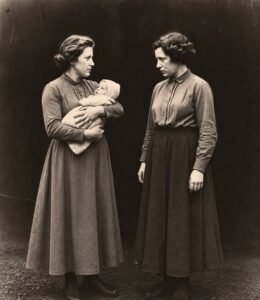
The Morning Their Childhood Ended
June 1942.
The village of Saint-Rémy-sur-Loire was still asleep when the military truck stopped outside the Durock family home.
Inside, seventeen-year-old Mélis Durock was helping her mother prepare bread.
Her older sister Aurore, nineteen, sat beside the window reading a schoolbook. She dreamed of becoming a teacher when the war ended.
Séverine, twenty-one, was finishing the delicate embroidery on a wedding dress for a neighbor.
The three sisters had spent their entire lives together.
They shared a bedroom, borrowed each other’s clothes, and made promises about the future.
They believed that if they stayed close to home and avoided trouble, the war might somehow pass them by.
They were wrong.
Shortly after sunrise, someone pounded on the front door.
Their father opened it.
Three German soldiers stood outside.
Behind them was a military officer holding a folder.
He examined the names on a document.
“Mélis Durock. Aurore Durock. Séverine Durock.”
Their mother stepped forward.
“What do you want with my daughters?”
The officer did not answer.
He simply ordered the sisters to gather their belongings.
Their father protested.
One soldier shoved him against the wall.
Mélis remembered her mother’s scream more clearly than anything else.
Then the sisters were pushed outside.
The morning sun was rising over the vineyards.
Mélis turned for one last glimpse of the house.
Her mother stood in the doorway, crying.
Her father held the doorframe to remain standing.
And then the truck began moving.
The Place Where Names Disappeared
The journey lasted several hours.
Inside the covered truck were other young women.
Some cried quietly.
Others stared at the floor.
Nobody knew where they were going.
Eventually, the vehicle stopped outside a large stone building surrounded by fences and guarded gates.
It had once been a country estate.
Now it served as a detention facility under German military control.
The women were ordered into a courtyard.
Their belongings were searched.
Their names were recorded.
Then they were assigned numbers.
Mélis became Prisoner 47.
Aurore was 48.
Séverine was 49.
The sisters were placed in a room with twelve other women.
There were narrow wooden beds, thin blankets, and a single window covered by iron bars.
That evening, Séverine held her younger sisters close.
“Whatever happens,” she whispered, “we stay together.”
Mélis nodded.
Aurore reached for their hands.
They made the promise three times.
None of them understood how difficult keeping it would become.
The Officer Who Controlled Their Fate
The detention facility was supervised by a fictional German officer named General Friedrich von Keller.
He was a man accustomed to obedience.
His uniform was immaculate.
His boots were polished.
His office contained expensive furniture, framed military photographs, and shelves of books taken from abandoned homes.
He rarely raised his voice.
He did not need to.
Everyone in the building understood the power he held over their lives.
Within days, he noticed the Durock sisters.
Aurore had been educated.
Séverine possessed exceptional sewing skills.
Mélis spoke enough German to understand simple instructions, having learned the language from an elderly schoolteacher.
The officer ordered all three transferred to domestic work inside the main building.
At first, they believed this might offer better conditions.
They were given clean clothing.
Their meals improved.
They were no longer required to perform the harshest outdoor labor.
But the apparent privileges came with a terrible price.
The officer began summoning them individually to his private quarters.
They had no meaningful ability to refuse.
He controlled their food, confinement, punishment, and access to the outside world.
What happened behind those doors was abuse of power and sexual violence, not a relationship or an act of affection.
And the sisters soon realized that their greatest danger was not only imprisonment.
It was the man who decided what would happen to them each day.
The First Sister to Discover the Truth
By the autumn of 1942, Aurore had begun feeling ill.
She struggled to eat.
Her strength faded.
One morning, she collapsed while cleaning a corridor.
A nurse examined her.
Several days later, the nurse delivered news that left Aurore speechless.
She was pregnant.
Aurore sat motionless on the edge of her bed.
For hours, she could not speak.
When Mélis finally found her, she was staring at the wall.
“What happened?” Mélis asked.
Aurore looked at her younger sister.
Then she began to cry.
Mélis held her.
Neither spoke about the officer.
They did not need to.
Within weeks, Séverine also learned she was pregnant.
And before winter ended, Mélis discovered that she, too, was carrying a child.
Three sisters.
Three pregnancies.
One officer who had used his position to violate women under his control.
The news spread quietly through the detention facility.
Some prisoners responded with sympathy.
Others were too frightened to speak.
The sisters themselves struggled with emotions they could barely understand.
They feared childbirth.
They feared separation.
They feared what the officer might do to their babies.
But above all, they feared that their children would be punished for the circumstances of their conception.
A Promise Made in the Dark
One freezing December night, the sisters sat together beneath a thin blanket.
Outside, snow covered the courtyard.
Aurore rested her hand on her stomach.
Séverine stared at the floor.
Mélis was trembling.
“I don’t know if I can love this baby,” Mélis whispered.
The words hung in the darkness.
Aurore looked at her.
“You don’t have to know tonight.”
Mélis began crying.
“What if I look at the child and remember him?”
Séverine took her hand.
“Then we’ll help you remember that the child is not the man.”
For a long time, nobody spoke.
Finally, Aurore said something that would become the foundation of their survival.
“We cannot control what he has done. But if our children live, we will not let him decide who they become.”
The three sisters held hands.
They had no guarantee that they would survive the war.
No certainty that their babies would remain with them.
But they made a promise.
If even one of them survived, she would try to protect the children of the others.
The Births Behind Locked Doors
Aurore went into labor first.
It was the spring of 1943.
The facility’s medical room was poorly equipped.
There were few supplies and little concern for the comfort of imprisoned women.
After hours of labor, Aurore gave birth to a girl.
She named her Claire.
When the nurse placed the baby in her arms, Aurore began to weep.
She had feared that seeing her daughter would awaken only memories of the officer.
Instead, she saw a tiny face, closed eyes, and a hand that curled around her finger.
Claire was innocent.
That truth did not erase what Aurore had suffered.
But it allowed her to recognize her daughter as a person separate from the violence.
Several weeks later, Séverine gave birth to a boy.
She named him Luc.
Mélis delivered her daughter, Elise, near the beginning of summer.
For a brief period, the three sisters shared something resembling happiness.
They cared for their babies together.
They sang songs their mother had taught them.
They whispered stories about vineyards, wheat fields, and the home they hoped to see again.
The children slept beside one another in a small wooden cradle.
But their fragile peace did not last.
The Order That Threatened Everything
One morning, the officer summoned the sisters.
He informed them that the children would be removed from the facility.
No explanation was offered.
No destination was given.
The sisters were told that the decision was final.
Aurore begged to keep Claire.
Séverine fell to her knees.
Mélis held Elise so tightly that the baby began crying.
The officer remained unmoved.
The children, he said, would be placed elsewhere.
That night, the sisters understood that the promise they had made months earlier might be impossible to keep.
They could survive hunger.
They could endure imprisonment.
But losing their children without knowing whether they were alive was almost unbearable.
Aurore began planning.
She had quietly developed a friendship with a French woman named Madeleine, who worked in the facility’s laundry.
Madeleine had access to transport schedules and occasionally carried messages between prisoners.
Aurore told her everything.
The pregnancies.
The threatened separation.
The officer’s control over the women.
Madeleine listened without interrupting.
Then she said:
“I may know someone who can help.”
The Woman Who Risked Everything
Madeleine had secretly assisted a local resistance network.
Her work was dangerous.
If discovered, she could be arrested, tortured, or killed.
But she understood what was at stake.
Over several days, she arranged contact with a sympathetic driver who delivered supplies to the detention facility.
The plan was simple but extremely risky.
During an upcoming transfer, the children would be concealed among laundry bundles and taken to a safe location.
The sisters could not escape at the same time.
There were too many guards.
Too many locked doors.
And too many opportunities for the plan to fail.
Aurore was devastated.
“How can we send them away without us?”
Madeleine answered quietly.
“Because keeping them here may mean losing them forever.”
The sisters spent their final night with the babies holding them close.
Mélis memorized the shape of Elise’s face.
Séverine kissed Luc’s tiny hands.
Aurore whispered Claire’s name again and again.
At dawn, they wrapped the children in clean blankets.
Madeleine arrived with a laundry cart.
One by one, the babies were placed inside carefully prepared compartments.
The sisters stood silently as the cart disappeared down the corridor.
Mélis wanted to scream.
Instead, she pressed her fist against her mouth.
The door closed.
And their children were gone.
The Long Silence
Days passed.
Then weeks.
No news arrived.
The sisters did not know whether the driver had reached the safe house.
They did not know whether the children had been discovered.
They did not even know whether Madeleine was still alive.
Eventually, the officer learned that the babies were missing.
He questioned the sisters.
They refused to reveal anything.
Punishments followed.
Their privileges disappeared.
They were transferred back to harsher conditions.
Yet none of them betrayed Madeleine.
In early 1944, Séverine became seriously ill.
Years of deprivation had weakened her body.
Despite Aurore’s efforts to care for her, her condition deteriorated.
One night, she asked Mélis to sit beside her.
“If you ever find Luc,” she whispered, “tell him I wanted him.”
Mélis began crying.
“You’ll tell him yourself.”
Séverine shook her head.
“Promise me.”
Mélis took her sister’s hand.
“I promise.”
Séverine died several days later.
She was twenty-three.
The sisters had entered captivity as three.
Now only two remained.
Liberation Did Not Bring Every Answer
As Allied forces advanced through France in 1944, German control over many occupied areas collapsed.
The detention facility was eventually abandoned during the retreat.
Aurore and Mélis survived.
But liberation did not immediately restore their lives.
They were exhausted.
Malnourished.
And deeply traumatized.
Their parents’ fate was uncertain.
Their home had been damaged during the war.
And their children were missing.
For months, the sisters searched.
They visited relief organizations.
They questioned former prisoners.
They contacted charitable groups caring for displaced children.
They wrote letters to anyone who might have information.
Most inquiries led nowhere.
Sometimes they received reports of children matching the babies’ descriptions.
Each time, hope returned.
And each time, disappointment followed.
Aurore struggled with guilt.
Had sending the children away saved them?
Or had she unknowingly placed them in greater danger?
Mélis carried the same question.
They had survived the officer.
They had survived imprisonment.
But they did not know whether their daughters and nephew had survived the war.
The Letter That Arrived Years Later
In 1951, seven years after liberation, Aurore received a letter from a woman living in southern France.
The sender was Madeleine.
She was alive.
And she had been searching for the sisters.
The letter contained news they had scarcely dared imagine.
The three babies had successfully escaped the detention facility.
They had been taken to a family connected with the resistance network.
As the war intensified, the children were moved several times for safety.
Eventually, they were placed with separate families.
Their identities had been changed to protect them.
Madeleine had lost contact with them during the final months of the occupation.
But after years of searching, she had found records that might lead to their whereabouts.
Aurore read the letter three times.
Then she handed it to Mélis.
For the first time in years, the sisters allowed themselves to believe their children might still be alive.
Three Children, Three Different Lives
The search took nearly two more years.
Claire was located first.
She had been raised by a couple in the countryside.
Her adoptive parents had told her that her birth mother had disappeared during the war.
When Aurore finally met her, Claire was ten years old.
The girl stood shyly beside her adoptive mother.
Aurore wanted to run toward her.
Instead, she knelt down.
“My name is Aurore,” she said gently.
Claire studied her face.
“Are you my mother?”
Aurore’s eyes filled with tears.
“Yes.”
The reunion was not simple.
Claire loved the family who had raised her.
Aurore understood that motherhood could not be restored in a single afternoon.
But slowly, they began building a relationship.
Luc was found several months later.
He had grown into a quiet, curious boy who loved drawing.
When Mélis met him, she brought a photograph of Séverine taken before the war.
She told him about his mother’s embroidery.
Her kindness.
Her dreams.
And the promise she had made before dying.
Luc listened without speaking.
Then he asked:
“Did she love me?”
Mélis held his hand.
“More than you could ever know.”
Elise was the last child located.
She had been living with a family near Lyon.
When Mélis saw her daughter, she recognized her immediately.
Not because Elise resembled the officer.
But because of a familiar expression around her eyes.
For several seconds, Mélis could not move.
Then Elise smiled.
And Mélis began to cry.