When the World Closed Its Doors, One Man Opened His Heart
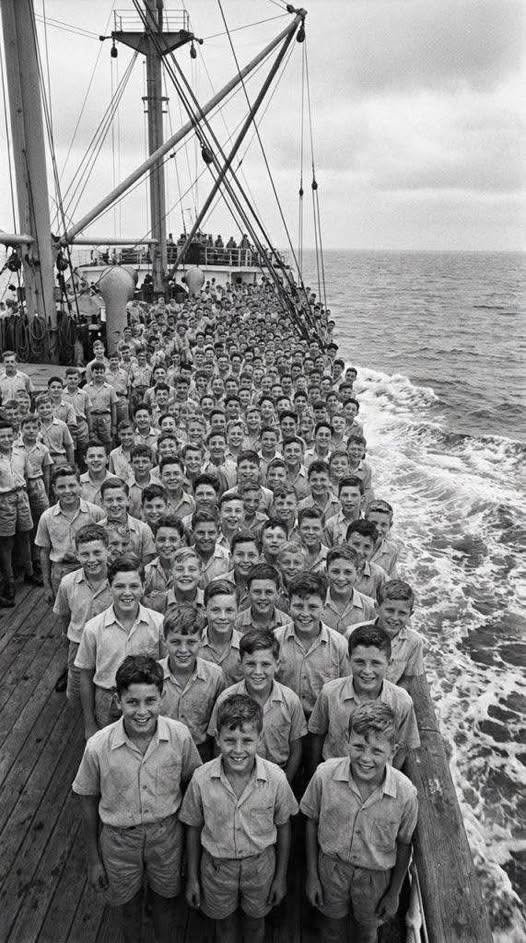
In the middle of one of the darkest chapters in human history, when war had turned millions of innocent lives into refugees, a ship crossed the Indian Ocean carrying a group of children who had already survived more suffering than most adults could imagine.
They were not soldiers.
They were not politicians.
They were not a threat to anyone.
They were children.
Seven hundred and forty Polish boys and girls who had lost their homes, their families, and nearly every piece of the world they once knew.
They had survived the nightmare of Soviet deportation.
They had endured hunger, disease, freezing temperatures, and the unbearable grief of losing their parents.
They had escaped one tragedy only to discover that the world beyond the prison camps was still unwilling to embrace them.
Their journey should have ended with safety.
Instead, it became another test of survival.
As their ship moved from port to port, the answer was repeatedly the same:
No.
There was no room.
No resources.
No permission.
No responsibility.
Behind those official explanations was a heartbreaking reality: these children had become unwanted victims of a war they never started.
But then their story reached a small kingdom in western India.
And one man made a decision that changed everything.
His name was Jam Sahib Digvijay Singhji.
He was a ruler without the power to stop the war.
He could not defeat armies.
He could not change international politics.
He could not force powerful governments to act.
But he could do one thing.
He could open his door.
And sometimes, in the darkest moments of history, one open door is enough to save hundreds of lives.
The Children Who Survived Two Different Wars
Before they became known around the world as the “Polish children of Nawanagar,” these boys and girls were simply children living ordinary lives in Poland.
They had families.
They had homes.
They had dreams.
Some wanted to become teachers.
Some wanted to become doctors.
Some wanted to grow up and return to the places where they were born.
Then World War II destroyed everything.
In September 1939, Nazi Germany invaded Poland from the west.
Soon afterward, the Soviet Union invaded from the east.
Poland was divided between two occupying powers.
For many Polish families living in areas controlled by the Soviet Union, the nightmare came in the form of forced deportation.
Thousands of Polish citizens were taken from their homes and sent deep into Soviet territory.
Families were separated.
People were transported thousands of miles away.
Many were forced to work in harsh conditions.
The children who survived these years witnessed things no child should ever see.
They saw parents become sick.
They saw hunger become normal.
They saw families disappear.
For many, childhood ended almost overnight.
Their memories were filled not with school and games, but with trains, snow, hunger, and fear.
Some children were separated from their parents forever.
Others watched their mothers and fathers die from exhaustion and illness.
They carried grief that was far too heavy for their young shoulders.
But they survived.
And survival eventually brought them to another uncertain chapter.
The Escape to Iran and the Search for a Home
In 1941, after political changes during the war, many Polish civilians who had survived Soviet imprisonment were allowed to leave.
Thousands traveled south toward Iran.
For many children, this was the first time in years they experienced something resembling freedom.
They saw sunlight.
They found food.
They received medical care.
They met people who treated them with kindness.
But freedom did not automatically mean they had a home.
The war was still raging.
Millions of refugees were moving across continents.
Governments were struggling with limited resources.
The Polish children needed somewhere safe to stay until the war ended.
Their journey became a desperate search for acceptance.
They were refugees without a country that could immediately protect them.
They had escaped one form of suffering only to face another painful question:
Where could they go?
The answer seemed impossible to find.
One by one, doors closed.
The children had already lost their parents.
Now they faced the possibility that the world itself might abandon them.
The Ship Nobody Wanted
The ship carrying the Polish children became a symbol of their uncertain future.
Every mile across the ocean represented hope.
Every rejected port represented another disappointment.
They were not carrying weapons.
They were not carrying political demands.
They were carrying only their memories and their hopes.
But international decisions were rarely made based on compassion alone.
Officials considered numbers.
Budgets.
Responsibilities.
Political consequences.
And behind every calculation were hundreds of children waiting for someone to say:
“You belong here.”
Instead, they heard uncertainty.
The children began to understand something painful.
Being rescued from danger did not always mean being welcomed afterward.
A twelve-year-old girl named Maria, like many older children, became responsible for younger siblings.
She had already learned lessons no child should have to learn.
She understood hunger.
She understood fear.
She understood loss.
But she still held onto one promise:
She would protect her little brother.
That promise represented something powerful.
Even after everything the war had taken from them, the children still had love.
And sometimes love survives where almost everything else disappears.
The Maharaja Who Refused to Look Away
Eventually, news of the children reached Nawanagar, a princely state in present-day Gujarat.
The ruler was Jam Sahib Digvijay Singhji.
Unlike the leaders of the world’s largest nations, he did not command enormous armies.
He did not control global decisions.
He was not in a position to end the war.
But he had something just as important.
He had compassion.
When advisers told him about the Polish children, he listened.
They explained the situation.
They explained that the children had nowhere to go.
They explained that powerful authorities had refused them.
Then came the question:
How many children?
The answer:
Seven hundred and forty.
For a moment, there was silence.
Because seven hundred and forty was not a small responsibility.
It meant food.
Shelter.
Education.
Medical care.
Protection.
It meant opening an entire community to children who had suffered unimaginable trauma.
Many leaders would have looked at the difficulty first.
The cost.
The complications.
The risks.
But Jam Sahib saw something else.
He saw children.
And he made his decision.
He would accept them.
“You Are No Longer Orphans”
When the Polish children arrived in Nawanagar in 1942, they carried the weight of everything they had experienced.
They arrived exhausted.
Many were physically weak.
Many struggled to trust adults.
After years of loss, kindness itself could feel unfamiliar.
They had learned that people could disappear.
Promises could be broken.
Homes could be destroyed.
But waiting for them was someone who wanted to give them something they had almost forgotten.
A sense of belonging.
Jam Sahib Digvijay Singhji welcomed them personally.
According to accounts from survivors, he told them words that remained with them for the rest of their lives:
“You are no longer orphans. You are now Nawanagar’s children.”
Those words mattered.
Because the children had lost more than possessions.
They had lost identity.
They had lost security.
They had lost the feeling that they belonged somewhere.
The Maharaja did not simply provide shelter.
He gave them dignity.
He treated them not as refugees or victims.
He treated them as children.
The Home Built for Healing
The children were placed in a settlement known as Balachadi, near the Maharaja’s summer palace.
There, they began rebuilding their lives.
They received food.
They received medical care.
They went to school.
They played.
They celebrated holidays.
Slowly, childhood returned.
The trauma did not disappear.
Many carried painful memories for the rest of their lives.
But they were finally in a place where survival was no longer their only goal.
They could begin becoming children again.
They learned new languages.
They formed friendships.
They experienced kindness from people who had no obligation to help them.
The people of Nawanagar became part of their story.
Indian families shared traditions with them.
Local communities supported them.
A connection formed between two cultures separated by thousands of miles.
The Polish children had arrived as strangers.
They left as part of a larger human family.
The Legacy of a Man Who Chose Compassion
After the war ended, many of the Polish children eventually returned to Europe or built new lives elsewhere.
But they never forgot Nawanagar.
They never forgot the man who welcomed them when others turned away.
Jam Sahib Digvijay Singhji became remembered not because of military victories or political achievements.
He became remembered because he made a moral choice.
He saw suffering.
He had the ability to help.
And he helped.
History often remembers powerful people for the wars they fight.
But sometimes the most meaningful actions are quieter.
A door opened.
A meal shared.
A child protected.
A promise kept.
The Polish children of Nawanagar became adults.
They became professionals.
They built families.
They carried their experiences forward.
And many continued to speak about the kindness they received in India.
Their story remains a reminder that compassion does not always come from the most powerful nations or the largest organizations.
Sometimes it comes from one person deciding that someone else’s suffering matters.
The Man Who Proved One Person Can Change History
During World War II, millions of people were displaced.
Millions suffered.
Many stories ended in tragedy.
But the story of the 740 Polish children carries a different message.
It shows that even during humanity’s darkest moments, there were people who chose kindness.
Jam Sahib Digvijay Singhji could not stop the war.
He could not save everyone.
But he saved the children who stood before him.
He gave them a home when they had none.
He gave them family when they had lost theirs.
He gave them hope when hope was disappearing.
The world had told those children:
Not here.
Not now.
Not our responsibility.
One man answered differently.
He said:
Come in.
You are welcome.
And because of that one decision, hundreds of children survived.
Decades later, their descendants still remember the place where they found safety.
A small corner of India became part of Polish history.
A Maharaja became a father figure to children from another continent.
And a simple act of compassion became a story that the world continues to tell.
Because sometimes history is not changed by the people who hold the greatest power.
Sometimes history is changed by the person who simply refuses to look away.