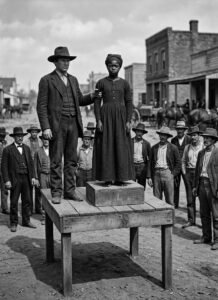
A Childhood Stolen Before It Had Truly Begun
Georgia, 1850.
The American South was deeply dependent on enslaved labor.
Cotton plantations, agricultural estates, and wealthy households relied on a system in which human beings could be bought, sold, and forced to work without compensation.
For enslaved children, childhood offered little protection.
They could be separated from their parents, assigned difficult labor, and sold to people they had never met.
According to the story of Ella, she was just 13 years old when she found herself standing at a slave auction.
Imagine being that young and knowing that your entire future depended on the decisions of strangers.
No one asked what she wanted.
No one offered her the freedom to choose where she would live.
In the account, Ella was sold to a plantation owner and taken to a life of exhausting work.
Her days reportedly began before sunrise.
She labored in agricultural fields under the southern sun, performing tasks that demanded strength and endurance.
Later, she was assigned to work inside the plantation kitchen.
Although domestic work sometimes differed from field labor, it did not mean freedom from exploitation.
Enslaved household workers could face long hours, strict supervision, and severe punishment.
For Ella, according to the narrative, each passing year brought another reminder that her life was controlled by others.
Yet she continued growing older.
The little girl became a young woman.
And somewhere beyond the plantation, the nation was moving toward a conflict that would eventually transform her world.

The Long Road to Freedom
In 1861, the American Civil War began.
The conflict would ultimately determine the future of slavery in the United States.
For millions of enslaved African Americans, the war created both uncertainty and hope.
As Union armies advanced through the South, many enslaved people escaped plantations, sought protection behind Union lines, and contributed directly to the struggle for emancipation.
On January 1, 1863, President Abraham Lincoln’s Emancipation Proclamation declared freedom for enslaved people in areas under Confederate rebellion.
But emancipation did not occur everywhere immediately.
The legal destruction of slavery required military victory and constitutional change.
In December 1865, the Thirteenth Amendment abolished slavery throughout the United States, except as punishment for a crime.
According to Ella’s story, she was approximately 28 years old when freedom finally came.
For the first time, she could begin imagining a life in which no plantation owner possessed legal authority over her body and labor.
But freedom was not the same as economic security.
Formerly enslaved people often emerged from bondage without savings, property, formal education, or reliable employment.
Many had been prevented from learning to read and write.
Families had been separated.
Communities faced discrimination and violence.
The end of slavery was an enormous historical victory, but the struggle to establish independence was far from over.
For Ella, the next challenge was learning how to build a future with almost nothing.
Freedom Without Money, Land, or a Place to Call Home
After the Civil War, millions of newly freed African Americans faced a difficult question.
How could they build independent lives in a society that had denied them ownership of their own labor?
Land was especially important.
Owning land meant having somewhere to live, grow food, establish a household, and potentially pass property to children.
But most formerly enslaved families did not receive farmland after emancipation.
The famous promise associated with “40 acres and a mule” never became a nationwide land redistribution program.
In many areas, land remained concentrated in the hands of former plantation owners.
As a result, large numbers of freedpeople entered sharecropping arrangements.
Under sharecropping, families cultivated land owned by someone else and paid a portion of their harvest as rent.
In theory, this arrangement offered a path toward earning an income.
In practice, it frequently trapped workers in cycles of debt.
Landowners and merchants often controlled credit, supplies, and the accounting used to determine what sharecroppers owed.
A poor harvest could leave a family with little or nothing.
Even a successful season might not produce enough income to purchase property.
Black women faced additional barriers because of racial discrimination, limited employment opportunities, and unequal treatment under local institutions.
According to the narrative, Ella spent approximately twelve years working as a sharecropper after emancipation.
She saved whatever money she could.
Every dollar represented hours of exhausting labor.
Every small amount set aside was money that could not be spent on immediate comforts.
Her goal, the story suggests, was not luxury.
It was independence.
She wanted something that could not be taken away simply because a landowner decided she no longer belonged there.
She wanted land.

The Day Ella Allegedly Bought 40 Acres for $400
In the most memorable part of the story, Ella accomplished her goal in 1877.
At approximately 40 years old, she reportedly purchased 40 acres of farmland in Georgia for $400 in cash.
For a woman who had once been enslaved, such a purchase would have represented an extraordinary personal milestone.
The land was no longer merely a place where she worked for someone else’s benefit.
It was something she could cultivate for herself and her family.
She could decide what to plant.
She could build a home.
She could imagine passing the property to her children.
And perhaps most importantly, she could experience a measure of economic independence that slavery had denied her.
The contrast is emotionally powerful.
As a child, Ella had allegedly been sold because other people claimed ownership over her.
As an adult, she was now said to possess legal ownership of land.
However, the claim that she was among the first Black women in Georgia to own property should be treated cautiously.
Free Black women owned property in parts of the United States before the Civil War, and Black landownership developed in different ways across the South during Reconstruction.
Without a verified deed, county record, or documented family history, Ella’s specific purchase cannot be established as a historical first.
Still, the larger historical significance of Black landownership is undeniable.
For formerly enslaved families, acquiring property could represent a major step toward economic independence.
It could provide a foundation for future generations.
And in a society where African Americans faced systematic exclusion, ownership carried profound meaning.
Forty Acres That Represented More Than Money
What makes the story of Ella’s farm compelling is not simply the reported acreage.
It is what that land symbolized.
For someone who had lived under slavery, property ownership could mark a fundamental change in personal circumstances.
Land could provide food.
It could support livestock.
It could offer space for children to grow up.
And it could create opportunities for families to build wealth over time.
But owning land was not easy.
Farmers had to purchase seeds, maintain equipment, manage livestock, and survive unpredictable weather.
Drought, flooding, pests, and changing crop prices could threaten an entire year’s income.
Black landowners also faced discriminatory lending practices, intimidation, and obstacles within the legal system.
Some families lost property because of debt, unclear titles, or unfair treatment.
Others struggled to keep land intact when it passed through multiple generations.
According to the supplied account, Ella worked her farm for approximately thirty years.
She reportedly raised seven children and taught them the value of maintaining the property.
The story presents her as a mother determined to give her family opportunities she had never possessed as a child.
That desire is easy to understand.
A person who has experienced insecurity may place enormous value on providing stability for loved ones.
A parent who has been denied choices may hope their children will enjoy greater independence.
And someone who has worked for years without compensation may regard ownership as a form of dignity.
For Ella, the land is portrayed not merely as an investment.
It was the beginning of a family legacy.
The Words She Supposedly Left Behind
One of the most emotional elements of Ella’s story concerns a message attributed to her will.
According to the narrative, she died in 1907 after leaving her family a powerful instruction:
“This land was bought with hands that were once sold. Do not sell it. Ever.”
Those words have become central to the story’s emotional appeal.
They connect the injustice of slavery with the achievement of property ownership.
They also express a determination that future generations should remember the sacrifices made before them.
However, no authenticated will or probate record has been provided to confirm that Ella actually wrote or spoke those words.
They should therefore be understood as an unverified quotation rather than a documented historical statement.
Even so, the sentiment reflects a genuine concern among many families who acquired land after emancipation.
Property could become a symbol of family identity.
A farm might contain memories of grandparents, childhood celebrations, hard work, and shared experiences.
Selling it could mean losing more than its market value.
It could mean losing a tangible connection to ancestors.
For some families, inherited land represents a story of perseverance.
The buildings may change.
The crops may change.
The surrounding community may grow.
But the property continues connecting one generation to another.
That connection can be especially meaningful when earlier generations struggled to acquire ownership under difficult circumstances.