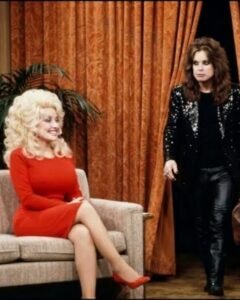
Dolly Parton Told the “Truth” About Ozzy Osbourne on TV — Then Ozzy Walked Onstage and Did the Unexpected
Few pairings in popular music could have looked more unlikely on paper than Dolly Parton and Ozzy Osbourne. One represented rhinestones, Appalachian songwriting, country harmonies, and an almost disarming warmth. The other had become one of heavy metal’s most notorious figures, surrounded by black clothing, dark imagery, controversy, and a reputation that often seemed larger than the man himself.
That contrast is what makes the story so irresistible.
According to the dramatic version of the tale that has circulated among entertainment fans, what began as an ordinary television conversation suddenly became something much more personal when Parton offered an unexpectedly sympathetic assessment of Osbourne. She did not describe him as a monster or a dangerous rock-and-roll villain. Instead, she supposedly suggested that underneath the theatrical image was a frightened, vulnerable man.
Then Ozzy appeared.
There is an important caveat: the specific 1987 Tonight Show confrontation described in viral versions of this story should be treated as an entertainment anecdote unless supported by an original broadcast, NBC archive, or reliable contemporary record. But the personalities and cultural contrast at the heart of the story make it a fascinating way to explore something very real about both performers: the enormous distance that can exist between a celebrity’s public image and the human being underneath it.
Two Stars From Completely Different Worlds
By 1987, Dolly Parton had long since moved beyond the boundaries of country music. She was a songwriter, recording star, actress, television personality, businesswoman, and one of America’s most recognizable entertainers.
Yet her public persona contained an unusual contradiction.
Parton dressed extravagantly. Her hair was enormous, her clothes sparkled, and she openly joked about the artificial elements of her appearance. But her music frequently traveled in the opposite direction. Songs such as “Coat of Many Colors” and “I Will Always Love You” depended not on spectacle but emotional directness.
That distinction became especially relevant with Trio, her celebrated collaboration with Emmylou Harris and Linda Ronstadt.
The project emphasized voices rather than spectacle. Three enormously successful singers stripped away much of the machinery surrounding celebrity and allowed harmony to carry the music.
Ozzy Osbourne seemed to inhabit another universe.
His years with Black Sabbath had helped define heavy metal, while his solo career transformed him into an even more theatrical figure. His concerts, album artwork, clothing and controversial reputation contributed to an image that frightened some parents and fascinated millions of young fans.
To an outsider, Dolly and Ozzy could hardly have appeared more different.
But Dolly Parton had built much of her songwriting career around looking past appearances.
And that is where the story becomes interesting.

The Question That Changed the Conversation
In the story, Johnny Carson’s interview with Parton begins conventionally enough.
They discuss music, Nashville, her career and Trio. Parton talks about the pleasure of singing with Harris and Ronstadt and about how three voices can reveal things that elaborate production sometimes conceals.
Eventually, the conversation supposedly shifts toward image.
Carson asks about performers who construct exaggerated personalities around themselves. The subject of rock music enters the conversation, and eventually Ozzy Osbourne’s name comes up.
The audience expects a joke.
After all, Dolly Parton commenting on the so-called Prince of Darkness practically writes its own punchline.
But according to the tale, Parton refuses the easy laugh.
Instead, she offers an interpretation that changes the atmosphere.
She suggests that people sometimes create enormous personalities because the person underneath them feels much smaller. The louder the costume becomes, she implies, the more carefully we should consider what it may be protecting.
Then comes the line around which later versions of the story would be built.
Ozzy, she supposedly says, isn’t somebody she finds frightening.
He looks like somebody who is frightened.
Not weak. Not ridiculous.
Frightened.
For a television audience accustomed to hearing Osbourne discussed through controversy and sensational headlines, the distinction would have been striking.
Parton was effectively separating the character from the man.
Behind the Curtain, Ozzy Was Listening
The legend becomes considerably more cinematic from here.
Elsewhere inside the NBC complex, Osbourne was supposedly preparing for another engagement. A television in the room was tuned to Carson.
At first, he paid little attention.
Then he heard his name.
The people around him reportedly became nervous as Parton’s comments continued. They expected Ozzy to be offended. His entire professional mythology depended, at least partly, upon the frightening image she appeared to be dismantling on national television.
But Ozzy supposedly did something nobody around him anticipated.
He listened.
Parton wasn’t mocking him.
She wasn’t accusing him of being fraudulent. She wasn’t claiming that the darkness surrounding his music meant nothing.
She was talking about the human cost of maintaining a persona.
And Osbourne knew better than most that the public version of “Ozzy” could consume enormous amounts of oxygen.
Behind the outrageous stories existed a man who had spoken about insecurity, addiction, family, fear and the strange psychological consequences of becoming famous.
Perhaps that was why, in the legend, he didn’t become angry.
He became quiet.
Then he stood up.

Ozzy Walks Onto the Stage
The studio audience initially doesn’t understand what is happening.
A figure appears near the curtain.
Dark clothes. Long hair. Rings catching the studio lights.
Then recognition spreads through the room.
Ozzy Osbourne.
There has supposedly been no introduction. No scheduled entrance. No Carson setup.
For a moment, even the host appears uncertain whether this is part of the program.
Parton turns toward the curtain.
And instead of looking frightened, she smiles.
That detail is central to why the story has endured in various forms online. Everything about the setup encourages viewers to expect confrontation.
Ozzy has apparently just heard himself described in deeply personal terms on national television. He has entered the studio unexpectedly. Dolly remains seated only a few feet away.
The audience waits for anger.
Instead, according to the story, Ozzy approaches her slowly.
He does not shout.
He does not challenge her.
He doesn’t perform the character everyone expects.
He simply asks why she said it.
Parton reportedly answers with the kind of uncomplicated observation that had become part of her public appeal.
Because she recognizes it.
People who grow up with very little, she suggests, learn how to make themselves appear bigger than they feel. Sometimes humor becomes armor. Sometimes beauty becomes armor. Sometimes outrageousness becomes armor.
The costumes are different.
The instinct isn’t.
Suddenly, the supposed clash between Dolly Parton and Ozzy Osbourne becomes a story about two entertainers who may have understood one another better than anyone expected.
“You Saw Me”
The most emotional versions of the story describe Ozzy becoming visibly affected.
The theatrical figure disappears for a moment.
He looks down. He struggles to respond. Then, instead of defending himself, he reportedly acknowledges the uncomfortable accuracy of Parton’s observation.
In some retellings, the sentiment is reduced to a few words:
“You saw me.”
Whether those exact words were ever spoken is precisely the sort of detail that requires original footage before being presented as historical fact. Yet the idea resonates because it touches something recognizable about celebrity culture.
Audiences frequently confuse persona with personality.
Performers are rewarded for becoming symbols. Dolly becomes the endlessly cheerful country icon. Ozzy becomes the dangerous madman of heavy metal. Johnny Carson becomes the permanently composed television host.
Eventually, the symbol can become easier to recognize than the person.
Parton’s own career offers an especially revealing example.
People sometimes saw the wigs, rhinestones and jokes before they recognized the formidable songwriter and businesswoman underneath them. She understood what it meant to deliberately exaggerate an appearance while refusing to let that appearance define the whole person.
Ozzy’s costume was darker.
But the principle wasn’t necessarily so different.
Both performers understood that entertainment requires transformation.
The danger begins when the audience forgets that transformation took place.

The Unexpected Gesture
According to the dramatic retelling, Ozzy then does the thing that nobody in the room anticipates.
He doesn’t argue with Dolly.
He embraces her.
The image practically explains the entire story without dialogue: one of country’s brightest personalities wrapped in red, embracing one of rock’s darkest icons dressed in black.
The contrast is almost too perfect.
But the symbolism goes deeper than wardrobe.
Neither person asks the other to become something different.
Dolly doesn’t condemn heavy metal.
Ozzy doesn’t ridicule country music.
Instead, the encounter becomes a recognition of the strange bargain every famous entertainer makes with an audience.
You create a version of yourself powerful enough for millions of strangers to remember.
Then you spend years hoping that somebody can still see the person behind it.
That is why the story works even for people who have never bought a Dolly Parton record or listened to Black Sabbath.
It isn’t really about country versus metal.
It is about being seen.
Why the Story Still Feels Believable
The internet has created an enormous appetite for forgotten celebrity encounters, especially stories supposedly rescued from classic television. Unfortunately, that same appetite has produced countless scenes in which real celebrities are placed into invented confrontations.
That means dramatic claims involving exact dates, dialogue and surprise appearances deserve verification before being described as documented history.
But there is another reason stories like this spread.
They attach fictionalized or unverified moments to truths audiences already recognize about the people involved.
Dolly Parton has spent decades demonstrating an unusual ability to move between cultural worlds. She has rarely needed to diminish another performer in order to strengthen her own identity.
Ozzy Osbourne’s intimidating image, meanwhile, never told his entire story. The public eventually saw considerably more of the humorous, vulnerable and domestic person behind the stage persona.
The contrast between “Prince of Darkness” and ordinary human vulnerability became part of what made Ozzy such a compelling cultural figure.
Perhaps that is why the imagined exchange with Dolly feels emotionally plausible.
She represents exactly the sort of person who might look at a frightening costume and wonder what exists underneath it.
And Ozzy represents exactly the sort of performer whose mythology became so enormous that discovering the human being beneath it could feel like a revelation.
More Than Country Meeting Heavy Metal
There is a tempting way to frame the story as a collision between two musical tribes.
Country meets metal.
Nashville meets Birmingham.
Rhinestones meet black leather.
But that interpretation misses the more interesting point.
Great performers often have far more in common than their audiences realize.
They understand nervousness before walking onstage. They understand being judged by strangers. They understand the pressure of repeating a public identity night after night. They understand what happens when newspapers and television reduce a complicated person to a recognizable character.
Most importantly, they understand that applause doesn’t necessarily eliminate insecurity.
Sometimes it magnifies it.
Parton has frequently used humor to control the conversation surrounding her appearance and background. Osbourne used theatrical darkness and unpredictability to construct one of rock music’s most unforgettable identities.
Different armor.
Same battlefield.
And that makes the emotional premise behind the story far more interesting than a celebrity argument ever could have been.
The Moment People Wanted to Believe
Maybe that is the lasting lesson of the tale.
Millions of people spend their lives constructing versions of themselves for other people: the strong father, the cheerful mother, the successful employee, the funny friend, the fearless performer.
Sometimes the costume is made of rhinestones.
Sometimes it is black leather and eyeliner.
Sometimes there is no visible costume at all.
But almost everyone knows the strange relief of meeting someone who looks beyond the performance and recognizes something underneath.
That is what makes the story of Dolly Parton and Ozzy Osbourne so powerful, regardless of how much of its television mythology can ultimately be documented.
The expected ending is confrontation.
Ozzy storms onto the stage. Dolly refuses to retreat. Television history explodes.
But the ending people remember is quieter.
A woman associated with warmth supposedly looked at a man associated with darkness and refused to be frightened by him. Instead, she recognized vulnerability.
And the man who had spent years frightening audiences supposedly responded not with anger, but gratitude.
For one imagined, extraordinary television moment, the rhinestones and darkness didn’t matter.
There were simply two human beings standing beneath the studio lights — and one of them had finally been seen.
