Which Baby Is a Girl? What Your Choice Might Reveal
Have you ever found yourself scrolling through your social media feed, moving past headlines, advertisements, photographs, and endless streams of information with a practiced sense of digital indifference, only to have your thumb suddenly freeze in place?
You stop. You stare. You look a little closer. Before you know it, you find yourself captivated by a simple image that seems to demand your undivided attention.
It might not contain an extraordinary photograph, a complicated question, or a particularly surprising piece of information. Sometimes, the simplest images are the ones that capture our curiosity most effectively.
This is the appeal of the viral « Which Baby Is a Girl? » challenge, a playful online puzzle that has encouraged countless social media users to pause, examine an image, and make a quick decision based on their first impression.
At first glance, the challenge appears innocent and straightforward. There are no complicated instructions, no lengthy explanations, and no special knowledge required. You simply look at the picture and choose the baby you believe is a girl.
However, what begins as an entertaining guessing game often develops into a broader conversation about intuition, personality, emotional awareness, and the way people interpret visual information.
The Image Features Four Adorable Babies
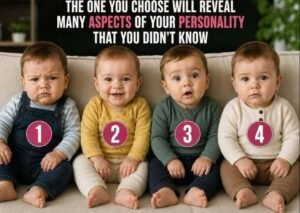
The image features four adorable babies, labeled from one to four, each displaying a different expression and posture. Although the babies appear together in the same visual challenge, each photograph creates a slightly different impression.
One baby might immediately attract your attention because of a noticeable expression. Another might seem particularly cheerful, calm, curious, or expressive. Sometimes, the difference is difficult to explain. You simply find yourself looking at one face longer than the others.
There is something appealing about how quickly this decision can happen. You might study the image carefully, comparing expressions and facial features, or you might settle on an answer almost immediately.
Either way, the invitation is the same: trust your first impression and make your choice.
It seems trivial, almost laughably simple, doesn’t it?
Yet, the internet is full of interpretations suggesting that your answer might reveal something about your personality, your emotional tendencies, or the way you perceive the people around you.
Some versions of the challenge encourage participants to think about whether they are guided primarily by logic or emotion. Others suggest that choosing a particular baby might be connected to empathy, intuition, or sensitivity to facial expressions.
These interpretations are part of the entertainment surrounding the puzzle rather than established psychological conclusions. Nevertheless, they add another layer of curiosity to an activity that would otherwise be a simple guessing game.
Suddenly, the question is no longer just which baby you believe is a girl. It also becomes a question about why you made that choice.
Did you notice a particular expression? Did one face seem more familiar? Were you drawn to a cheerful appearance, a relaxed posture, or something you cannot quite describe?
The simplicity is precisely what makes this challenge engaging. It encourages you to make a decision without spending too much time analyzing it, then invites you to reconsider the reasoning behind your answer.
It combines curiosity, entertainment, and a small opportunity for personal reflection.
But an important question remains: is there actually a deeper psychological meaning behind your selection, or does the challenge simply make an ordinary first impression feel unusually significant?
The Anatomy of a Viral Sensation
Why do challenges like this spread so easily across social media?
Part of their appeal comes from a familiar aspect of human behavior: people are naturally curious about themselves and how they compare with others.
A visual guessing game takes this interest and presents it in a format that requires almost no preparation.
You do not need to complete a long questionnaire or understand specialized psychological terminology. All you need to do is examine a picture and select an answer.
This accessibility makes the experience particularly appealing. The question is easy to understand, the decision feels manageable, and the result creates an immediate opportunity for discussion.
People Love Testing Their Instincts
People love testing their instincts. Many of us enjoy believing that we are observant, perceptive, and capable of recognizing meaningful details in a brief glance.
We often rely on first impressions in ordinary social situations. Someone’s expression, posture, or general appearance may influence our initial perception before we have had an opportunity to learn anything more about them.
The « Which Baby Is a Girl? » challenge places that familiar process at the center of an entertaining visual exercise.
Instead of asking you to solve a difficult logic puzzle or work through a complicated mathematical problem, it asks you to look at four faces and make a personal judgment.
The decision may happen so quickly that you struggle to explain it afterward.
Perhaps one baby’s expression seemed especially welcoming. Perhaps another appeared particularly animated. You may even have chosen an image because it reminded you of someone familiar, without consciously considering that resemblance at the time.
That immediate response can feel like a message from your subconscious, especially when the challenge suggests that there is a hidden meaning behind your answer.
However, an instinctive response is not necessarily evidence of a specific personality trait. A quick visual preference can be influenced by many aspects of the image and by the way a person happens to interpret it.
Why Simple Visual Challenges Capture Attention
In the middle of a busy day, a visual puzzle can provide a brief and welcome distraction.
Unlike content that requires prolonged attention, this type of challenge gives you a clear question and a limited number of possible answers. You can participate without committing to a lengthy activity.
The presence of four numbered babies also makes the decision feel organized and approachable. You can compare the images, eliminate possibilities if you wish, and settle on one answer.
For some people, the most enjoyable part is making an immediate selection. For others, the entertainment comes from examining the photograph more closely and questioning their initial response.
The puzzle also naturally encourages conversation.
You might show the picture to a friend and ask which baby they would choose. If your answers are different, you may begin comparing what each of you noticed.
One person might focus on the baby’s smile, while another concentrates on posture or overall appearance. Neither observation necessarily establishes the baby’s sex, but the difference can reveal how differently people interpret the same image.
That contrast makes the challenge easy to discuss and share.
There is also an element of anticipation. Once you have made your selection, you naturally want to discover which answer the puzzle identifies as correct.
If the challenge includes a personality interpretation, that anticipation becomes even stronger because you are not simply waiting for an answer. You are also waiting for a description that supposedly relates to you.
The Appeal of Personality Interpretations
Personality interpretations add a personal dimension to an otherwise ordinary guessing game.
When a quiz connects your answer with qualities such as kindness, sensitivity, confidence, or intuition, it encourages you to evaluate whether those descriptions resemble your own behavior.
Both responses can encourage reflection.
For example, if an interpretation suggests that you are emotionally observant, you might think about situations in which you noticed someone else’s feelings. You may also remember occasions when you misunderstood another person’s expression.
This kind of reflection can be interesting, but it should remain separate from the idea that a single image choice can accurately measure emotional intelligence or personality.
A meaningful psychological assessment requires more than one spontaneous answer to a visual question. The puzzle does not provide sufficient information to establish how empathetic, intuitive, or emotionally aware someone is.
That limitation does not make the activity pointless.
It simply means that the challenge is best enjoyed as entertainment and as a conversation starter rather than as a scientific evaluation of your personality.
Understanding the « Correct » Answer: Baby #2
In many versions of this viral trend, baby number two is presented as the popular choice and is often identified as the « correct » answer.
According to the narrative surrounding the challenge, baby number two is the girl.
For participants who selected the second baby immediately, this answer may feel particularly satisfying. Their first impression appears to match the result presented by the puzzle.
For those who chose another baby, the answer may be surprising. They might return to the image, compare the faces again, and wonder what led them toward a different conclusion.
However, there is an important distinction between an answer provided by an online challenge and a conclusion supported by reliable information.
Without verified details about the original photograph or the children depicted, there is no reliable basis for confirming the baby’s sex solely from the image.
A baby’s facial expression, posture, perceived temperament, or apparent personality cannot establish whether that baby is a girl or a boy.
Features that viewers interpret as feminine or masculine may reflect personal expectations rather than reliable information about the child.
For this reason, baby number two should be understood as the answer associated with the viral puzzle, not as an independently verified biological conclusion.
This distinction matters because the challenge encourages viewers to make assumptions from appearance while presenting the result as though the image itself contains a definite clue.
In reality, the expression that makes a baby appear cheerful, gentle, curious, or particularly expressive does not establish the child’s sex.
Recognizing this limitation allows participants to enjoy the puzzle without treating its suggested answer as proof.
Why Baby Number Two May Attract Attention
The popularity of baby number two may partly reflect the way viewers interpret the baby’s expression.
Some participants may perceive this baby as especially cheerful or welcoming. Others might find the expression unusually memorable or simply prefer the overall appearance of the photograph.
These reactions are subjective. What seems immediately appealing to one person may not stand out to someone else.
For example, a viewer who tends to notice smiles may focus on an expressive face. Someone who pays more attention to posture may be drawn toward a different baby.
Another participant may not identify any particular reason for their selection.
None of these reactions automatically indicates that one person is more perceptive, sensitive, or intuitive than another.
They simply demonstrate that people can focus on different visual details when examining the same set of images.
Even when the puzzle provides one preferred answer, the process of choosing can remain more interesting than the result itself.
After all, the image gives participants an opportunity to observe their own reactions and compare them with those of other people.
The baby’s expression becomes a starting point for thinking about perception, intuition, and the personal explanations we create for our choices.
Decoding Your Instincts: The Portrait of Baby #2
If you gravitated toward baby number two, you may enjoy reflecting on what attracted you to that particular image.
Perhaps the baby’s expression was the first detail you noticed. Maybe the face appeared friendly, cheerful, or especially expressive. It is also possible that you simply found this photograph more appealing than the others.
Your decision may have felt immediate and effortless, or you may have compared all four babies before returning to number two.
Neither approach is inherently more meaningful than the other.
Some personality interpretations associated with viral challenges suggest that choosing a welcoming or expressive-looking baby reflects emotional awareness, empathy, and sensitivity to other people’s feelings.
These descriptions may sound appealing, particularly if they resemble qualities you value in yourself.
However, selecting baby number two cannot establish whether you actually possess those traits. The choice alone is not a measure of empathy, emotional intelligence, or psychological insight.
What it can do is encourage you to reflect on the qualities that capture your attention and the ways you respond to expressions in everyday life.
Rather than treating the interpretation as a definitive personality profile, consider it an invitation to think about your own experiences.
Natural Empathy
Empathy involves recognizing, understanding, and responding thoughtfully to the feelings of other people.
It is an important part of how we communicate, maintain relationships, and offer support to those around us.
If you consider yourself an empathetic person, you may pay close attention to facial expressions, tone of voice, and subtle changes in someone’s behavior.
You might notice when a friend seems uncomfortable during a conversation, even when that friend has not directly explained what is wrong.
You may recognize when a family member appears worried, distracted, or unusually quiet and consider whether that person needs reassurance or support.
Sometimes, empathy begins with something as simple as observing another person’s expression and taking the time to consider what they might be feeling.
However, noticing an expression and correctly understanding the emotion behind it are not necessarily the same thing.
A person may smile while feeling nervous, remain quiet while feeling content, or appear serious while concentrating on something completely ordinary.
This is why empathetic communication involves more than forming an immediate impression. It also requires openness, attention, and a willingness to understand someone else’s perspective.
Choosing baby number two does not prove that you are naturally empathetic. Nevertheless, reflecting on why a particular expression appealed to you may encourage you to think about how you interpret other people’s emotions.
For example, consider whether you generally notice when someone around you seems uncomfortable. Think about how you respond when another person appears to need encouragement.
Do you immediately try to understand the situation? Do you prefer to listen carefully before drawing conclusions? Are you willing to reconsider your initial impression when someone explains how they actually feel?
These questions offer a more meaningful opportunity for self-reflection than the original visual selection alone.
Emotional Awareness and First Impressions
Another interesting aspect of the challenge is the relationship between emotional awareness and visual perception.
When looking at a photograph of a face, you may instinctively notice features that seem to communicate a particular emotion.
A smile may suggest happiness, while a more neutral expression may feel calm or difficult to interpret.
Yet facial expressions do not always tell the complete story.
Without additional context, it is easy to assign feelings or personality characteristics to someone based on appearance alone.
The four-baby challenge highlights this tendency because participants are asked to form an opinion using very limited information.
You see an expression and a posture, but you know little else about the person in the photograph.
As a result, much of the interpretation comes from your own perception rather than from confirmed details about the baby.
Understanding this difference can make the puzzle more thought-provoking.
Instead of asking whether your answer proves that you possess exceptional emotional awareness, consider what you noticed and why it influenced your choice.
Perhaps you were drawn toward a cheerful expression because you personally appreciate warmth and friendliness.
Perhaps you focused on a particular facial detail because it stood out visually.
Or perhaps your answer was simply a spontaneous guess without any deeper reasoning.
All of these possibilities are consistent with the playful nature of the challenge.
The Difference Between Intuition and Evidence
Intuition can feel remarkably convincing, particularly when a decision seems to come naturally.
You may look at the four babies and feel immediately certain about your answer, even though you cannot explain precisely how you reached that conclusion.
That feeling of certainty can be part of what makes the experience entertaining.
However, confidence in a first impression does not necessarily mean that the impression is accurate.
The challenge provides an opportunity to recognize the difference between what you instinctively believe and what the available information can actually establish.
You can feel strongly that one baby is the girl while also acknowledging that the photograph does not contain enough reliable information to verify your assumption.
Similarly, you may enjoy a personality interpretation without assuming that it provides an accurate account of your emotional strengths or weaknesses.
These two ideas can coexist.
You can appreciate the playful uncertainty of the puzzle while maintaining a thoughtful perspective on its limitations.
In fact, approaching the challenge this way may make it more interesting because your attention shifts from simply being right or wrong to understanding how you arrived at your answer.
What Your Choice Really Says About You
The most reasonable interpretation of the « Which Baby Is a Girl? » challenge is that it reveals which image attracted your attention during a particular moment.
That selection may reflect a temporary impression, a visual preference, or an assumption based on familiar expectations about appearance.
It does not provide enough information to determine your personality, emotional intelligence, or ability to understand other people.
This does not mean that reflecting on your answer has no value.
On the contrary, the puzzle can become an interesting exercise in noticing how you make decisions when very little information is available.
Consider the following questions:
- Which baby caught your attention first? Think about whether you noticed the expression, posture, or overall appearance before examining the other photographs.
- Did you choose immediately? Consider whether your answer came from a quick impression or a more deliberate comparison.
- What made your selected image stand out? Try to identify the detail that influenced you, even if your reason initially seemed difficult to explain.
- Did the suggested answer change your opinion? Notice whether learning that baby number two is commonly presented as the girl encouraged you to reconsider your original selection.
- How did you respond to the personality interpretation? Think about whether you recognized yourself in the description or questioned its relevance.
These questions do not transform the challenge into a scientific test. Instead, they help turn a brief moment of entertainment into an opportunity for personal observation.
Why Different People Notice Different Details
One of the most interesting aspects of the puzzle is that two people can examine the same image and arrive at completely different answers.
One person may immediately select baby number two, while another may feel equally confident about baby number one, three, or four.
Someone might focus on facial expression. Another person might mention posture, while someone else may admit that the decision was little more than a guess.
The differences do not establish that one participant has a stronger personality or better intuition.
Instead, they illustrate how people can approach the same visual information from different perspectives.
This is also why the challenge works well as a conversation starter. Comparing answers can be more engaging than discovering which response the original puzzle identifies as correct.
You may find yourself noticing details that you completely overlooked before hearing someone else’s explanation.
How to Enjoy the Challenge Without Overinterpreting It
The best way to approach this viral puzzle is with curiosity and a lighthearted attitude.
Look at the four babies, make your selection, and pay attention to the detail that influenced your decision.
If you want to compare answers with someone else, allow that person to choose independently before sharing your own opinion.
Once both selections have been made, discuss the different expressions and visual details that attracted your attention.
You can also read the personality interpretation as an entertaining prompt for reflection, rather than as a description that must accurately represent who you are.
Remember that no single selection can establish whether you are empathetic, intuitive, sensitive, confident, or particularly skilled at understanding emotions.
Those qualities are much more complex than a spontaneous response to four photographs.
Above all, avoid assuming that facial expressions or perceived personality provide reliable evidence of a baby’s sex.
Final Thoughts: More Than a Simple Guessing Game
The « Which Baby Is a Girl? » challenge demonstrates how an ordinary image can capture attention, inspire curiosity, and encourage conversations about the way we perceive others.
Its appeal comes from a simple combination of visual interest, instinctive decision-making, and the promise of discovering something unexpected about ourselves.
Although baby number two is often presented as the answer, that identification should not be confused with a verified fact about the child.
Likewise, the personality descriptions associated with the challenge should be understood as entertainment rather than scientifically established conclusions.
The real fascination lies in the experience itself: noticing which image attracts you, questioning your first impression, and discovering that other people may interpret the same photograph differently.
Sometimes, a simple online puzzle does not need to reveal a hidden truth about your personality to be enjoyable.
It only needs to make you curious enough to stop scrolling, look a little closer, and ask yourself why one image stood out from the rest.
Now it is your turn: which baby did you choose first, and what made that particular image catch your attention?