
The Hollow Ridge Children: The Forgotten Appalachian Mystery That Was Never Meant to Be Found
In the summer of 1968, deep in the forgotten mountains between Kentucky and Virginia, two hunters followed the trail of a wounded deer into a place most people in the region had stopped talking about decades earlier.
The woods were thick, the paths were overgrown, and the old family properties scattered across the hills had slowly disappeared beneath nature’s relentless return. To outsiders, it was just another abandoned corner of Appalachia — a place where empty houses collapsed into the earth and forgotten names faded away.
But hidden behind a wall of trees stood an old wooden barn.
The hunters later said they almost walked past it.
The building looked like it had been untouched for generations. The boards were gray with age. The roof sagged beneath years of storms. The doors were covered in rusted metal hinges that appeared frozen in place.
According to the story that spread through the region afterward, the barn had not been opened in nearly forty years.
Inside, they found something they never expected.
Seventeen children.
They were alive.
They were human.
But everything about them seemed impossible.
They did not run.
They did not cry for help.
They simply stood together in silence, watching the two hunters with expressions that were impossible to understand.
The hunters described a moment that stayed with them for the rest of their lives.
A moment when the entire barn seemed to stop breathing.
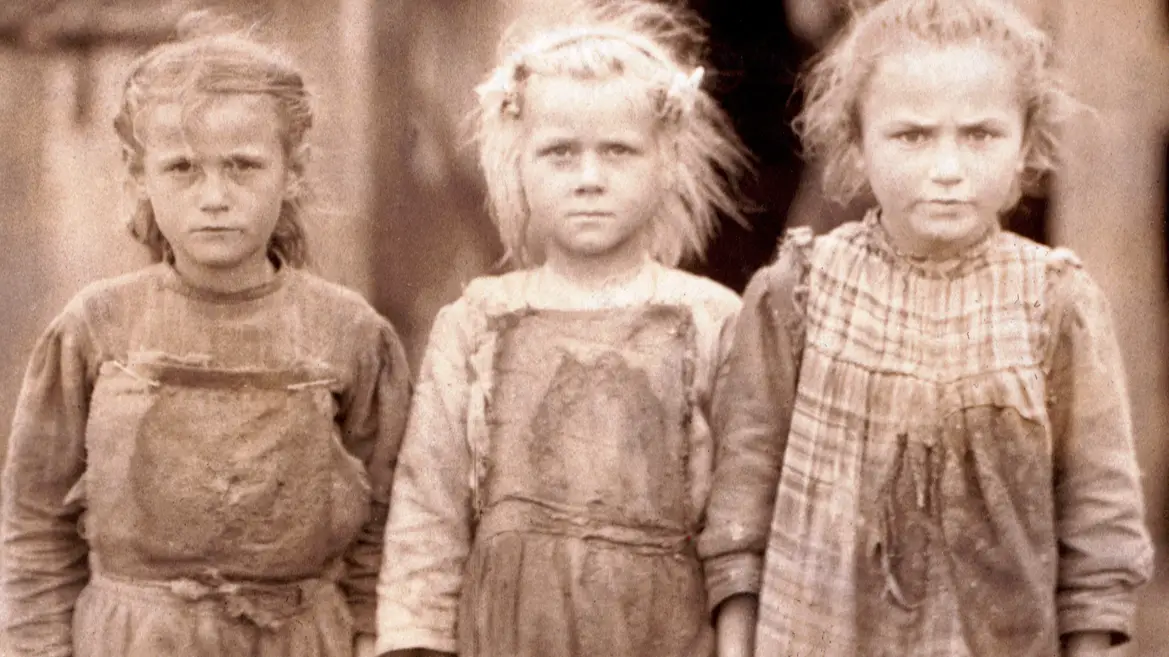
The children had spent years hidden away from the outside world. They had no electricity, no modern clothing, no formal education, and no connection to the society that existed only a few miles away.
When authorities arrived, the first question everyone asked was simple:
How could seventeen children disappear for so long without anyone knowing?
The answer would lead investigators into the history of one of the strangest families ever whispered about in the mountains.
A family known as the Hollow Ridge Clan.
For generations, the Hollow Ridge area had belonged to a group of families who rarely interacted with outsiders. They lived deep in valleys where roads were difficult to build and where the mountains themselves created a natural barrier between communities.
The people who lived nearby knew the names.
They knew the stories.
But they rarely knew the truth.
The Dalhart family was one of those names.
Old records showed different spellings over the years — Dalhart, Dalhard, Dale Hart. Like many Appalachian families, their history existed partly in official documents and partly in oral stories passed from one generation to another.
What was known was that the family had lived on the same stretch of land for more than two centuries.
They farmed their own fields.
Built their own homes.
Raised their own children.
Neighbors remembered them as private, even mysterious.
They did not attend local churches.
Their children did not go to nearby schools.
They avoided town gatherings and rarely visited doctors unless absolutely necessary.
For decades, people simply accepted that the Dalharts preferred isolation.
In rural communities, especially in earlier generations, unusual families were often left alone.
People valued privacy.
They believed that every mountain had its secrets.
But by the middle of the twentieth century, even the most isolated families became connected to the modern world.
Electric lines reached the countryside.
Roads expanded.
Children were expected to attend school.
Medical services became more available.
Yet the Dalharts remained separated.
Then, after World War II, something changed.
The family seemed to vanish.
No smoke rose from their chimneys.
No lights appeared in their windows.
No one saw them buying supplies in town.
The old farmhouse slowly deteriorated.
The fields became covered with weeds.
The property became a place people passed without stopping.
Some believed the family had moved away.
Others believed the last members had died.
Eventually, the Hollow Ridge land became little more than a forgotten memory.
Until June of 1968.
The discovery of the barn reopened a question nobody had thought to ask:
What happened to the Dalhart family?
And why had seventeen children been hidden away from the world?
The first official responders arrived late in the evening.
A team of local police officers, medical workers, and social service representatives entered the property expecting a rescue operation.
Instead, they found themselves facing something far more complicated.
The children were physically alive, but they had grown up in an environment completely separated from normal society.
They did not know basic things other children knew.
They did not understand ordinary conversations.

They reacted differently to strangers.
They communicated mostly through gestures and sounds.
The social worker assigned to the case was Margaret Dunn, a veteran child welfare professional who had spent sixteen years working with neglected and abandoned children.
She had handled difficult cases before.
She had seen poverty.
She had seen families struggling.
She had seen children who had endured terrible circumstances.
But she later described Hollow Ridge as something unlike anything she had ever experienced.
The first thing she noticed was not the children.
It was the silence.
The property was strangely quiet.
No animals nearby.
No sounds of daily life.
No signs that the outside world had ever reached that place.
In her notes, Dunn described the children as cautious but observant.
They watched every movement.
Every gesture.
Every person who entered their space.
They seemed afraid of the unfamiliar, but they also seemed curious.
They had survived by learning one thing above everything else:
Pay attention.
For children raised without normal social contact, observation had become their language.
The medical examination revealed that the children were malnourished but surprisingly resilient.
They had adapted to their environment.
Their bodies showed signs of hardship, but also signs of survival.
The doctors were especially interested in the unusual physical characteristics shared by many of them.
Several children had extremely pale skin.
Some had unusual sensitivity to sunlight.
Others showed inherited traits that suggested generations of close family connections.
The investigation quickly moved beyond child welfare.
It became a question of genetics, isolation, and history.
How long had this family been separated from the outside world?
And how many generations had lived this way?
The answers were buried deep in old records.
Researchers examining the Dalhart family history discovered patterns that raised serious concerns.
For generations, marriages had occurred almost exclusively within the same small group of relatives.
The family had remained genetically isolated for decades.
The children found in the barn were not the result of something supernatural.
They were the result of human decisions repeated over generations.
Isolation had created consequences.
The mountains had protected the family from the outside world.
But they had also trapped them.
As investigators continued searching the property, they discovered journals, handwritten notes, and fragments of family records hidden inside the abandoned farmhouse.
The documents revealed a family obsessed with protecting itself.
They believed the outside world was dangerous.
They believed outsiders would harm them.
They believed separation was survival.
The oldest writings suggested that these fears had started generations earlier, possibly after conflicts with neighboring communities.
Over time, caution became tradition.
Tradition became isolation.
Isolation became a way of life.
And eventually, an entire generation of children grew up knowing nothing beyond the boundaries of Hollow Ridge.
The most disturbing discovery, however, was not what investigators found.
It was what they did not find.
There were no school records.
No medical records.
No birth certificates for several of the children.
They existed almost entirely outside official society.
They had been born into a world that most people did not know existed.
For the first time in their lives, the children were surrounded by strangers who wanted to help them.
But help itself was frightening.
The younger children struggled the most.
They did not understand why people wanted to separate them.
To authorities, moving the children into different homes was necessary.
To the children, it was another disappearance.
The barn had been their entire world.
The other children were their family.
Their language.
Their protection.
Their only connection to anything familiar.
And when social workers attempted to take them away individually, something happened that shocked everyone present.
The children reacted together.
Not violently.
Not aggressively.
But with a unified sound.
A deep, rhythmic cry that witnesses later described as something between a call and a warning.
The adults stopped.
The children stopped.
For a moment, everyone understood the same thing:
These children were not simply siblings.
They were a survival group.
They had developed their own way of existing.
Their bond was stronger than anyone expected.
The event became one of the most discussed moments of the Hollow Ridge investigation.
Some people exaggerated the story over the years.
Some claimed impossible things.
Some turned the children into a legend.
But those closest to the case described something much more human.
They described children who had been forced into a world they did not understand.
Children who were not monsters.
Children who were not mysterious creatures.
Children who were simply survivors of circumstances created long before they were born.
The investigation would continue for years.
But the most important question remained unanswered:
What happened to the seventeen children after they left the barn?
