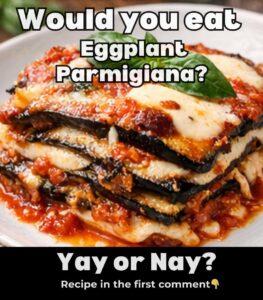
The Way It Was Before Restaurants Changed It
There was a time when Eggplant Parmigiana didn’t crunch.
It didn’t come stacked like a skyscraper or drowning under inches of molten cheese. It didn’t arrive with a breadcrumb armor so thick you needed a steak knife to cut through it.
The original version — the one made in small southern Italian kitchens — was softer. Quieter. More patient.
It was thin-sliced eggplant, lightly kissed with flour and olive oil, layered gently with tomato sauce, basil, and fresh mozzarella, then baked until it melted into itself.
It didn’t fight you on the plate.
It yielded.
And if you’ve only ever had the breaded restaurant version, you haven’t tasted the real thing.
Eggplant Parmigiana – The True Southern Classic
In Italy, it’s called Melanzane alla Parmigiana.
And despite what many believe, it did not originate as a breaded, deep-fried dish.
This beloved layered bake is strongly associated with:
Naples
Sicily
Campania
Each region claims it. Each grandmother insists hers is the only correct one.
But what they agree on is this:
No breadcrumbs.
Thin slices.
Layered like memory.
Why It Was Never Supposed to Be Crispy
The modern American version evolved for restaurant speed and visual appeal.
Breadcrumbs add crunch. Deep frying adds bulk. Thick slices hold shape.
But the original Eggplant Parmigiana was designed to soften — almost collapse — in the oven.
The eggplant becomes silky.
The tomato sauce seeps into every layer.
The mozzarella stretches but doesn’t overwhelm.
It’s closer to a vegetable lasagna without pasta than to a fried entrée.
The beauty is in the tenderness.
A Name Wrapped in Mystery
Many assume “Parmigiana” means it came from Parma.
But historians suggest the word may derive from parmiciana, referring to the layered wooden shutters found in southern Italy — resembling the overlapping eggplant slices.
Whether from Parma or shutters, the meaning remains layered — literally and figuratively.
The Original Eggplant Parmigiana Recipe (No Breadcrumbs)
This is the version you would have found in a southern Italian home, especially at the end of summer when eggplants were abundant and sweet.
Ingredients
3 large firm eggplants
2 teaspoons sea salt (for drawing out moisture)
1 cup light flour (optional but traditional in many regions)
Olive oil, for pan frying
3 cups simple tomato sauce (San Marzano preferred)
12 oz fresh mozzarella, sliced thin
¾ cup freshly grated Parmigiano Reggiano
Fresh basil leaves
Black pepper to taste
Step-by-Step Instructions
Step 1: Slice & Salt
Slice eggplant lengthwise into thin strips — about ¼ inch thick.
Lay them out on towels and sprinkle lightly with salt.
Let them rest for 30–45 minutes.
This draws out bitterness and excess moisture.
You’ll notice beads of liquid forming. Gently pat dry.
Step 2: Light Flour (Optional but Traditional)
Dust slices lightly in flour.
Shake off excess.
The flour helps them brown and gives structure without heaviness.
Some regions skip this step entirely.
Step 3: Olive Oil Pan-Fry
Heat a thin layer of olive oil in a wide skillet.
Cook slices gently on both sides until lightly golden.
They should be tender — not crispy.
Place on paper towels to drain.
Do not deep fry.
The goal is silk, not crunch.
Step 4: Layer Gently
In a ceramic or glass baking dish:
Spoon a thin layer of tomato sauce.
Add eggplant slices in overlapping rows.
Add mozzarella slices.
Sprinkle Parmigiano.
Add basil.
Repeat layers.
Finish with sauce and Parmigiano on top.
Step 5: Bake Until It Melts
Bake at 375°F (190°C) for 30–40 minutes.
The top should bubble.
The layers should sink slightly.
Let it rest at least 20 minutes before slicing.
Better yet — serve it the next day.
Like many Italian dishes, it deepens overnight.
The Secret Most People Don’t Know
Traditional Eggplant Parmigiana is often served at room temperature.
Not piping hot.
Not stiff.
Room temperature allows flavors to settle and texture to soften.
Cold leftovers? Even better.
It was never meant to be rushed.
Why Summer Eggplant Tastes Different
In Southern Italy, eggplant is a late summer vegetable.
When picked in season:
It’s sweeter.
It’s less bitter.
It absorbs olive oil beautifully.
It doesn’t turn watery.
Out-of-season eggplant can still work — but salting becomes even more important.
Common Mistakes That Ruin It
• Slicing too thick
• Using pre-shredded mozzarella
• Skipping the resting time
• Overloading with cheese
• Deep frying
This dish is about restraint.
It’s about balance.
It’s about letting eggplant be the star.
Make It Even More Traditional
If you want to lean fully old-world:
Use whole peeled San Marzano tomatoes and crush by hand.
Use fresh basil only (no dried herbs).
Avoid garlic-heavy sauce.
Use fresh mozzarella packed in water.
Bake in a ceramic dish, not metal.
The difference is subtle but powerful.
Can You Make It Without Frying?
Yes.
Some southern families grill eggplant slices instead of frying.
Others bake slices briefly before layering.
But olive oil pan-frying gives the most authentic silkiness.
Why It Became Breaded in America
When Italian immigrants arrived in America, eggplant became larger and less sweet.
Restaurants needed dishes that:
Held shape on plates
Stayed crisp under heat lamps
Felt hearty for American appetites
Breadcrumbs and deep frying solved that.
But something was lost in translation.
The Emotional Side of This Dish
Eggplant Parmigiana wasn’t flashy.
It wasn’t reserved for guests.
It was everyday comfort.
It was late August heat drifting through open windows.
It was sauce simmering slowly.
It was someone saying, “Just let it rest.”
And maybe that’s what we need more of.
Food that rests.Food
Food that softens.
Food that doesn’t shout.
Frequently Asked Questions
Can I make Eggplant Parmigiana ahead of time?
Yes. In fact, it tastes better the next day. Store covered in the refrigerator and reheat gently.
Do I have to salt the eggplant?
For modern varieties, bitterness is lower, but salting still improves texture and prevents excess moisture.
Can I freeze it?
Yes. Freeze fully baked and cooled. Thaw overnight and reheat covered.
Can I make it gluten-free?
Yes. Skip the flour or use a gluten-free flour blend.
Can I add ricotta?
Traditional versions do not include ricotta, but some regional variations do.