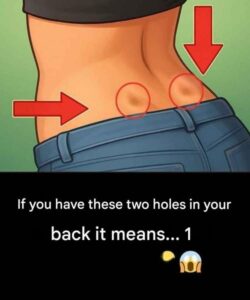
If you’ve ever noticed two small indentations on your lower back, just above your buttocks, you may have wondered what they mean. Commonly known as “Venus dimples” in women and “Apollo dimples” in men, these small indentations have fascinated scientists and the general public for centuries. While some see them as purely aesthetic, others believe they are a sign of good health, beauty, or even genetic luck. But the real question is: why do only some people have them?
The Role of Anatomy:
Back creases form where the skin attaches to underlying structures via a short ligament. They are located directly over the sacroiliac joints, the area where the pelvis connects to the spine. Unlike muscle tone or fat distribution, these creases are not something that can be achieved simply through exercise. Instead, they are a result of body structure and how the skin adheres to deeper tissues. In other words, their presence or absence is largely determined even before birth.
Genetics and Heredity
One of the main reasons why only certain people develop back dimples is genetics. These dimples are considered an inherited trait, meaning that if one or both parents have them, there’s a higher chance their children will too. Scientists explain that the location of ligaments, as well as skeletal alignment, can vary from person to person. In some people, this variation naturally results in visible indentations. In others, the ligaments are positioned differently, so dimples don’t appear.
Body Shape and Fat Distribution:
While genetics plays a fundamental role, body composition can influence the visibility of back dimples. People with a slimmer build or a lower percentage of body fat tend to show dimples more clearly. On the other hand, someone who has them genetically but has more fat in the lower back area may not have them as prominently displayed. For this reason, athletes or dancers, who typically have less body fat, may appear to have more defined back dimples.
Myths and Realities About Health:
There are many myths surrounding these small dimples on the back. Some believe they are a sign of “better circulation” or “greater fertility.” Others think they facilitate physical activity or even increase sexual pleasure. While these claims sound appealing, most are not supported by solid scientific evidence. What we do know is that these dimples do not negatively affect health. They are simply a neutral anatomical feature that varies from person to person.
A symbol of beauty in different cultures.
If you have these two dimples on your back, it means you don’t
Although they have no clear medical function, back dimples have been admired for centuries. In art and sculpture, especially during the Renaissance, artists often highlighted these indentations as symbols of feminine beauty. Today, they are sometimes considered attractive because they accentuate the curves of the lower back and hips. Their rarity also makes them stand out, adding to their allure.
Can you create them? Due to their popularity, many people wonder if it’s possible to “reduce” back dimples through exercise. Unfortunately, since they aren’t muscles but rather the result of ligament placement, no amount of training can create them if your anatomy doesn’t allow it. However, strengthening your core and reducing body fat can make existing dimples appear more defined.
In conclusion
, only some people have back dimples, as they are primarily determined by genetics and anatomy, not lifestyle or exercise. While they have no proven health benefits, they are often admired as a sign of beauty and uniqueness. If you have them, it simply means your body structure favors their appearance. And if you don’t, it doesn’t mean anything is wrong; your body is simply expressing its uniqueness in different ways.